
WHAT THE RUCK?
Three years after rugby began lowering the legal tackle height, we look at what changed, what the evidence tells us, and what the new tackle law means for the game.
The Tackle Has Changed.
Three years after rugby began lowering the legal tackle height, the evidence is starting to show what happened next.
You probably didn't notice the moment rugby changed.
There was no dramatic announcement during a Six Nations match. No stadium clock stopped. No player walked onto the pitch with a new piece of equipment.
Instead, one of the most instinctive skills in rugby began to change quietly, training ground by training ground, match by match.
The tackle.
For generations, players had been taught to meet the ball carrier, make contact and wrap. It was one of the fundamental skills of the game, learned through repetition until technique became instinct.
Then rugby started asking players to change where that contact happened.
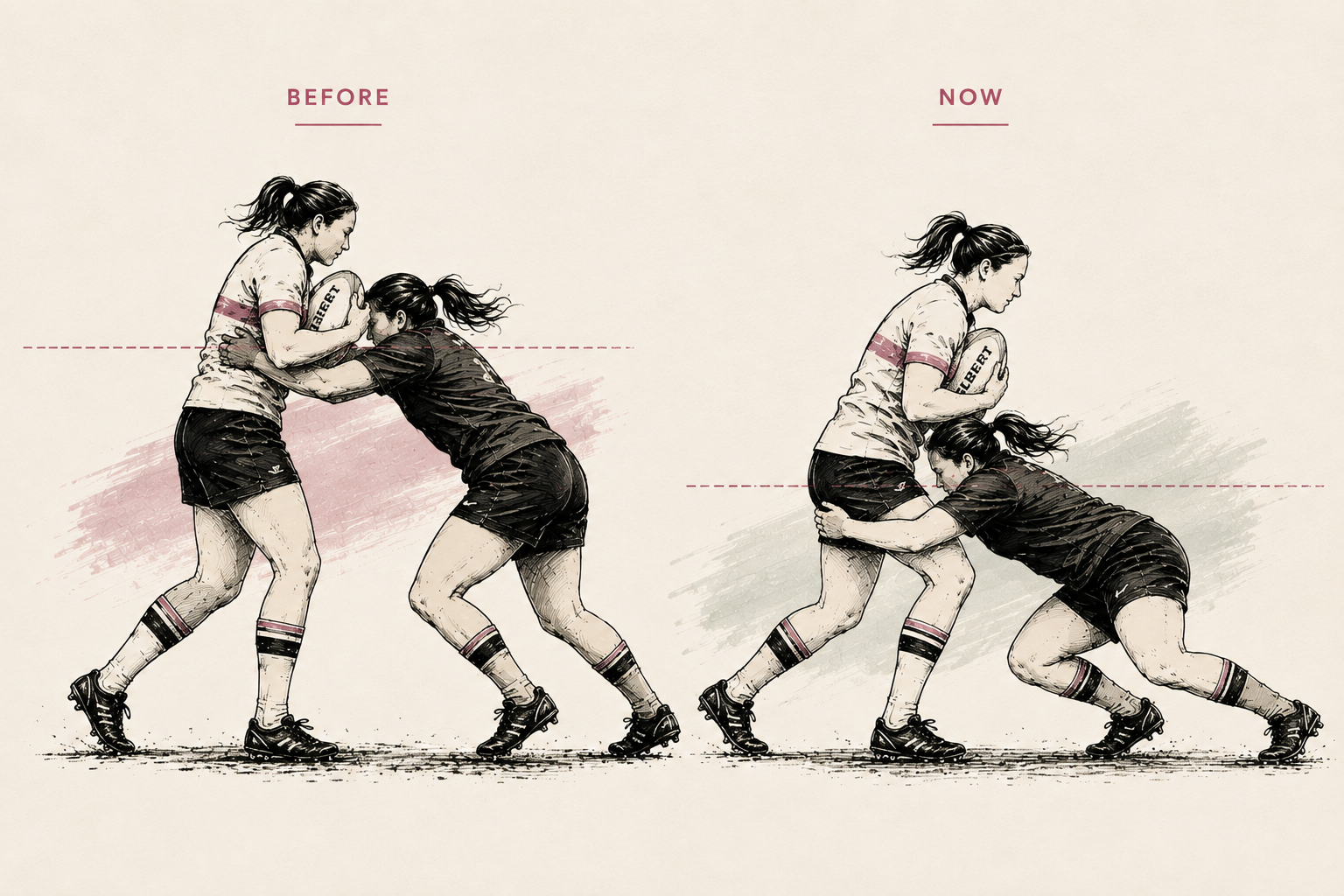
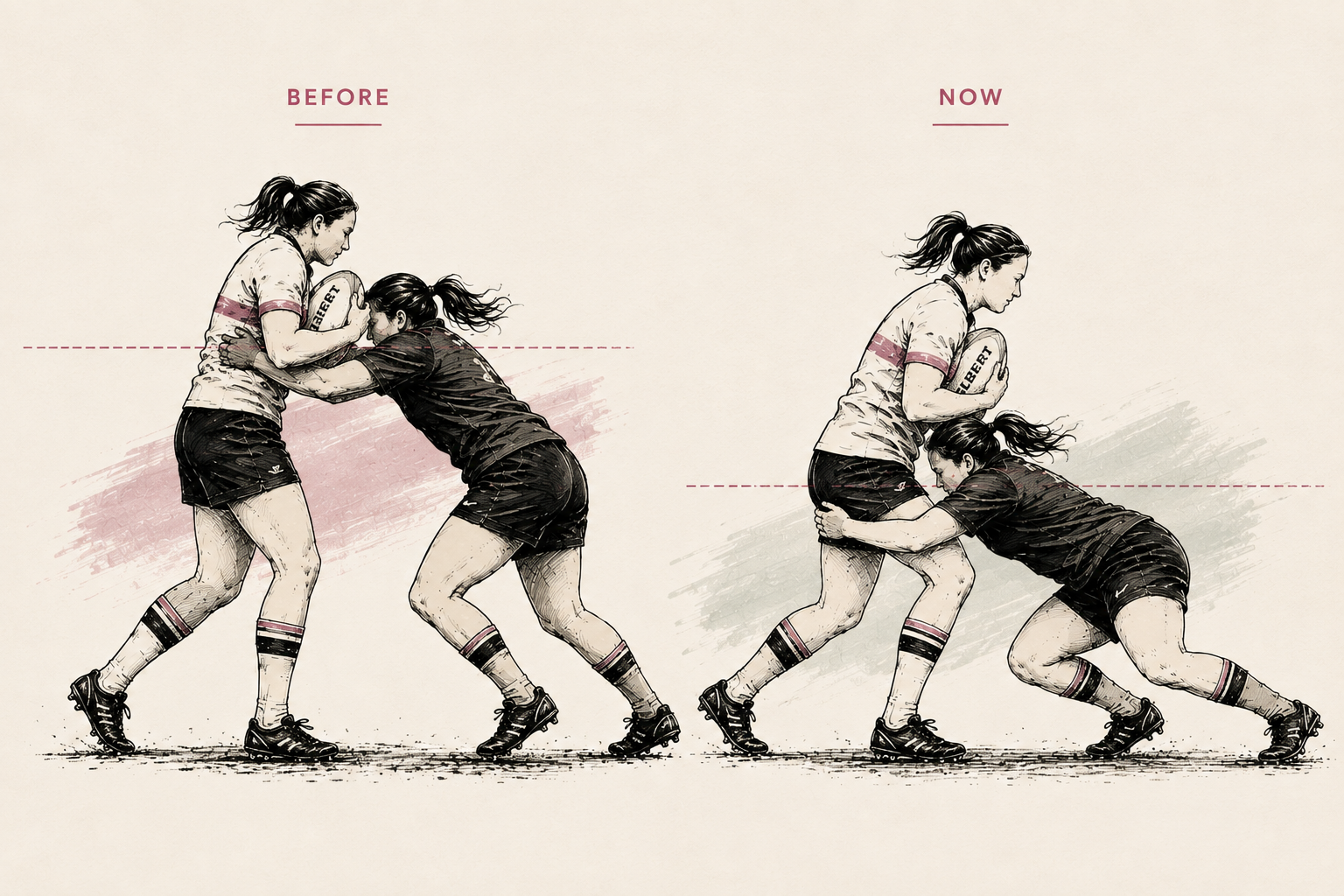
In community rugby, the legal tackle height was lowered, moving the target away from the upper body and towards the waist or the base of the sternum. In England, the RFU had already introduced the lower tackle-height approach in 2023. Now, in June 2026, World Rugby has taken the measure from trial to full community law. From 1 July, unions can choose either the waist or base of the sternum as the maximum legal tackle height.
The reasoning is straightforward. If the tackler goes lower, the two players' heads should be further apart.
But changing a law is one thing.
Changing the way people play the game is another.
Three years on, we are beginning to see what that change has actually done.
The Shape Of The Tackle
The most important thing about the lower tackle law may not be what referees are penalising.
It may be what players are doing differently.
World Rugby's trials, involving more than 170,000 tackles across 11 unions, found a consistent change in tackler behaviour. In men's community rugby, the proportion of upright tacklers fell from 36% to 29%. In women's rugby, it fell from 51% to 44%. The overall shape of the game remained broadly intact, with tackle numbers, tackle success and what happened after the tackle not fundamentally changing.
That matters.
The purpose of the law was never to remove the tackle from rugby. It was to change the circumstances in which it happens.
The evidence suggests players have responded.
Instead of arriving upright, more tacklers are entering contact with a lower body position. The target has moved, and the technique has followed it.
Research from Scottish community women's rugby tells a similar story. After the maximum tackle height was lowered to below the base of the sternum, researchers analysed more than 11,000 tackle actions across two seasons. Upright tackling reduced, while tackles made with the tackler bent at the waist increased. Contacts above the sternum also fell.
Perhaps most significantly, the researchers found reductions in the proximity of the tackler's and ball carrier's heads and shoulders.
In other words, the change was doing what it was intended to do.
It was changing the amount of shared head space in the tackle.
So, Has Rugby Become Safer?
This is where the story gets more interesting.
For a while, the evidence around lower tackle height was largely about behaviour. Players were tackling differently. High and upright tackles were reducing. That was encouraging, but it did not automatically prove that fewer injuries would follow.
Now we have stronger evidence.
A new Irish study, published in the Journal of Science and Medicine in Sport in June 2026, examined almost a decade of injury surveillance data. Researchers analysed approximately 86,000 hours of match play, more than 3,700 injuries and data from 239 men's, women's and schoolboy teams involving more than 8,800 players. Crucially, they were able to compare five seasons before the law change with two seasons afterwards.
The results were striking.
Among amateur women's rugby players, concussion rates fell by 63% after the lower tackle height was introduced. Among amateur men, concussion rates fell by 38%. Overall injury rates also fell in the adult game.
For a sport that has spent years looking for practical ways to reduce concussion risk, those numbers are difficult to ignore.
And the women's result is particularly significant.
Women's rugby has expanded rapidly, bringing more players into the game and increasing the importance of understanding how changes to the laws affect women specifically. The Scottish research had already shown that lowering the tackle height could reduce head contact and head proximity in women's community rugby. The Irish research now provides much larger-scale evidence of a substantial reduction in concussion rates among adult women.
That does not mean the tackle has suddenly become safe.
It means there is increasingly persuasive evidence that changing the tackle can reduce some of the risks associated with it.
But The Evidence Isn't Simple
There is an important reason not to turn those numbers into a victory lap.
The Irish study also looked at schoolboy rugby. Overall injuries fell by 19%, but there was no statistically significant reduction in concussion rates among school players.
That doesn't necessarily mean the lower tackle height doesn't work for younger players. It means the evidence is less conclusive, and the researchers point to possible differences in physical development, technique and playing characteristics as areas that need further investigation.
The Scottish women's study reached a similarly cautious conclusion. It found clear changes in tackle behaviour and reductions in head contact and head proximity, but it did not find a statistically significant reduction in concussion during the two seasons studied. The researchers explicitly called for further injury surveillance.
That distinction matters.
A change in behaviour is not automatically a change in injury rates.
But when behavioural change is accompanied by encouraging injury data from a much larger study, the picture begins to look considerably more promising.
The Ball Carrier Matters Too
There is another part of the change that is easy to miss.
Lowering the tackle doesn't only ask something of the person making the tackle. It can also affect the person carrying the ball.
The new community law recognises that relationship. World Rugby's wording gives the ball carrier a responsibility to enter the tackle safely, and the optional Game On variations allow match organisers to sanction a ball carrier who significantly lowers their height into dangerous contact.
It makes sense when you think about the mechanics.
If the tackler learns to go lower but the ball carrier suddenly drops their body height immediately before contact, the two players can still end up occupying the same dangerous space.
The aim, therefore, isn't simply to make everyone shorter at the moment of impact.
It is to change the shape of the collision.
That is a much more sophisticated proposition than simply saying: tackle lower.
A Law Change Becomes A Habit
There is also something fascinating about what this tells us about rugby itself.
Law changes can look very different on paper from how they feel on a training pitch.
A referee can blow a whistle and penalise a tackle above the permitted height. But ultimately, the law only succeeds if players stop thinking about the old version of the tackle and start instinctively performing the new one.
That is what the evidence increasingly suggests is happening.
The lower tackle has moved from a rule that players had to remember into a technique they are learning.
The upright tackle is becoming less common.
The lower body position is becoming more familiar.
The point of contact has moved.
And, in doing so, the game has demonstrated something rugby has sometimes been reluctant to acknowledge: changing a fundamental skill does not necessarily mean changing the character of the sport.
The tackle is still there.
The physical contest is still there.
Players still have to stop one another.
But the game is asking them to do it differently.
From Trial To Law
That is why World Rugby's decision on 17 June 2026 matters.
After two years of community trials involving more than 150,000 tackles in the original evaluation — with subsequent analysis expanding the dataset further — World Rugby Council approved the lower tackle height as full community law. The measure takes effect from 1 July 2026 for seasons beginning after that date, with unions able to choose between the waist and base-of-sternum heights.
This is no longer an experiment.
It is part of the way community rugby is being played.
And that makes the question slightly different now.
We're no longer asking whether rugby could change the tackle.
It has.
We're asking what happens next.
Because the most interesting thing about the lower tackle law may ultimately be less about the height of the tackle itself and more about what happens when an entire sport decides that one of its most instinctive skills needs to be relearned.
So far, the evidence suggests players can adapt.
The evidence also suggests that, at least in adult community rugby, that adaptation may be reducing concussion and injury.
There are still questions to answer, particularly around younger players and the long-term effects.
But three years after rugby began asking players to tackle differently, one thing is becoming clear.
The tackle has changed.
And for once, changing the way rugby is played may be helping preserve the part of the game that matters most: letting people keep playing it.
SOURCES
World Rugby — Lowering the legal tackle height in community rugby
World Rugby Passport — 2026 community tackle-height law wording
Journal of Science and Medicine in Sport — Tackle behaviour trial lowers concussion and overall injury rates: A seven-season prospective study in adult men's, women's and schoolboy rugby union
British Journal of Sports Medicine / PubMed Central — Scottish community women's rugby tackle-height research
Not Every Hero Wears A Kit.
The people who shape a rugby club aren't always the ones wearing the jersey. From volunteers and coaches to physios and parents, this feature celebrates the individuals whose dedication makes every match possible—even if their names never appear on the team sheet.
Issue 03 Cover Story
The people who make rugby happen rarely ask for recognition. They deserve it anyway.
.
Every rugby club has one
.
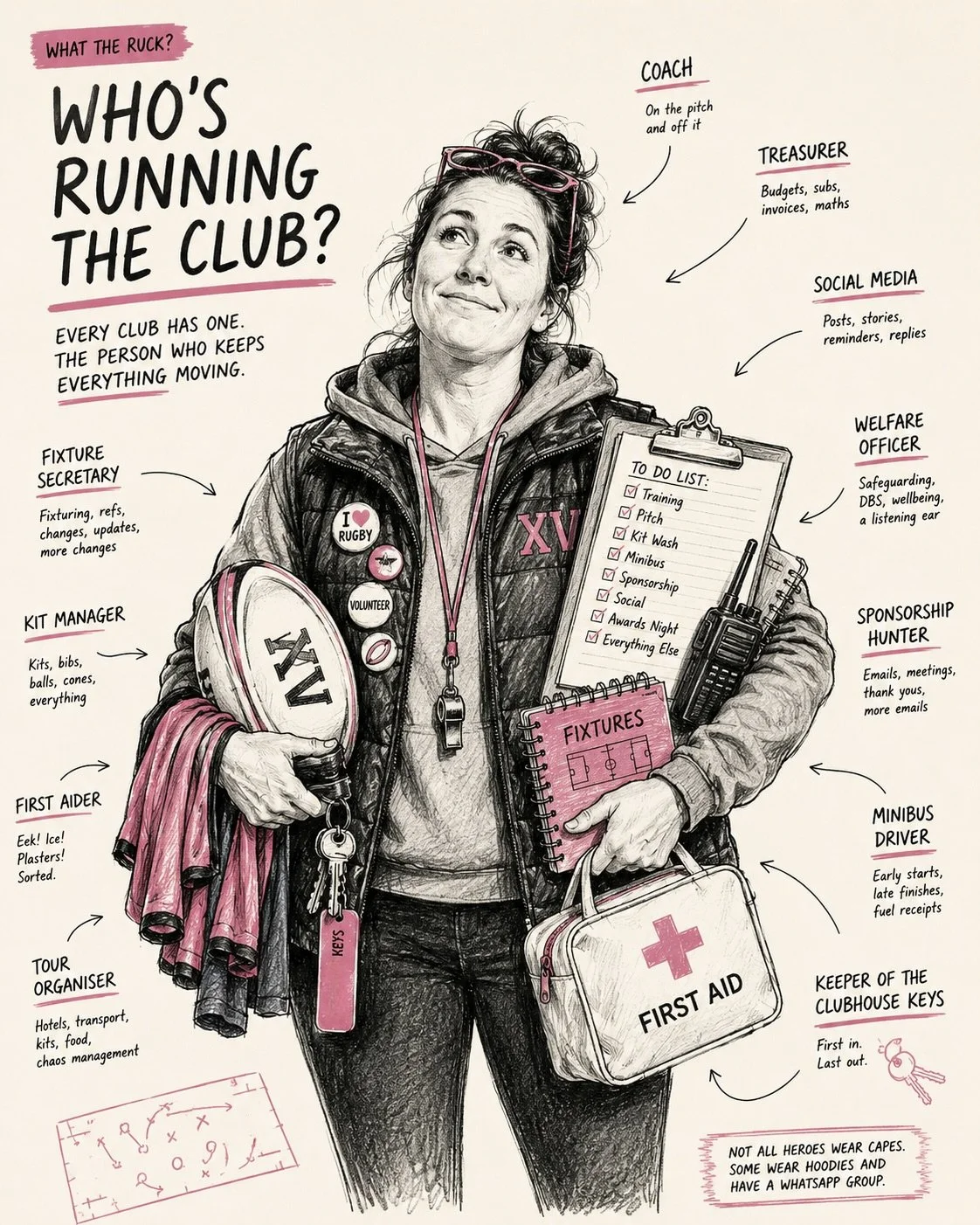
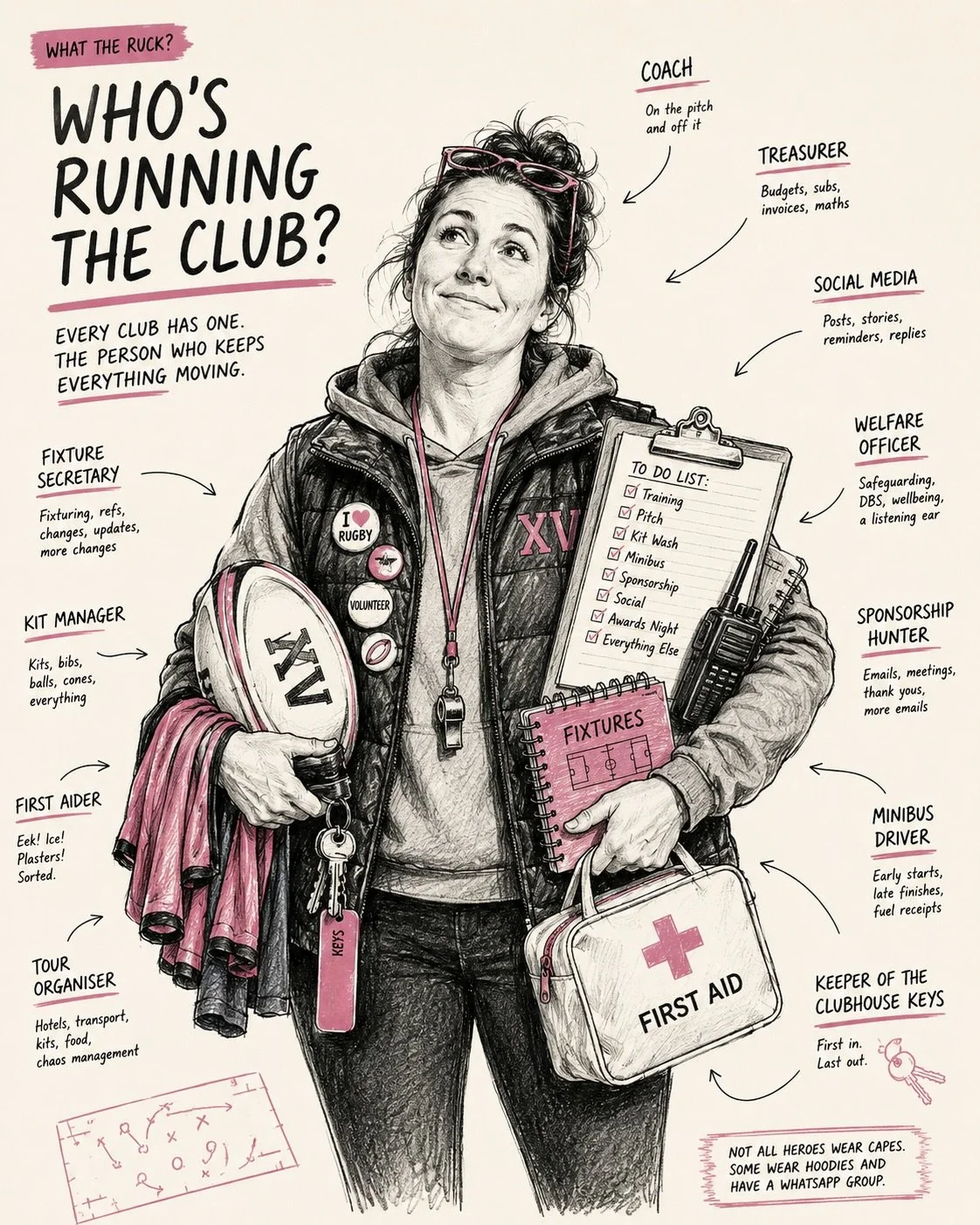
The person who seems to know where everything is. The one with the clubhouse keys in one pocket, a whistle around their neck and a phone buzzing with messages they somehow always answer.
They are the first to arrive and the last to leave.
Long before the players pull on their shirts, someone has already unlocked the gates, checked the pitch, switched on the floodlights and made sure the changing rooms are ready. Long after the final whistle, while everyone else heads home nursing tired legs and celebrating a hard-earned win, they're still folding bibs, washing kit and making sure everything is ready for next week.
Most people know them simply as 'the volunteer'.
But anyone involved in grassroots rugby knows they're much more than that.
On any given training evening, long before the first player arrives, somebody has already been at the club for half an hour. They've unlocked the gates, checked the pitch, switched on the floodlights and made sure everything is ready before anyone else even pulls into the car park.
It's six o'clock on a wet Tuesday evening, and training starts in thirty minutes. A late message arrives from a player who can't make it. The opposition have changed Saturday's kick-off time. Someone forgot the tacklebagss, the first aid kit needs restocking, and a new player is coming along for the first time but doesn't know where to park.
Before the first pass has even been thrown, one person has already solved half a dozen problems.
Nobody notices.
That's exactly the point.
The Invisible Job Description
There isn't a formal title for what these people do because no single title could possibly cover it.
They're the coach, fixture secretary, treasurer, kit manager, volunteer coordinator, minibus driver, social media manager, first aider, fundraiser, safeguarding lead, tea maker, cleaner and the person responsible for locking up at the end of the night. More often than not, they're several of those things at once.
The titles change from club to club, but the pattern is always the same. Whenever something needs doing, someone quietly steps forward and gets on with it.
Most don't volunteer because they're looking for recognition.
They volunteer because somebody has to.
Women's rugby has never been stronger. Crowds are growing, professional contracts are expanding, international matches are filling stadiums and participation continues to rise.
But none of those headlines begin in the biggest stadiums. They begin on cold Tuesday evenings at community clubs all over the country.
They begin on cold Tuesday evenings at community clubs all over the country.
Every international player once relied on somebody washing bibs, organising fixtures, remembering the spare gumshield or welcoming them through the clubhouse door for their very first training session.
Grassroots rugby isn't simply where players start.
It's where confidence begins.
“Women’s rugby doesn’t run on players. It runs on volunteers.”
There are jobs nobody sees. Hours nobody counts. Messages nobody thanks you for answering. The WhatsApp group never really sleeps. Fixtures change. Referees pull out. Pitches become unplayable. Sponsors need thanking. Parents need information. Someone forgets the corner flags. Someone loses the clubhouse keys. Something always needs fixing.
If rugby teaches resilience, volunteers practise it every single week.
More Than A Volunteer
Spend enough time around any rugby club and you'll notice something interesting. The people holding everything together rarely talk about themselves.
Ask them how much time they give, and they'll shrug.
Ask how many jobs they do, and they'll laugh.
Ask why they keep coming back, and the answer is almost always the same.
"Because I love this club."
It isn't about the title.
It's about belonging.
“The first person to arrive. The last person to leave.”
Every club has stories like these. The volunteer who quietly paid for extra rugby balls when the budget wouldn't stretch. The coach who stayed behind after training because one player needed a little more confidence. The committee member who spent an entire Sunday marking pitches in the rain. The parent who started helping one season and somehow became indispensable.
None of these moments appear in league tables.
Yet together they become the foundations on which clubs are built.
Success in rugby is often measured by wins, promotions, finals and trophies.
Perhaps success should also be measured by how many new players stayed because somebody made them feel welcome. How many young girls discovered they belonged in rugby because someone believed in them. How many friendships began because one volunteer decided to keep the clubhouse open for another cup of tea.
Those victories rarely make the headlines.
They're no less important.
The Real Club Hero
This issue of XV Style celebrates the people who rarely ask for applause. The people who never expect their name in the programme. The ones who don't lift trophies but quietly make sure someone else can.
They don't wear capes.
Most don't even wear a match shirt.
They wear waterproof jackets, muddy boots and a lanyard carrying more keys than anyone should reasonably own.
Their reward isn't a medal.
It's seeing a team run onto the pitch knowing they helped make it possible.
Women's rugby continues to grow because extraordinary athletes inspire us.
But it continues to thrive because ordinary people choose to give their time, every week, without expecting anything in return.
Professional rugby may produce heroes.
Grassroots rugby produces communities.
Every community begins with someone willing to unlock the clubhouse door.
“Not every hero wears a kit. Some wear hoodies, carry keys and keep an entire club moving.”
Every club has its heroes.
Most never score the winning try.
They rarely lift the trophy.
They don't feature in the photographs.
Yet without them there would be no team to cheer, no match to play and no community to belong to.
Not every hero wears a kit.
Some simply keep the game alive.
What The Ruck?
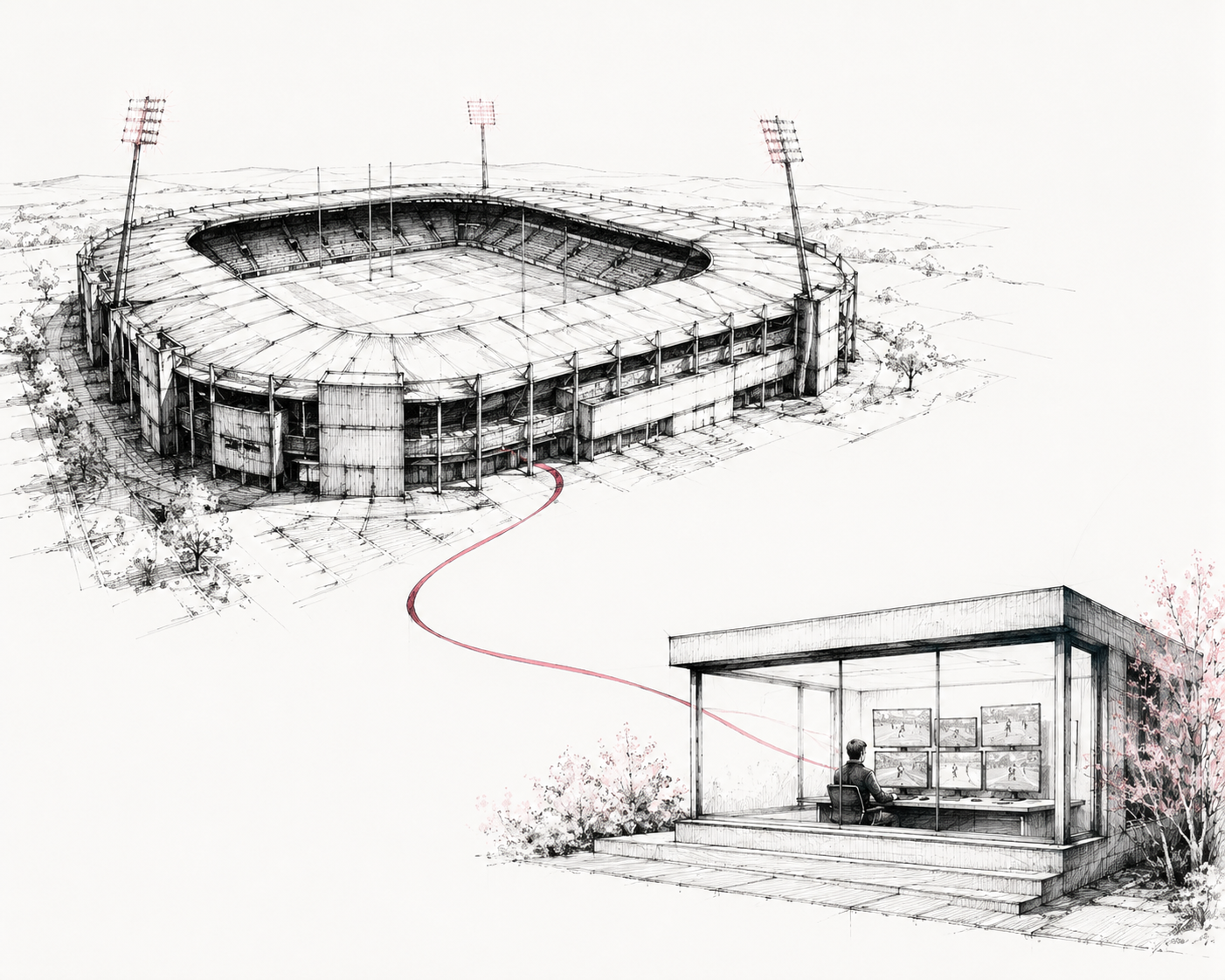
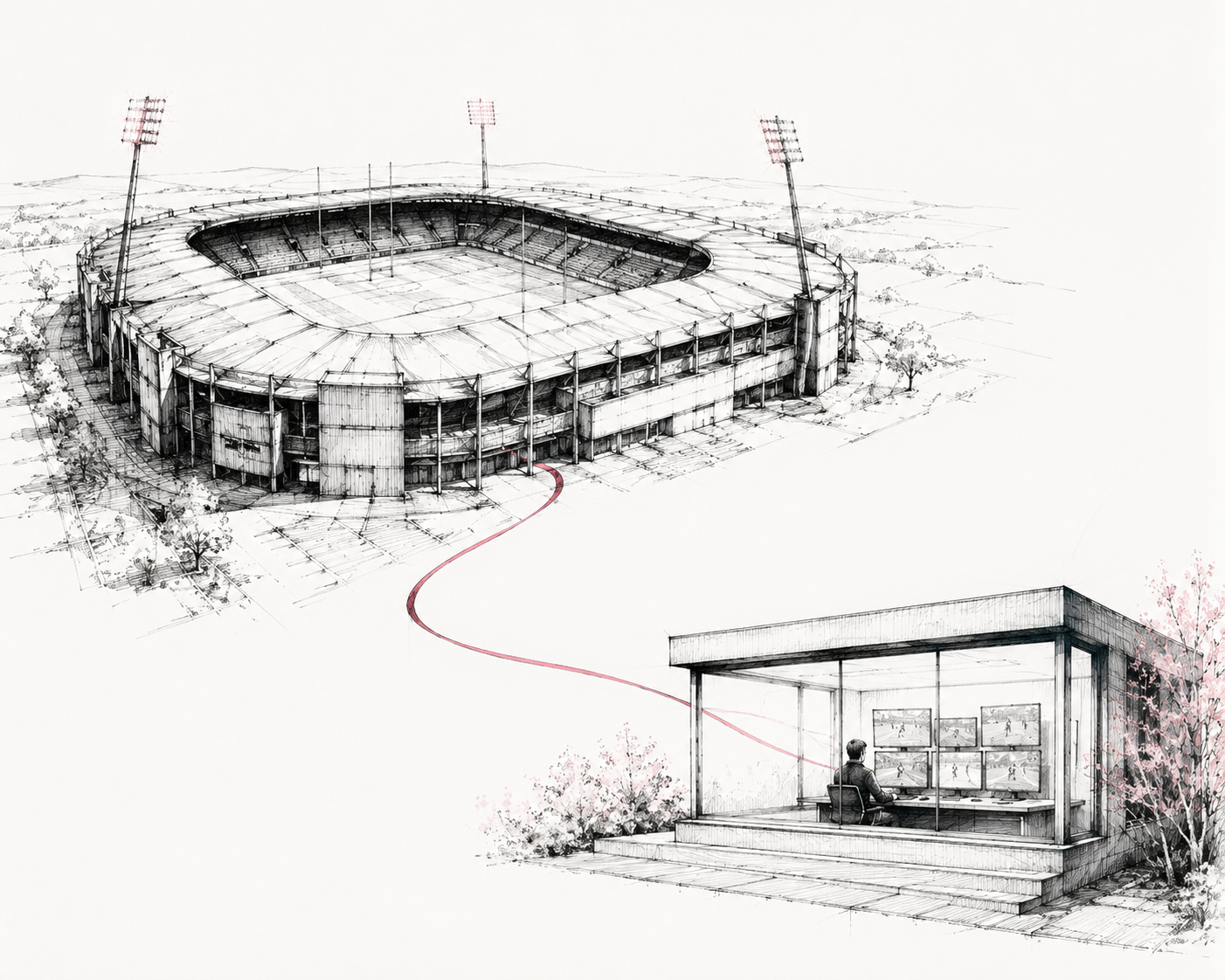
World Rugby is changing more than where the Television Match Official sits. As remote officiating begins to separate decision-making from live television production, could greater independence lead to greater trust in the modern game?
The TMO Has Left the Stadium. Is That a Good Thing?
Technology has transformed rugby officiating, but the biggest change isn't what the TMO is reviewing—it's where they're reviewing it from. As World Rugby trials a new era of remote officiating, could greater independence lead to greater trust?
There was a time when refereeing a rugby match was relatively simple. One referee. Two touch judges. Eighty minutes of decisions made in real time
Those days are long gone.
Elite rugby now operates in an environment where every tackle, every clear-out and every try can be reviewed from multiple angles within seconds. Technology has become as much a part of the modern game as the whistle itself, and with it has come the Television Match Official.
For some supporters, the TMO has improved the game beyond recognition. Dangerous play is identified more consistently, foul play is reviewed more thoroughly and referees have another set of experienced eyes to help them make difficult decisions.
For others, every intervention feels like another interruption.
Either way, the TMO isn't going anywhere.
What's changing is where they're sitting.
This summer, World Rugby began trialling a fully remote TMO hub during the World Rugby Nations Cup and the World Rugby U20 Championship. Rather than working from inside the stadium, Television Match Officials are based at a central operations hub in Basingstoke, reviewing incidents from hundreds of miles away with specialist technology and dedicated replay support.
It's a significant shift, one that's likely to shape the future of international rugby.
World Rugby has already confirmed that new minimum technology standards will be introduced across international rugby by August 2027. Among them is a simple but important principle: the TMO should have independent access to every available camera angle, rather than relying on the television feed produced for the broadcast.
At first glance, it sounds like a purely technical change.
In reality, it raises a much bigger question.
For years, one criticism has quietly followed almost every controversial decision.
When a referee asks to see another angle, who decides what the TMO actually sees?
“The referee isn’t looking for the most compelling replay. They’re looking for the most accurate one.”
The answer has traditionally been the host broadcaster.
Television directors are experts at telling the story of a match. Their job is to produce the best possible broadcast for viewers, selecting replays that capture the drama, emotion and pace of the game.
Officiating, however, has a different objective.
The referee isn't looking for the most compelling replay.
They're looking for the most accurate one.
Most of the time those two priorities align perfectly.
Occasionally, they don't.
We've all experienced those moments when commentators ask for another angle, social media becomes convinced that footage exists somewhere, or everyone in the stadium is left wondering whether the decisive replay was ever shown.
That's not necessarily anyone's fault. Television broadcasts are designed to entertain millions of viewers, not to function as forensic review systems.
By separating the TMO from the live television production, World Rugby hopes to create something more independent.
Officials can review every available camera angle, control replays themselves and apply the same procedures regardless of which broadcaster is covering the match.
Perhaps that's the real story here.
This isn't simply about moving someone from a room inside the stadium to one many miles away.
It's about separating officiating from broadcasting.
In an era where every decision is scrutinised frame by frame, trust in the process matters just as much as the decision itself.
Will it eliminate controversy?
Almost certainly not.
Rugby will always have moments that divide opinion. Slow-motion replays won't remove human judgement, and supporters will probably never agree on every decision.
That's part of the game's DNA.
But if independent replay technology leads to more consistent decisions, greater transparency and increased confidence that every available angle has been reviewed, then it's difficult to argue the game hasn't taken a step forward.
The biggest change isn't that the TMO has left the stadium.
It's that, for the first time, the replay official is beginning to step outside the television production too.
And that might prove to be the most important decision of all.
Issue Context
World Rugby's fully remote TMO hub was first trialled during the 2026 World Rugby Nations Cup and World Rugby U20 Championship. Wider minimum technology standards for international rugby, including independent TMO access to all available camera angles, are due to be introduced by August 2027.

What The Ruck?
The group chats, the characters, the 247 unread messages. A love letter to the WhatsApp groups that run women's rugby.
Is The WhatsApp Group The New Clubhouse?

Every rugby club has one
Actually, every rugby club has seven.
The First XV Group. The Women's Squad Group. The Committee Group. The Committee Group (Actual Important Stuff). The Tour Group. The Tour Group (No Coaches). The Tour Group (Definitely No Coaches).
And somehow, despite all of this, nobody knows what time kick-off is.
At some point, without anybody officially agreeing to it, the rugby clubhouse moved into a WhatsApp group.
The bar is still there. The chairs are still there. The suspiciously sticky table in the corner is almost certainly still there.
But the real conversation now happens on a screen. Twenty-four hours a day. Seven days a week. With notifications permanently muted.
247 UNREAD MESSAGES
Nobody knows how it happens.
You open your phone at 9:14am. Three unread messages. Manageable.
You attend a meeting. Buy a coffee. Reply to one email.
Suddenly it's 11:32am. The group has generated 247 new messages.
You have missed:
Two lift requests
Four training updates
A discussion about post-match food
Three GIFs
One argument about whether the tour theme should be pirates
A photo of somebody's dog
The original message has vanished forever. Nobody will ever find it again.
THE MODERN CLUB NOTICEBOARD
There was a time when rugby information lived on a clubhouse wall. Fixture posters. Social event flyers. Training times.
Now all of it arrives through WhatsApp. And disappears approximately six seconds later beneath a debate about who forgot the match balls.
The modern rugby player receives information through a process best described as archaeological. You don't read messages. You excavate them.
THE GROUP CHAT CHARACTERS
Every club has them.
The React-Only Member Never writes anything. Hasn't spoken since 2022. Responds exclusively with 👍. Nobody knows if they're still playing.
The Accidental Comedian Attempts to be serious. Posts something unintentionally hilarious. Creates six hours of chaos.
The Voice Note Criminal Could have typed twelve words. Instead sends a four-minute voice note recorded while driving. Nobody listens. Everyone pretends they did.
The Fixture Secretary Posts genuinely important information. Receives three reactions. Immediately buried beneath a GIF. Posts the same information again.
The Admin The closest thing rugby has to a dictator. Can remove you from the group. Knows this.
THE DIGITAL CHANGING ROOM
The strange thing is that WhatsApp isn't replacing rugby culture. It's becoming rugby culture.
The group chat has quietly inherited the jobs once performed by the clubhouse. It organises lifts. Starts friendships. Creates inside jokes. Checks on injured players. Celebrates wins. Supports people through losses that have nothing to do with rugby.
It's where teams become communities.
“Half of modern rugby culture now exists between two green ticks.”
THE MESSAGE YOU WERE LOOKING FOR
We've all done it.
You know there was an important message. You definitely saw it. Somewhere. Last week. Possibly.
You scroll. And scroll. And scroll.
You accidentally revisit a conversation about Christmas fancy dress from fourteen months ago. The message remains lost.
Some things are simply gone forever. Like socks in a washing machine. Or your dignity after tour.
“The game lasts eighty minutes. The group chat lasts all year.”
THE REAL QUESTION
Is the WhatsApp group annoying? Occasionally. Overwhelming? Frequently. Muted? Almost certainly.
But remove it tomorrow and most clubs would immediately feel the difference.
Because beneath the GIFs, polls, reminders and endless debates about who is bringing oranges, something important is happening.
People are staying connected.
The game lasts eighty minutes. The group chat lasts all year.
And for many players, that's where rugby really lives now. Not in the clubhouse. Not on the pitch. But somewhere between a fixture reminder, a photo of somebody's dog and 247 unread messages.
COMING IN ISSUE 03 — Who's Running The Club?
The volunteers, organisers, coaches and club heroes holding grassroots rugby together. We want to hear about yours.
hello@xvstyle.co.uk