
WHAT THE RUCK?
The Tackle Has Changed.
Three years after rugby began lowering the legal tackle height, the evidence is starting to show what happened next.
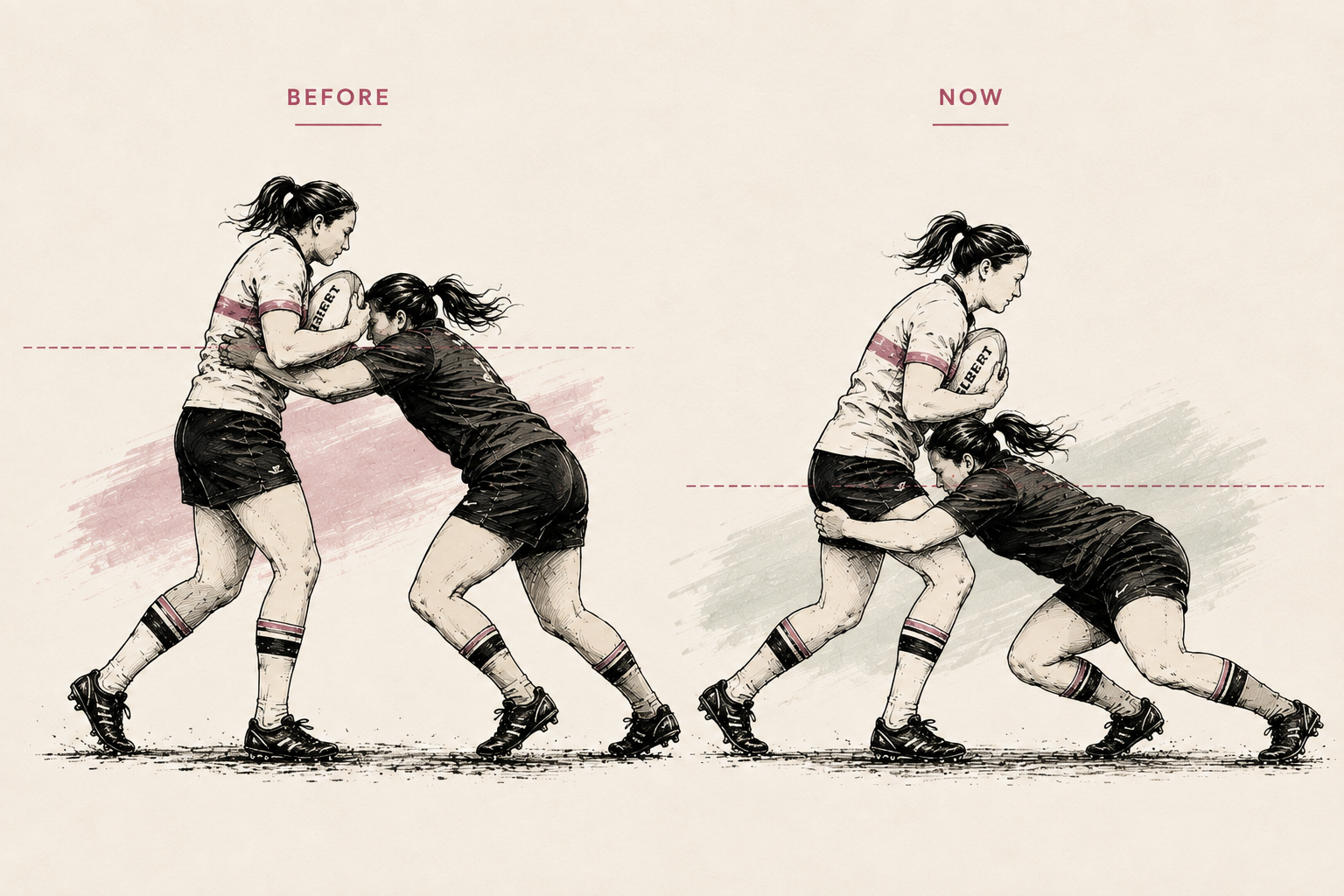
You probably didn't notice the moment rugby changed.
There was no dramatic announcement during a Six Nations match. No stadium clock stopped. No player walked onto the pitch with a new piece of equipment.
Instead, one of the most instinctive skills in rugby began to change quietly, training ground by training ground, match by match.
The tackle.
For generations, players had been taught to meet the ball carrier, make contact and wrap. It was one of the fundamental skills of the game, learned through repetition until technique became instinct.
Then rugby started asking players to change where that contact happened.
In community rugby, the legal tackle height was lowered, moving the target away from the upper body and towards the waist or the base of the sternum. In England, the RFU had already introduced the lower tackle-height approach in 2023. Now, in June 2026, World Rugby has taken the measure from trial to full community law. From 1 July, unions can choose either the waist or base of the sternum as the maximum legal tackle height.
The reasoning is straightforward. If the tackler goes lower, the two players' heads should be further apart.
But changing a law is one thing.
Changing the way people play the game is another.
Three years on, we are beginning to see what that change has actually done.
The Shape Of The Tackle
The most important thing about the lower tackle law may not be what referees are penalising.
It may be what players are doing differently.
World Rugby's trials, involving more than 170,000 tackles across 11 unions, found a consistent change in tackler behaviour. In men's community rugby, the proportion of upright tacklers fell from 36% to 29%. In women's rugby, it fell from 51% to 44%. The overall shape of the game remained broadly intact, with tackle numbers, tackle success and what happened after the tackle not fundamentally changing.
That matters.
The purpose of the law was never to remove the tackle from rugby. It was to change the circumstances in which it happens.
The evidence suggests players have responded.
Instead of arriving upright, more tacklers are entering contact with a lower body position. The target has moved, and the technique has followed it.
Research from Scottish community women's rugby tells a similar story. After the maximum tackle height was lowered to below the base of the sternum, researchers analysed more than 11,000 tackle actions across two seasons. Upright tackling reduced, while tackles made with the tackler bent at the waist increased. Contacts above the sternum also fell.
Perhaps most significantly, the researchers found reductions in the proximity of the tackler's and ball carrier's heads and shoulders.
In other words, the change was doing what it was intended to do.
It was changing the amount of shared head space in the tackle.
So, Has Rugby Become Safer?
This is where the story gets more interesting.
For a while, the evidence around lower tackle height was largely about behaviour. Players were tackling differently. High and upright tackles were reducing. That was encouraging, but it did not automatically prove that fewer injuries would follow.
Now we have stronger evidence.
A new Irish study, published in the Journal of Science and Medicine in Sport in June 2026, examined almost a decade of injury surveillance data. Researchers analysed approximately 86,000 hours of match play, more than 3,700 injuries and data from 239 men's, women's and schoolboy teams involving more than 8,800 players. Crucially, they were able to compare five seasons before the law change with two seasons afterwards.
The results were striking.
Among amateur women's rugby players, concussion rates fell by 63% after the lower tackle height was introduced. Among amateur men, concussion rates fell by 38%. Overall injury rates also fell in the adult game.
For a sport that has spent years looking for practical ways to reduce concussion risk, those numbers are difficult to ignore.
And the women's result is particularly significant.
Women's rugby has expanded rapidly, bringing more players into the game and increasing the importance of understanding how changes to the laws affect women specifically. The Scottish research had already shown that lowering the tackle height could reduce head contact and head proximity in women's community rugby. The Irish research now provides much larger-scale evidence of a substantial reduction in concussion rates among adult women.
That does not mean the tackle has suddenly become safe.
It means there is increasingly persuasive evidence that changing the tackle can reduce some of the risks associated with it.
But The Evidence Isn't Simple
There is an important reason not to turn those numbers into a victory lap.
The Irish study also looked at schoolboy rugby. Overall injuries fell by 19%, but there was no statistically significant reduction in concussion rates among school players.
That doesn't necessarily mean the lower tackle height doesn't work for younger players. It means the evidence is less conclusive, and the researchers point to possible differences in physical development, technique and playing characteristics as areas that need further investigation.
The Scottish women's study reached a similarly cautious conclusion. It found clear changes in tackle behaviour and reductions in head contact and head proximity, but it did not find a statistically significant reduction in concussion during the two seasons studied. The researchers explicitly called for further injury surveillance.
That distinction matters.
A change in behaviour is not automatically a change in injury rates.
But when behavioural change is accompanied by encouraging injury data from a much larger study, the picture begins to look considerably more promising.
The Ball Carrier Matters Too
There is another part of the change that is easy to miss.
Lowering the tackle doesn't only ask something of the person making the tackle. It can also affect the person carrying the ball.
The new community law recognises that relationship. World Rugby's wording gives the ball carrier a responsibility to enter the tackle safely, and the optional Game On variations allow match organisers to sanction a ball carrier who significantly lowers their height into dangerous contact.
It makes sense when you think about the mechanics.
If the tackler learns to go lower but the ball carrier suddenly drops their body height immediately before contact, the two players can still end up occupying the same dangerous space.
The aim, therefore, isn't simply to make everyone shorter at the moment of impact.
It is to change the shape of the collision.
That is a much more sophisticated proposition than simply saying: tackle lower.
A Law Change Becomes A Habit
There is also something fascinating about what this tells us about rugby itself.
Law changes can look very different on paper from how they feel on a training pitch.
A referee can blow a whistle and penalise a tackle above the permitted height. But ultimately, the law only succeeds if players stop thinking about the old version of the tackle and start instinctively performing the new one.
That is what the evidence increasingly suggests is happening.
The lower tackle has moved from a rule that players had to remember into a technique they are learning.
The upright tackle is becoming less common.
The lower body position is becoming more familiar.
The point of contact has moved.
And, in doing so, the game has demonstrated something rugby has sometimes been reluctant to acknowledge: changing a fundamental skill does not necessarily mean changing the character of the sport.
The tackle is still there.
The physical contest is still there.
Players still have to stop one another.
But the game is asking them to do it differently.
From Trial To Law
That is why World Rugby's decision on 17 June 2026 matters.
After two years of community trials involving more than 150,000 tackles in the original evaluation — with subsequent analysis expanding the dataset further — World Rugby Council approved the lower tackle height as full community law. The measure takes effect from 1 July 2026 for seasons beginning after that date, with unions able to choose between the waist and base-of-sternum heights.
This is no longer an experiment.
It is part of the way community rugby is being played.
And that makes the question slightly different now.
We're no longer asking whether rugby could change the tackle.
It has.
We're asking what happens next.
Because the most interesting thing about the lower tackle law may ultimately be less about the height of the tackle itself and more about what happens when an entire sport decides that one of its most instinctive skills needs to be relearned.
So far, the evidence suggests players can adapt.
The evidence also suggests that, at least in adult community rugby, that adaptation may be reducing concussion and injury.
There are still questions to answer, particularly around younger players and the long-term effects.
But three years after rugby began asking players to tackle differently, one thing is becoming clear.
The tackle has changed.
And for once, changing the way rugby is played may be helping preserve the part of the game that matters most: letting people keep playing it.
SOURCES
World Rugby — Lowering the legal tackle height in community rugby
World Rugby Passport — 2026 community tackle-height law wording
Journal of Science and Medicine in Sport — Tackle behaviour trial lowers concussion and overall injury rates: A seven-season prospective study in adult men's, women's and schoolboy rugby union
British Journal of Sports Medicine / PubMed Central — Scottish community women's rugby tackle-height research