
Not Every Hero Wears A Kit.
Issue 03 Cover Story
The people who make rugby happen rarely ask for recognition. They deserve it anyway.
.
Every rugby club has one
.
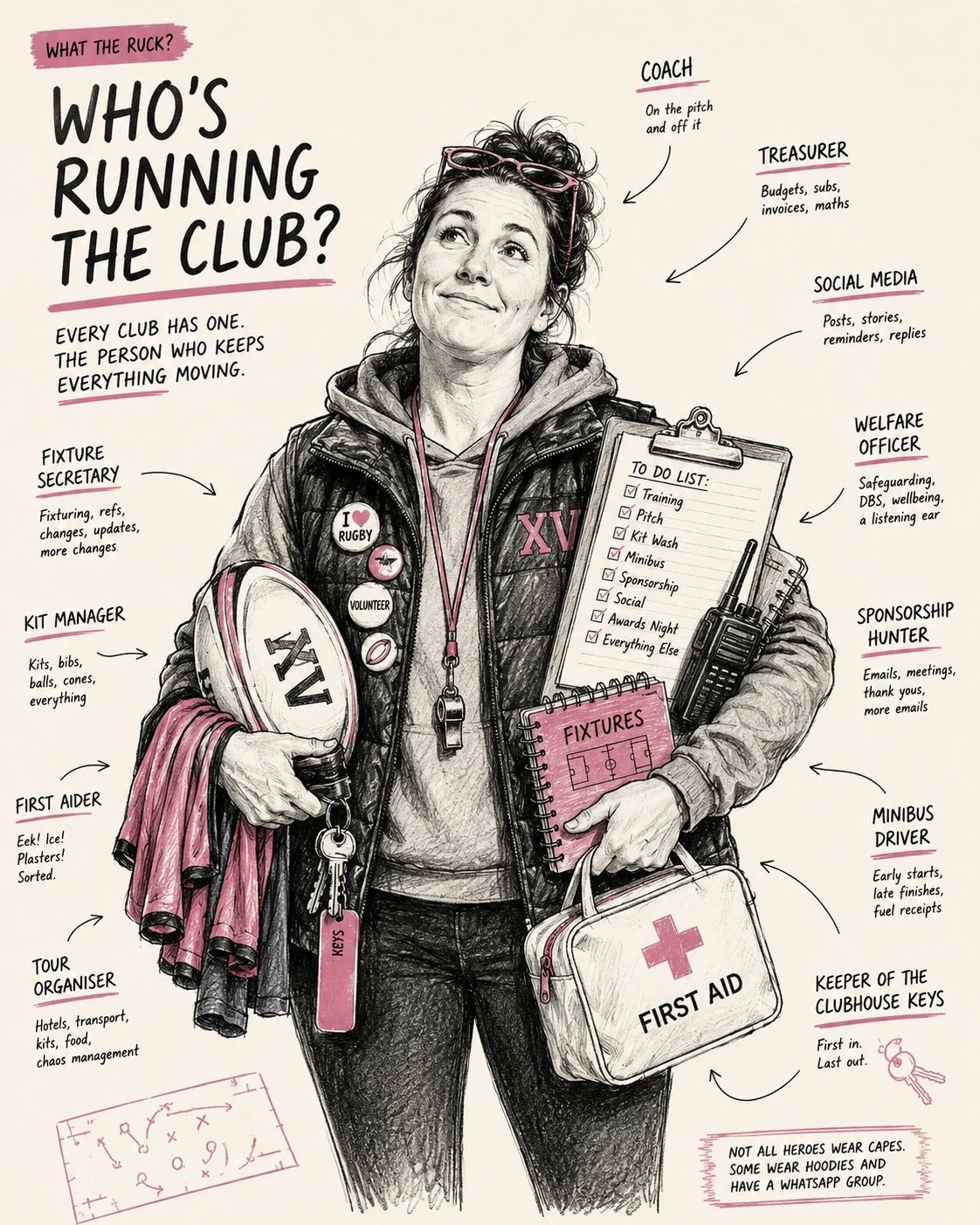
The person who seems to know where everything is. The one with the clubhouse keys in one pocket, a whistle around their neck and a phone buzzing with messages they somehow always answer.
They are the first to arrive and the last to leave.
Long before the players pull on their shirts, someone has already unlocked the gates, checked the pitch, switched on the floodlights and made sure the changing rooms are ready. Long after the final whistle, while everyone else heads home nursing tired legs and celebrating a hard-earned win, they're still folding bibs, washing kit and making sure everything is ready for next week.
Most people know them simply as 'the volunteer'.
But anyone involved in grassroots rugby knows they're much more than that.
On any given training evening, long before the first player arrives, somebody has already been at the club for half an hour. They've unlocked the gates, checked the pitch, switched on the floodlights and made sure everything is ready before anyone else even pulls into the car park.
It's six o'clock on a wet Tuesday evening, and training starts in thirty minutes. A late message arrives from a player who can't make it. The opposition have changed Saturday's kick-off time. Someone forgot the tacklebagss, the first aid kit needs restocking, and a new player is coming along for the first time but doesn't know where to park.
Before the first pass has even been thrown, one person has already solved half a dozen problems.
Nobody notices.
That's exactly the point.
The Invisible Job Description
There isn't a formal title for what these people do because no single title could possibly cover it.
They're the coach, fixture secretary, treasurer, kit manager, volunteer coordinator, minibus driver, social media manager, first aider, fundraiser, safeguarding lead, tea maker, cleaner and the person responsible for locking up at the end of the night. More often than not, they're several of those things at once.
The titles change from club to club, but the pattern is always the same. Whenever something needs doing, someone quietly steps forward and gets on with it.
Most don't volunteer because they're looking for recognition.
They volunteer because somebody has to.
Women's rugby has never been stronger. Crowds are growing, professional contracts are expanding, international matches are filling stadiums and participation continues to rise.
But none of those headlines begin in the biggest stadiums. They begin on cold Tuesday evenings at community clubs all over the country.
They begin on cold Tuesday evenings at community clubs all over the country.
Every international player once relied on somebody washing bibs, organising fixtures, remembering the spare gumshield or welcoming them through the clubhouse door for their very first training session.
Grassroots rugby isn't simply where players start.
It's where confidence begins.
“Women’s rugby doesn’t run on players. It runs on volunteers.”
There are jobs nobody sees. Hours nobody counts. Messages nobody thanks you for answering. The WhatsApp group never really sleeps. Fixtures change. Referees pull out. Pitches become unplayable. Sponsors need thanking. Parents need information. Someone forgets the corner flags. Someone loses the clubhouse keys. Something always needs fixing.
If rugby teaches resilience, volunteers practise it every single week.
More Than A Volunteer
Spend enough time around any rugby club and you'll notice something interesting. The people holding everything together rarely talk about themselves.
Ask them how much time they give, and they'll shrug.
Ask how many jobs they do, and they'll laugh.
Ask why they keep coming back, and the answer is almost always the same.
"Because I love this club."
It isn't about the title.
It's about belonging.
“The first person to arrive. The last person to leave.”
Every club has stories like these. The volunteer who quietly paid for extra rugby balls when the budget wouldn't stretch. The coach who stayed behind after training because one player needed a little more confidence. The committee member who spent an entire Sunday marking pitches in the rain. The parent who started helping one season and somehow became indispensable.
None of these moments appear in league tables.
Yet together they become the foundations on which clubs are built.
Success in rugby is often measured by wins, promotions, finals and trophies.
Perhaps success should also be measured by how many new players stayed because somebody made them feel welcome. How many young girls discovered they belonged in rugby because someone believed in them. How many friendships began because one volunteer decided to keep the clubhouse open for another cup of tea.
Those victories rarely make the headlines.
They're no less important.
The Real Club Hero
This issue of XV Style celebrates the people who rarely ask for applause. The people who never expect their name in the programme. The ones who don't lift trophies but quietly make sure someone else can.
They don't wear capes.
Most don't even wear a match shirt.
They wear waterproof jackets, muddy boots and a lanyard carrying more keys than anyone should reasonably own.
Their reward isn't a medal.
It's seeing a team run onto the pitch knowing they helped make it possible.
Women's rugby continues to grow because extraordinary athletes inspire us.
But it continues to thrive because ordinary people choose to give their time, every week, without expecting anything in return.
Professional rugby may produce heroes.
Grassroots rugby produces communities.
Every community begins with someone willing to unlock the clubhouse door.
“Not every hero wears a kit. Some wear hoodies, carry keys and keep an entire club moving.”
Every club has its heroes.
Most never score the winning try.
They rarely lift the trophy.
They don't feature in the photographs.
Yet without them there would be no team to cheer, no match to play and no community to belong to.
Not every hero wears a kit.
Some simply keep the game alive.