
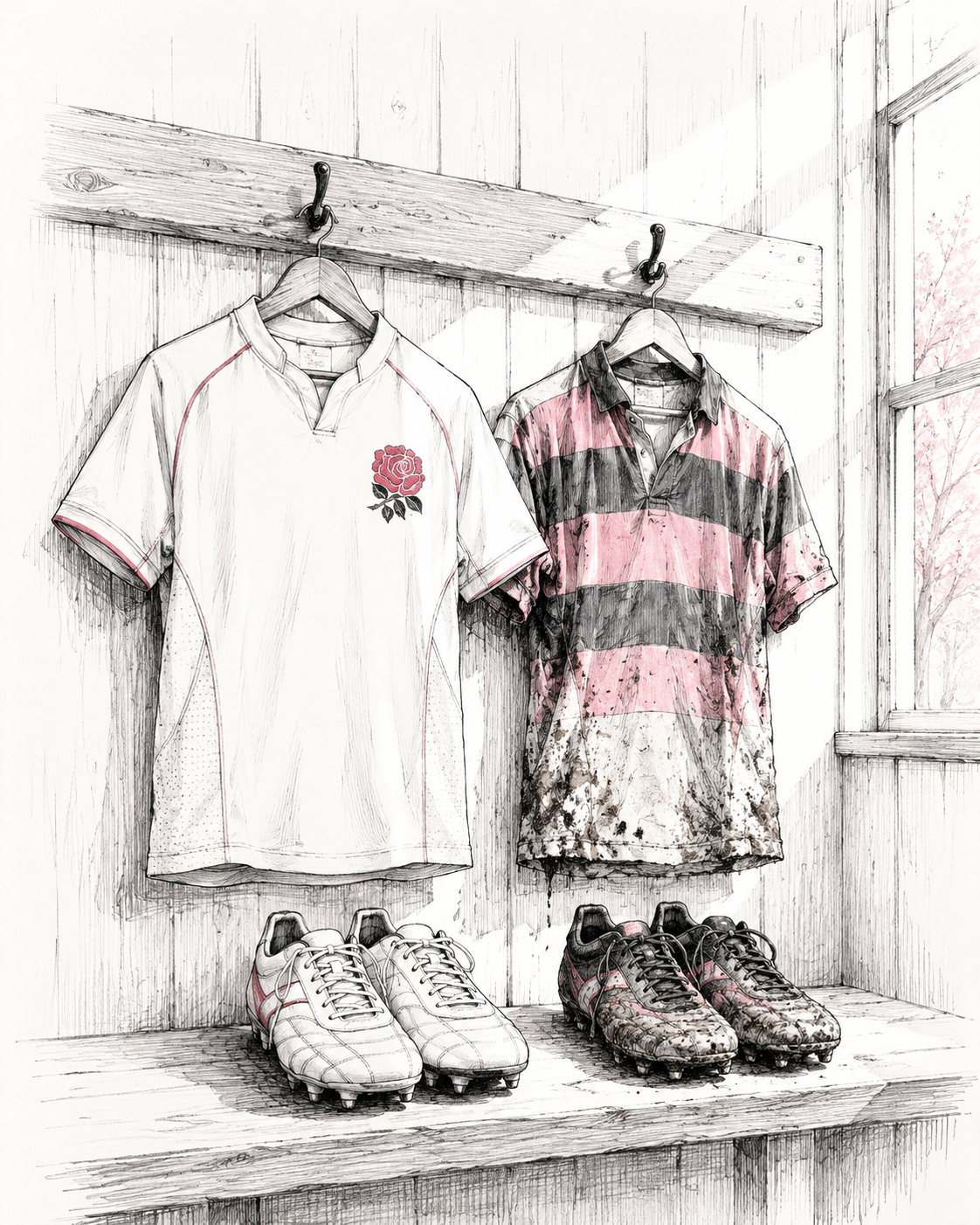
Talking Rugby
Women's rugby is growing at the elite level, but what does that success mean for grassroots clubs? Exploring why the future of the game depends on both.
What Does Success at the Top Mean for the Rest of the Game?
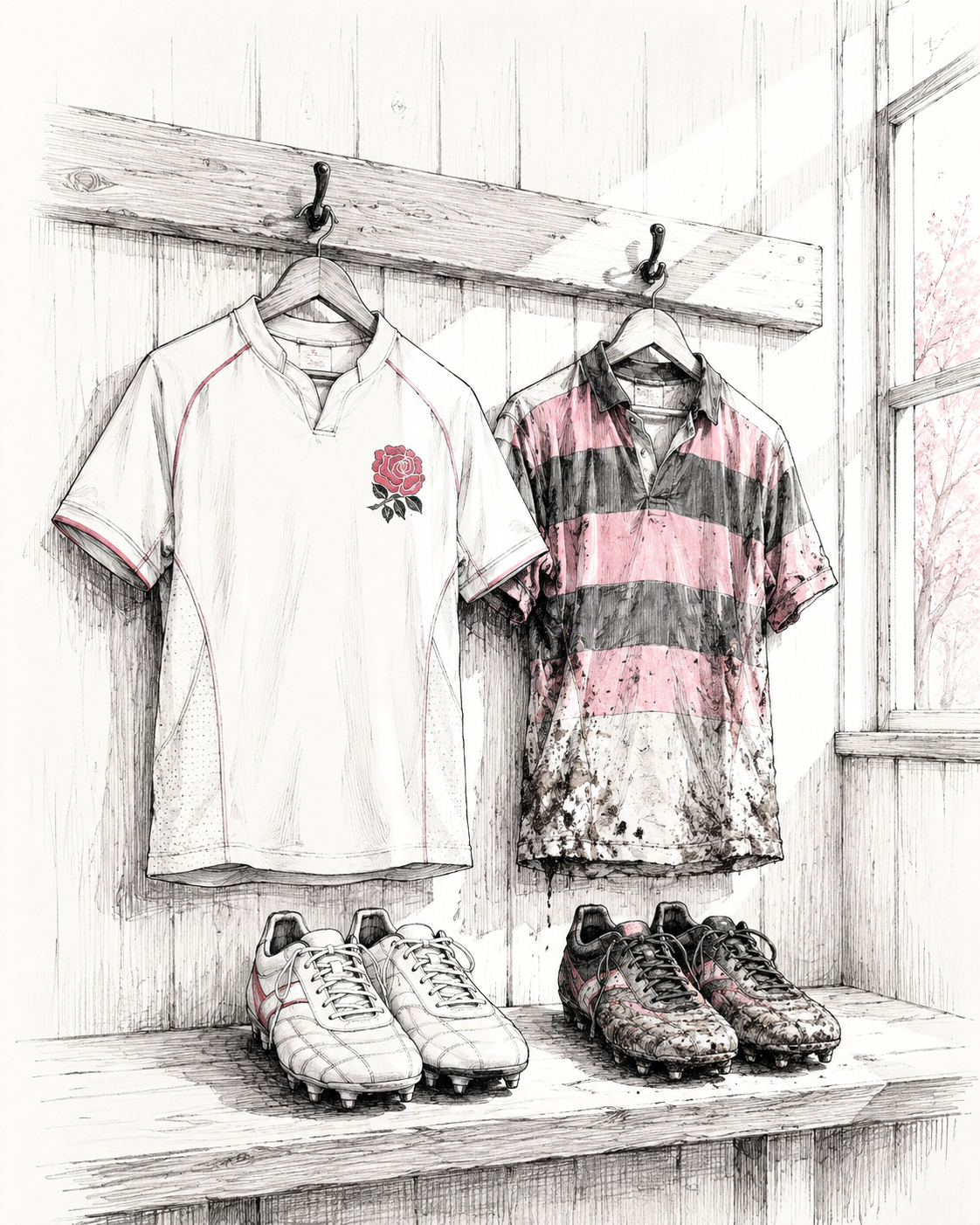
“Professional rugby gives young players heroes. Grassroots rugby gives them somewhere to become one.”
Women's rugby has every reason to celebrate.
The continued investment in the elite game is a sign of how far the sport has come. Better contracts, improved facilities, growing crowds and increased visibility are all positive steps. For the players reaching the very top of the game, these changes are long overdue.
The success of the Red Roses has inspired a generation, while Premiership Women's Rugby continues to raise standards on and off the pitch.
But every significant step forward also raises an important question.
What does success at the top actually mean for the rest of the game?
Because every international player, every league champion and every future star starts in exactly the same place.
A local rugby club.
Long before there are television cameras, professional contracts or sold-out stadiums, there are floodlit training sessions on cold Tuesday evenings. Volunteers marking pitches before work. Coaches giving up evenings with their families. Committee members balancing budgets, organising fixtures and trying to make every new player feel welcome.
Without those people, there is no pathway to the top.
The relationship between elite rugby and grassroots rugby shouldn't be viewed as separate worlds. One depends entirely on the other.
When investment reaches the professional game, the hope is that its impact extends much further than the players wearing England shirts. Increased visibility can attract new players. Success can inspire young girls to pick up a rugby ball for the first time. Commercial growth can create opportunities that simply didn't exist a decade ago.
But inspiration is only the beginning.
Every player motivated by what they see on television eventually arrives at a local club looking for somewhere to belong.
The question is whether those clubs have the people, facilities and support they need to welcome them..
Where We Go From Here
The investment announced this summer deserves to be recognised for what it is: a significant step forward for women's rugby in England.
But the real measure of its success won't simply be bigger contracts, larger crowds or higher television audiences.
It will be whether more clubs are thriving rather than surviving.
Whether volunteers feel supported rather than stretched.
Whether coaches have the confidence and resources to keep players in the game.
Whether every girl inspired by the Red Roses can find a welcoming team close to home.
The healthiest game isn't one where only the top flourishes.
It's one where every level grows together.
If, in four years' time, we have a stronger Red Roses team and stronger grassroots clubs, then this investment won't just have transformed elite rugby.
It will have strengthened the game from the ground up.
And that's the future we'd love to see..
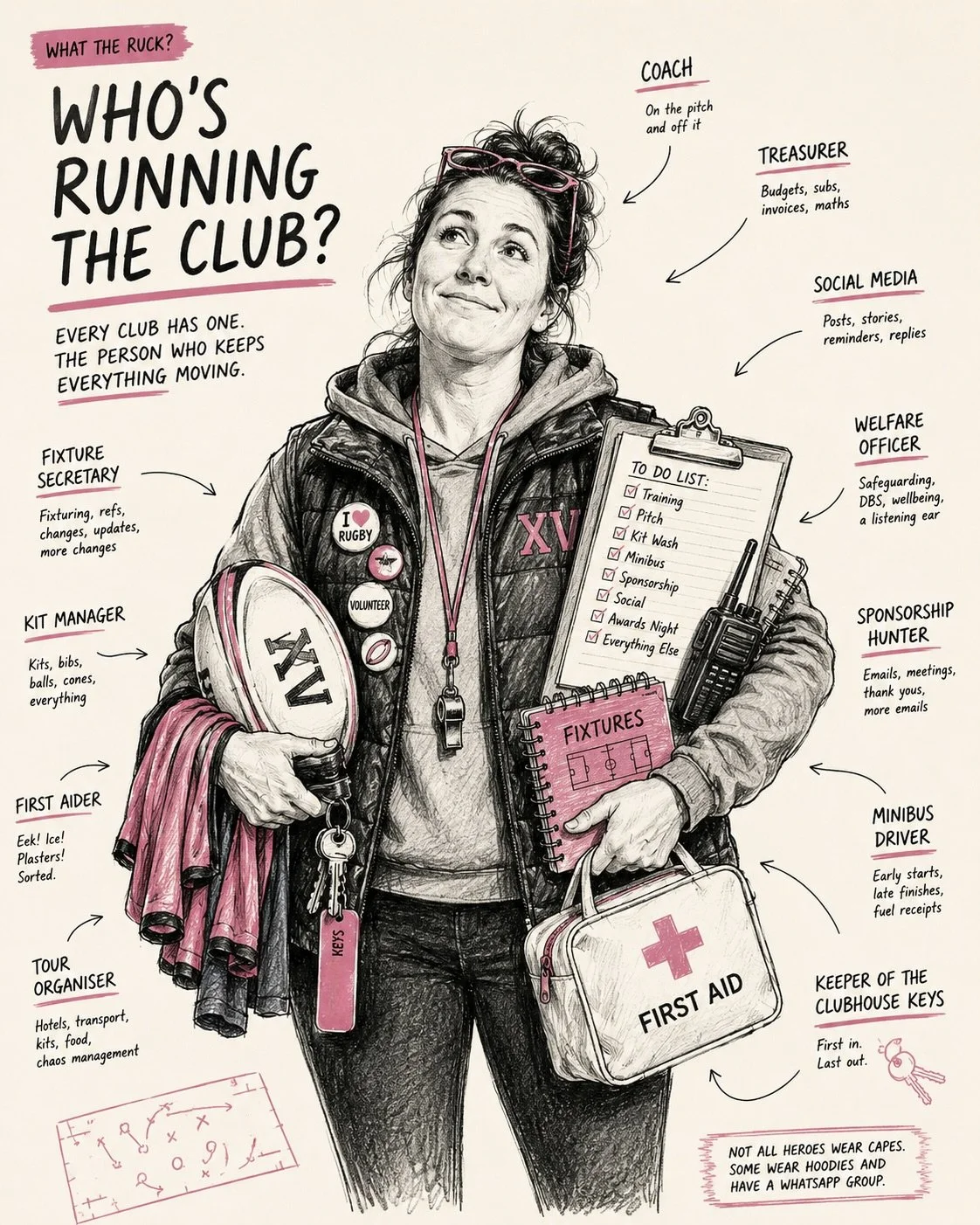
Not Every Hero Wears A Kit.
The people who shape a rugby club aren't always the ones wearing the jersey. From volunteers and coaches to physios and parents, this feature celebrates the individuals whose dedication makes every match possible—even if their names never appear on the team sheet.
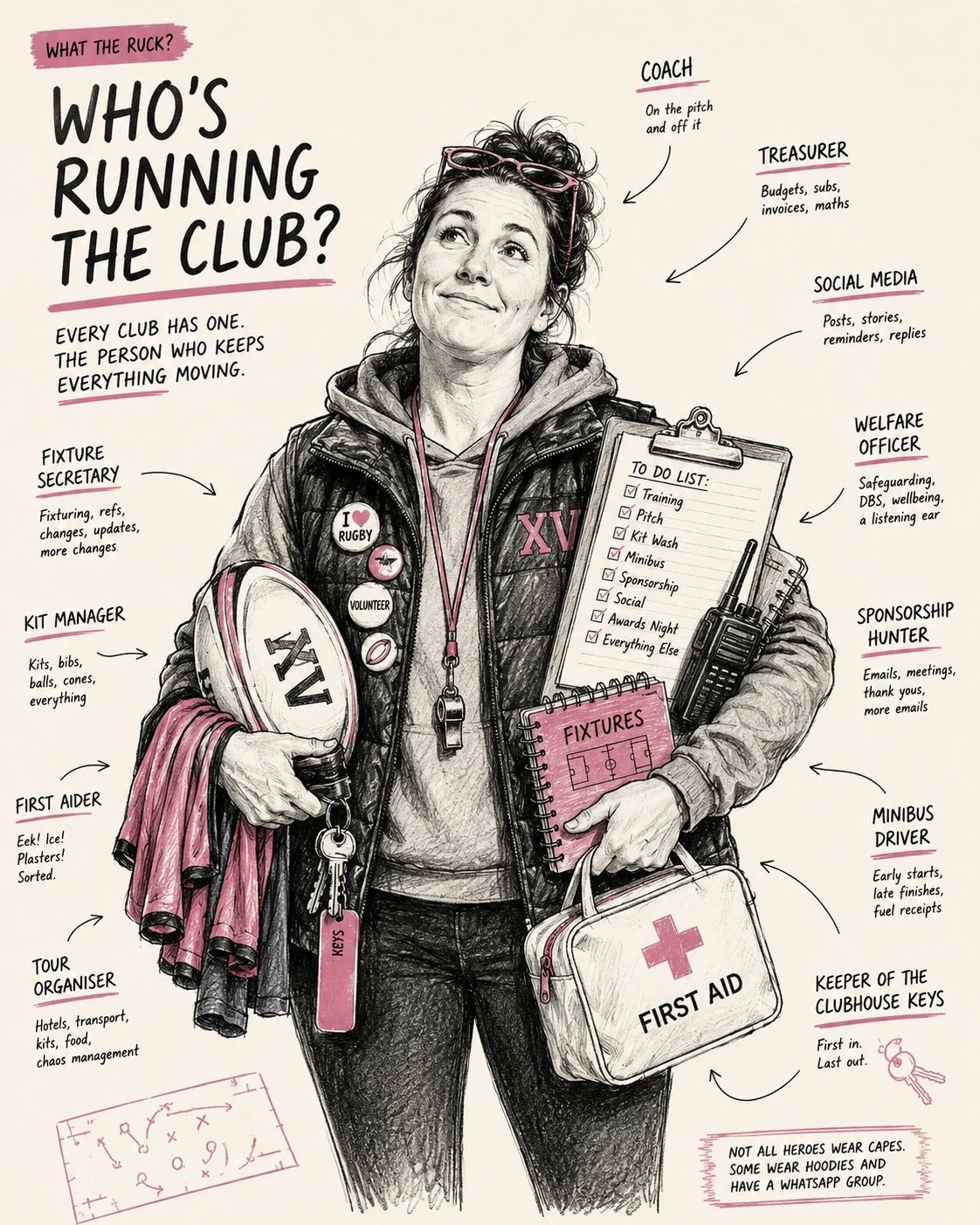
Issue 03 Cover Story
The people who make rugby happen rarely ask for recognition. They deserve it anyway.
.
Every rugby club has one
.
The person who seems to know where everything is. The one with the clubhouse keys in one pocket, a whistle around their neck and a phone buzzing with messages they somehow always answer.
They are the first to arrive and the last to leave.
Long before the players pull on their shirts, someone has already unlocked the gates, checked the pitch, switched on the floodlights and made sure the changing rooms are ready. Long after the final whistle, while everyone else heads home nursing tired legs and celebrating a hard-earned win, they're still folding bibs, washing kit and making sure everything is ready for next week.
Most people know them simply as 'the volunteer'.
But anyone involved in grassroots rugby knows they're much more than that.
On any given training evening, long before the first player arrives, somebody has already been at the club for half an hour. They've unlocked the gates, checked the pitch, switched on the floodlights and made sure everything is ready before anyone else even pulls into the car park.
It's six o'clock on a wet Tuesday evening, and training starts in thirty minutes. A late message arrives from a player who can't make it. The opposition have changed Saturday's kick-off time. Someone forgot the tacklebagss, the first aid kit needs restocking, and a new player is coming along for the first time but doesn't know where to park.
Before the first pass has even been thrown, one person has already solved half a dozen problems.
Nobody notices.
That's exactly the point.
The Invisible Job Description
There isn't a formal title for what these people do because no single title could possibly cover it.
They're the coach, fixture secretary, treasurer, kit manager, volunteer coordinator, minibus driver, social media manager, first aider, fundraiser, safeguarding lead, tea maker, cleaner and the person responsible for locking up at the end of the night. More often than not, they're several of those things at once.
The titles change from club to club, but the pattern is always the same. Whenever something needs doing, someone quietly steps forward and gets on with it.
Most don't volunteer because they're looking for recognition.
They volunteer because somebody has to.
Women's rugby has never been stronger. Crowds are growing, professional contracts are expanding, international matches are filling stadiums and participation continues to rise.
But none of those headlines begin in the biggest stadiums. They begin on cold Tuesday evenings at community clubs all over the country.
They begin on cold Tuesday evenings at community clubs all over the country.
Every international player once relied on somebody washing bibs, organising fixtures, remembering the spare gumshield or welcoming them through the clubhouse door for their very first training session.
Grassroots rugby isn't simply where players start.
It's where confidence begins.
“Women’s rugby doesn’t run on players. It runs on volunteers.”
There are jobs nobody sees. Hours nobody counts. Messages nobody thanks you for answering. The WhatsApp group never really sleeps. Fixtures change. Referees pull out. Pitches become unplayable. Sponsors need thanking. Parents need information. Someone forgets the corner flags. Someone loses the clubhouse keys. Something always needs fixing.
If rugby teaches resilience, volunteers practise it every single week.
More Than A Volunteer
Spend enough time around any rugby club and you'll notice something interesting. The people holding everything together rarely talk about themselves.
Ask them how much time they give, and they'll shrug.
Ask how many jobs they do, and they'll laugh.
Ask why they keep coming back, and the answer is almost always the same.
"Because I love this club."
It isn't about the title.
It's about belonging.
“The first person to arrive. The last person to leave.”
Every club has stories like these. The volunteer who quietly paid for extra rugby balls when the budget wouldn't stretch. The coach who stayed behind after training because one player needed a little more confidence. The committee member who spent an entire Sunday marking pitches in the rain. The parent who started helping one season and somehow became indispensable.
None of these moments appear in league tables.
Yet together they become the foundations on which clubs are built.
Success in rugby is often measured by wins, promotions, finals and trophies.
Perhaps success should also be measured by how many new players stayed because somebody made them feel welcome. How many young girls discovered they belonged in rugby because someone believed in them. How many friendships began because one volunteer decided to keep the clubhouse open for another cup of tea.
Those victories rarely make the headlines.
They're no less important.
The Real Club Hero
This issue of XV Style celebrates the people who rarely ask for applause. The people who never expect their name in the programme. The ones who don't lift trophies but quietly make sure someone else can.
They don't wear capes.
Most don't even wear a match shirt.
They wear waterproof jackets, muddy boots and a lanyard carrying more keys than anyone should reasonably own.
Their reward isn't a medal.
It's seeing a team run onto the pitch knowing they helped make it possible.
Women's rugby continues to grow because extraordinary athletes inspire us.
But it continues to thrive because ordinary people choose to give their time, every week, without expecting anything in return.
Professional rugby may produce heroes.
Grassroots rugby produces communities.
Every community begins with someone willing to unlock the clubhouse door.
“Not every hero wears a kit. Some wear hoodies, carry keys and keep an entire club moving.”
Every club has its heroes.
Most never score the winning try.
They rarely lift the trophy.
They don't feature in the photographs.
Yet without them there would be no team to cheer, no match to play and no community to belong to.
Not every hero wears a kit.
Some simply keep the game alive.
What The Ruck?
World Rugby is changing more than where the Television Match Official sits. As remote officiating begins to separate decision-making from live television production, could greater independence lead to greater trust in the modern game?
The TMO Has Left the Stadium. Is That a Good Thing?
Technology has transformed rugby officiating, but the biggest change isn't what the TMO is reviewing—it's where they're reviewing it from. As World Rugby trials a new era of remote officiating, could greater independence lead to greater trust?
There was a time when refereeing a rugby match was relatively simple. One referee. Two touch judges. Eighty minutes of decisions made in real time
Those days are long gone.
Elite rugby now operates in an environment where every tackle, every clear-out and every try can be reviewed from multiple angles within seconds. Technology has become as much a part of the modern game as the whistle itself, and with it has come the Television Match Official.
For some supporters, the TMO has improved the game beyond recognition. Dangerous play is identified more consistently, foul play is reviewed more thoroughly and referees have another set of experienced eyes to help them make difficult decisions.
For others, every intervention feels like another interruption.
Either way, the TMO isn't going anywhere.
What's changing is where they're sitting.
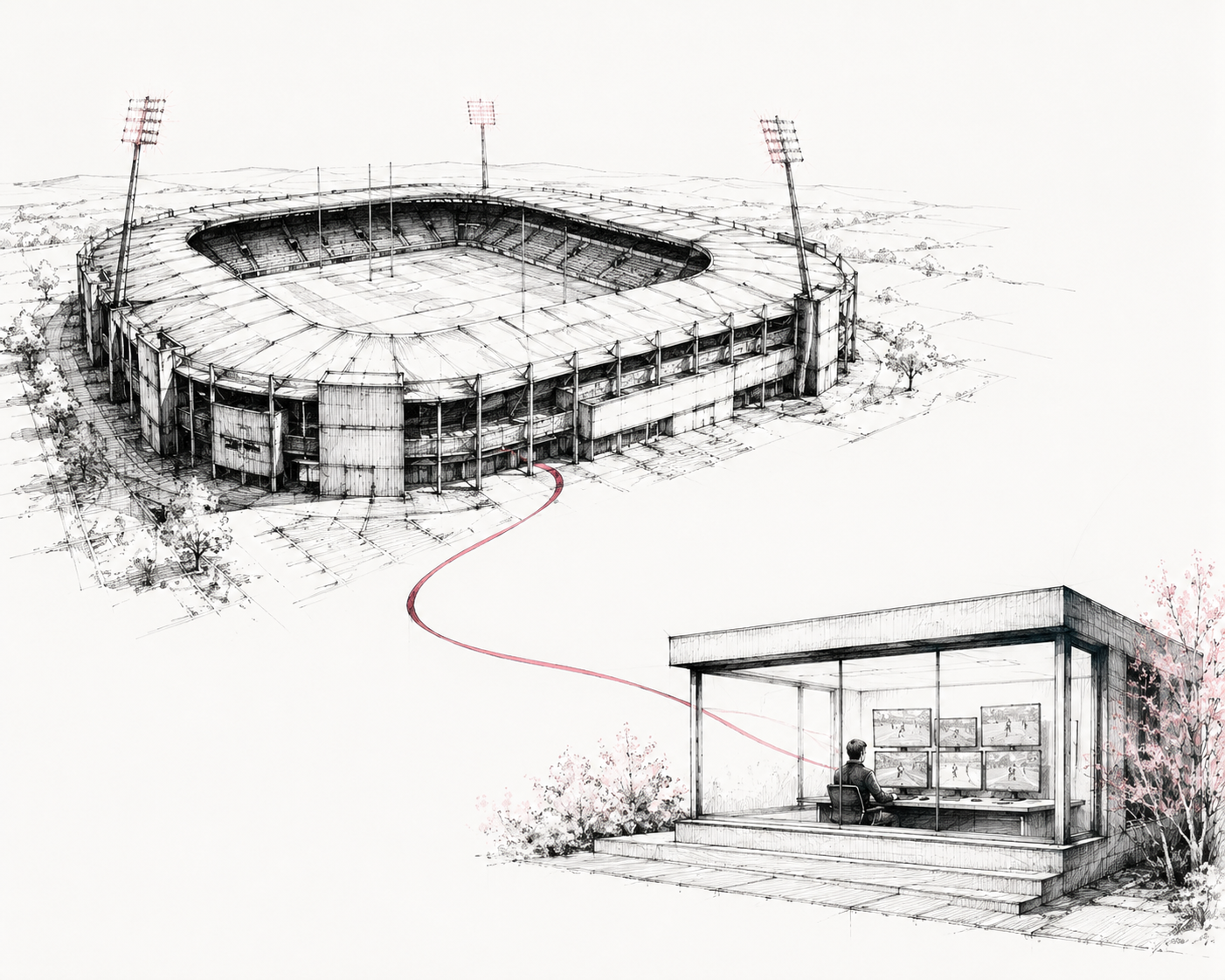
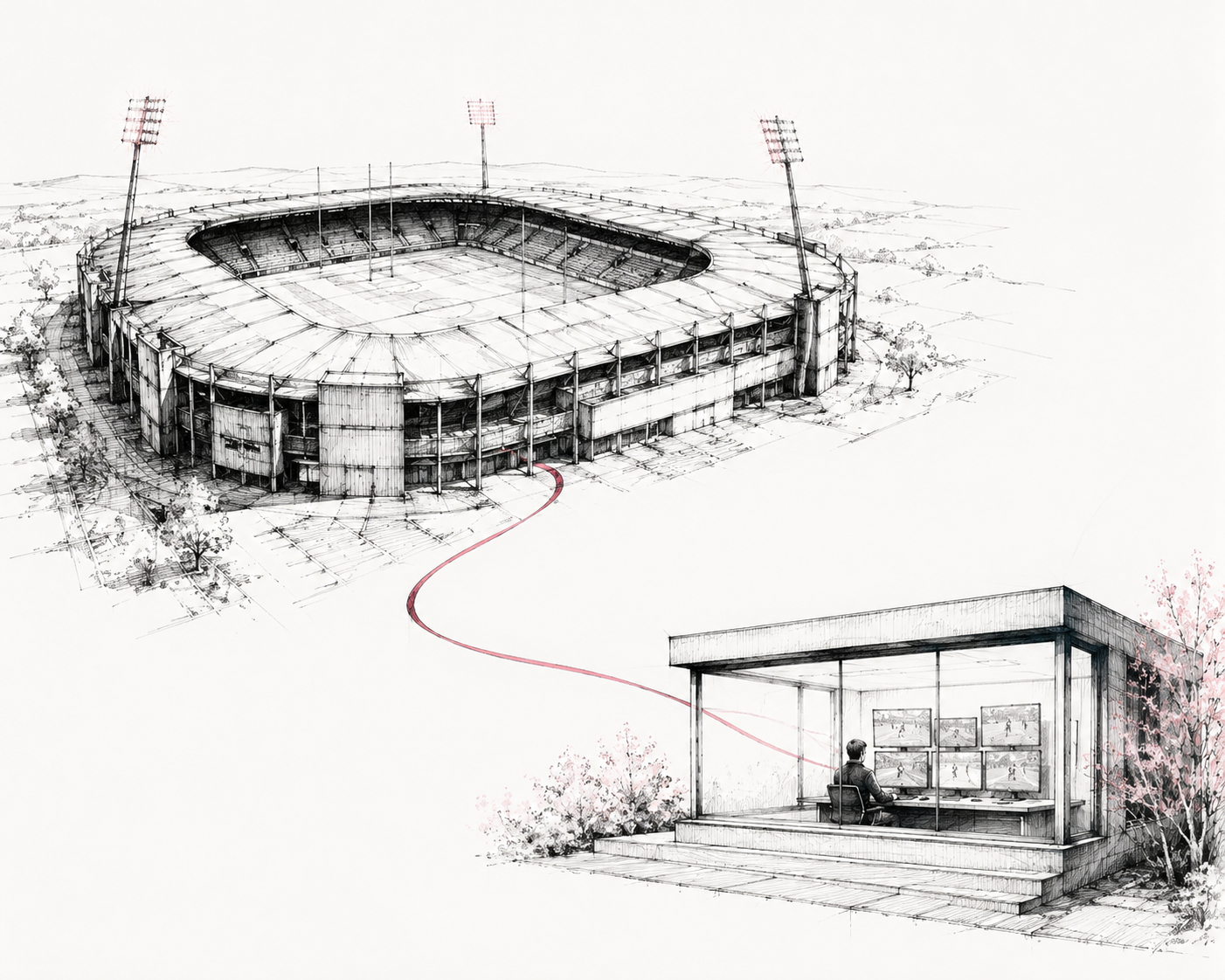
This summer, World Rugby began trialling a fully remote TMO hub during the World Rugby Nations Cup and the World Rugby U20 Championship. Rather than working from inside the stadium, Television Match Officials are based at a central operations hub in Basingstoke, reviewing incidents from hundreds of miles away with specialist technology and dedicated replay support.
It's a significant shift, one that's likely to shape the future of international rugby.
World Rugby has already confirmed that new minimum technology standards will be introduced across international rugby by August 2027. Among them is a simple but important principle: the TMO should have independent access to every available camera angle, rather than relying on the television feed produced for the broadcast.
At first glance, it sounds like a purely technical change.
In reality, it raises a much bigger question.
For years, one criticism has quietly followed almost every controversial decision.
When a referee asks to see another angle, who decides what the TMO actually sees?
“The referee isn’t looking for the most compelling replay. They’re looking for the most accurate one.”
The answer has traditionally been the host broadcaster.
Television directors are experts at telling the story of a match. Their job is to produce the best possible broadcast for viewers, selecting replays that capture the drama, emotion and pace of the game.
Officiating, however, has a different objective.
The referee isn't looking for the most compelling replay.
They're looking for the most accurate one.
Most of the time those two priorities align perfectly.
Occasionally, they don't.
We've all experienced those moments when commentators ask for another angle, social media becomes convinced that footage exists somewhere, or everyone in the stadium is left wondering whether the decisive replay was ever shown.
That's not necessarily anyone's fault. Television broadcasts are designed to entertain millions of viewers, not to function as forensic review systems.
By separating the TMO from the live television production, World Rugby hopes to create something more independent.
Officials can review every available camera angle, control replays themselves and apply the same procedures regardless of which broadcaster is covering the match.
Perhaps that's the real story here.
This isn't simply about moving someone from a room inside the stadium to one many miles away.
It's about separating officiating from broadcasting.
In an era where every decision is scrutinised frame by frame, trust in the process matters just as much as the decision itself.
Will it eliminate controversy?
Almost certainly not.
Rugby will always have moments that divide opinion. Slow-motion replays won't remove human judgement, and supporters will probably never agree on every decision.
That's part of the game's DNA.
But if independent replay technology leads to more consistent decisions, greater transparency and increased confidence that every available angle has been reviewed, then it's difficult to argue the game hasn't taken a step forward.
The biggest change isn't that the TMO has left the stadium.
It's that, for the first time, the replay official is beginning to step outside the television production too.
And that might prove to be the most important decision of all.
Issue Context
World Rugby's fully remote TMO hub was first trialled during the 2026 World Rugby Nations Cup and World Rugby U20 Championship. Wider minimum technology standards for international rugby, including independent TMO access to all available camera angles, are due to be introduced by August 2027.
XV IQ — What's That Thing Between Their Shoulder Blades?
Every elite rugby player seems to wear one, but what is that small black device between their shoulder blades? XV IQ explains how GPS technology helps coaches monitor performance, manage workloads and keep players performing at their best.
Every elite rugby player seems to wear one. Here's what it does—and why coaches wouldn't want to be without it.
What is it, exactly?
If you've watched professional rugby recently, you've almost certainly seen it.
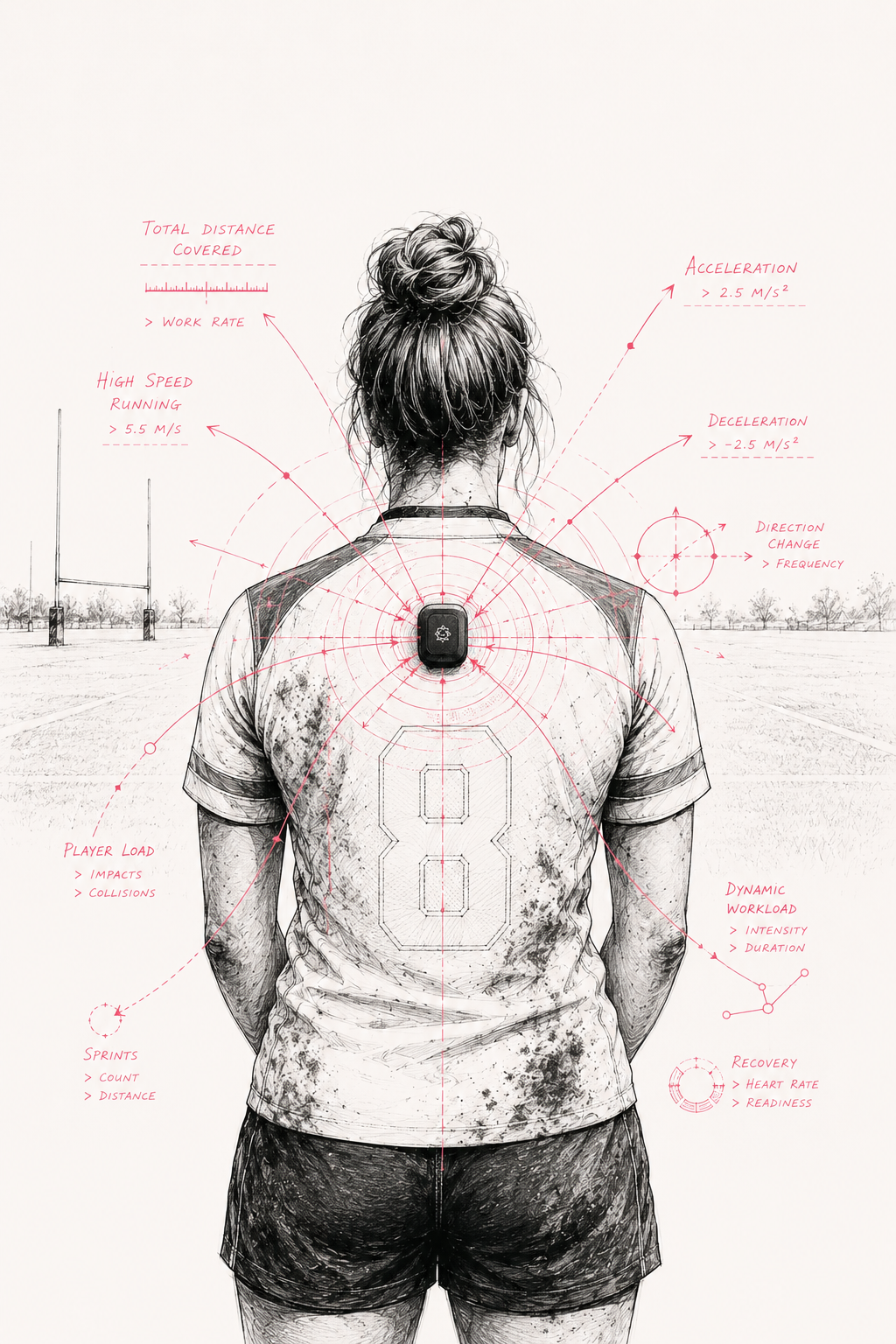
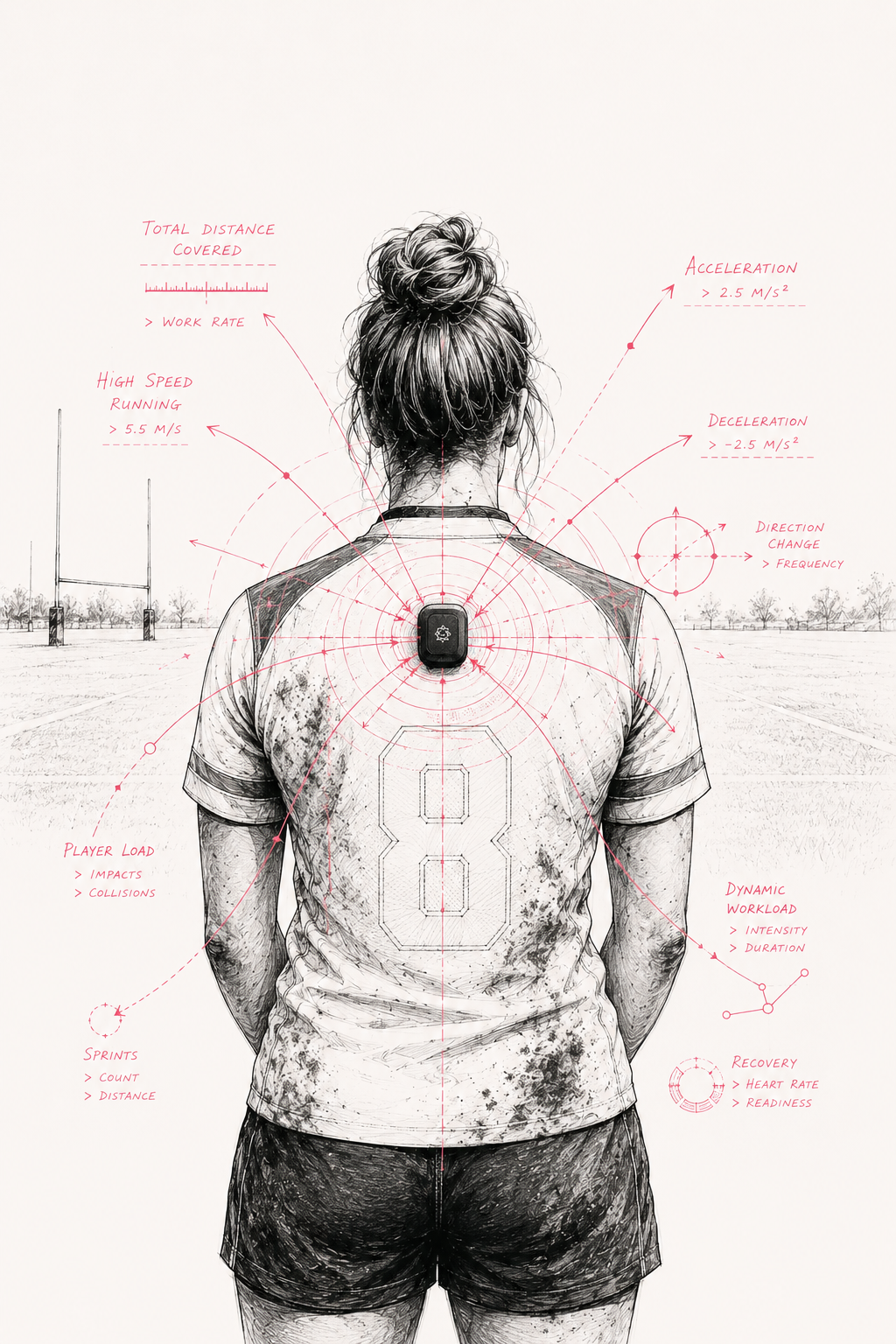
A small black rectangle sitting between a player's shoulder blades beneath their shirt.
Once you notice it, you see it everywhere.
Every player is wearing one. Every warm-up. Every training session. Sometimes even during matches.
Commentators mention "GPS data" as though everyone already knows what it means.
Coaches glance at laptops.
Analysts exchange numbers.
Players finish training and immediately hand the little black device back to a member of staff, who disappears with a box full of them.
Most fans have absolutely no idea what just happened.
So... what exactly is that little box?
More Than Just GPS
Despite the name, the small pod between a player's shoulder blades does far more than simply track their position on the pitch.
Inside that small pod are several different sensors working together.
The GPS receiver records where a player moves around the pitch.
An accelerometer measures how quickly they speed up, slow down and absorb impacts.
A gyroscope monitors changes in movement and body position.
Together, they build an incredibly detailed picture of a player's workload.
Not just where they ran.
How they ran.
What Can It Measure?
Quite a lot.
During a single training session or match, coaches can monitor:
Total distance covered
Maximum sprint speed
Number of sprints
High-speed running distance
Accelerations
Decelerations
Changes of direction
Overall workload
Positioning and movement across the pitch
Some systems even estimate the physical demands created by repeated collisions and contact, helping coaches understand how demanding a session has really been.
It isn't simply counting steps.
It's building a performance profile.
.
Why Does Any Of This Matter?
Imagine two players walking off the pitch after training.
Both tell the coach:
"I'm feeling good."
Without technology, that's all the information available.
With GPS data, the picture becomes much clearer.
One player may have completed twenty-five high-speed efforts.
Another may have completed fifteen.
One player's sprint speed might be exactly where coaches expect it to be.
Another's might have dropped noticeably compared to previous weeks.
Neither player necessarily feels different.
But the data tells another story.
That doesn't automatically mean someone is injured.
It simply gives coaches another piece of evidence when deciding tomorrow's training load.
Sometimes the smartest coaching decision isn't asking a player to do more.
It's recognising when they should do less.
The Hidden Team Behind Every Match
Most supporters focus on the players.
Modern rugby is supported by an entire performance team working behind the scenes.
Performance analysts download the data.
Strength and conditioning coaches compare workloads.
Medical staff monitor recovery.
Coaches look for patterns across the entire squad.
Instead of relying purely on instinct, elite teams can combine experience with evidence.
The numbers never replace coaching.
They support it.
“Think of it less as a crystal ball... ...and more as an early warning system.”
Can GPS Prevent Injuries?
Not completely.
No piece of technology can promise that.
What it can do is help coaches spot changes that the human eye might miss.
If a player's workload has increased dramatically over several weeks, training can be adjusted before small problems become bigger ones.
If someone returning from injury is gradually increasing their running volume, GPS helps ensure that progression happens safely rather than too quickly.
Think of it less as a crystal ball...
...and more as an early warning system.
Does It Decide Who Gets Picked?
No.
At least, it shouldn't.
Rugby is still played by people.
Not spreadsheets.
A GPS unit can't measure courage.
It can't measure leadership.
It can't recognise calm decision-making in the final minute of a match.
It doesn't know who will produce a perfectly timed tackle or inspire teammates when a game is slipping away.
The best coaches understand that.
Technology provides information.
People provide judgement.
The two work best together.
The Future Of Rugby?
The little device between a player's shoulder blades is just one part of a much bigger picture.
Elite rugby now uses video analysis, smart mouthguards, recovery technology and performance data in ways that would have seemed almost unimaginable twenty years ago.
The modern game is becoming smarter as well as faster.
Yet for all the technology now available, the objective hasn't changed.
Help players perform at their best.
Help them stay fit.
Help them enjoy long, successful careers.
The tiny black box can't score tries.
But it can help players be in the best possible condition to score them.
Next time you watch a match...
...you'll know exactly what you're looking at.
XV IQ | Next Time You Watch A Match...
Look for the black pod between a player's shoulder blades during the warm-up.
Remember, it isn't just tracking where they've been.
It's helping coaches understand:
How hard they've worked.
How quickly they've recovered.
Whether they're ready to go again.
The smallest piece of equipment on the pitch may be collecting the biggest story of the match.
XV IQ appears in every issue of XV Style — breaking down the moments, moves and mechanics that make rugby the game we love.

The Four Women Who Started a Revolution
Before sold-out stadiums, television deals and professional contracts, four volunteers dared to imagine a Women's Rugby World Cup. This is the remarkable story of Deborah Griffin, Sue Dorrington, Alice Cooper and Mary Forsyth—and the revolution they quietly began.
Long before sold-out stadiums, television deals and professional contracts, four volunteers quietly changed the course of women's rugby forever.

There are moments in sport that, looking back, feel inevitable.
Looking back, it's easy to believe they were always going to happen.
Professional leagues.
International tournaments.
World Cups.
History has a habit of making progress look effortless.
It rarely is.
Because every great sporting event begins with somebody looking at an impossible idea and deciding to try anyway.
In 1991, four women did exactly that.
Their names were Deborah Griffin, Sue Dorrington, Alice Cooper and Mary Forsyth.
Outside rugby circles, many people have never heard of them.
Yet without their determination, there may never have been a Women's Rugby World Cup as we know it today
“History remembers the tournament. It should also remember the four volunteers who made it possible.”
At the end of the 1980s, women's rugby was growing steadily, but opportunities remained limited. International fixtures were rare, funding was scarce and official
recognition varied enormously from country to country. The idea of staging a global tournament seemed ambitious, perhaps even unrealistic.
From their base at Richmond Women's Rugby Club, however, Deborah Griffin, Sue Dorrington, Alice Cooper and Mary Forsyth believed something very simple.
If the men's game could have a World Cup...
...why couldn't the women's game?
There was no blueprint.
No commercial investment.
No governing body leading the project.
No guarantee that national unions would support the idea.
There was simply a belief that women's rugby deserved the same opportunity to compete on the world's biggest stage.
So they stopped waiting for somebody else to make it happen.
They started planning instead..
Today it's almost impossible to appreciate the scale of what they were attempting.
If four volunteers decided to organise an international tournament now, they would create a WhatsApp group before breakfast. Documents would be shared online. Video meetings would connect organisers across continents. Fixtures could be confirmed in minutes, while cloud storage, shared calendars and project management software would keep everyone moving in the same direction.
None of that existed.
Communication depended on letters, fax machines and carefully timed international telephone calls. Information travelled through the post. Documents were typed, copied and physically distributed. Every conversation required patience. Every amendment created more paperwork. Every unexpected problem meant starting the process all over again.
What feels like a few clicks today could take days—or even weeks.
Perhaps that's what makes their achievement so extraordinary.
They weren't simply organising a rugby tournament.
They were doing it in a world that lacked almost every communication tool we now take for granted.
“No WhatsApp. No shared documents. No cloud storage. Just determination, persistence and four volunteers who believed the tournament should exist.”
Of course, organising any major sporting event has never simply been about paperwork.
Teams had to be contacted.
Venues secured.
Accommodation arranged.
Sponsors persuaded.
Budgets balanced.
Problems solved.
Every task depended upon volunteers fitting the work around full-time jobs, family commitments and everyday life.
Nobody was being paid to build the future of women's rugby.
They simply believed it was worth doing. And because they did, women's rugby changed forever.
Perhaps that's the detail history sometimes overlooks.
The Women's Rugby World Cup wasn't created because somebody invested millions of pounds.
It existed because ordinary people kept saying yes to one more meeting.
One more phone call.
One more problem that needed solving.
That feels strangely familiar.
Anyone involved in a community rugby club today will recognise the pattern immediately.
The fixture secretary quietly rearranging postponed matches before work.
The coach locking up long after everyone else has gone home.
The committee member answering emails late into the evening because somebody has to.
Different jobs.
The same spirit.
When the inaugural Women's Rugby World Cup finally took place in Cardiff in 1991, something remarkable happened.
Not because a trophy was lifted.
Not because history was written in a single afternoon.
But because something that many believed couldn't happen...
...had happened.
A door had been opened.
Every Women's Rugby World Cup since has walked through it.
It's tempting to view progress as inevitable, as though the professional game we enjoy today was always destined to arrive.
It wasn't.
Progress happened because people chose to create opportunities instead of waiting for permission.
That may be the greatest legacy Deborah Griffin, Sue Dorrington, Alice Cooper and Mary Forsyth leave behind.
Issue 03 has celebrated the people who make rugby happen.
The volunteers who unlock the clubhouse before training.
The referees who give up their weekends because without them there is no match.
The committee members who quietly keep clubs alive.
The coaches who stay behind after training because one player wants ten more minutes practising kicks.
Deborah Griffin, Sue Dorrington, Alice Cooper and Mary Forsyth belonged to exactly that tradition.
They simply changed the game on a much bigger stage.
Technology has transformed rugby since 1991.
We organise fixtures through smartphones.
We communicate instantly.
We share documents with a tap of a screen.
The tools have changed beyond recognition.
The people haven't.
The game still depends on individuals prepared to organise, encourage, persuade and quietly keep everything moving behind the scenes.
Thirty-five years later, women still arrive at clubhouses where somebody has already unlocked the doors.
Somebody has marked the pitches.
Somebody has organised the fixtures.
Somebody has decided the game is worth giving their time to.
The Women's Rugby World Cup exists because four volunteers made exactly the same decision
You may not have known their names before reading this article.
Now you do.
And the next time the world gathers to celebrate the very best of women's rugby, perhaps spare a thought for the four volunteers who quietly proved that the impossible sometimes begins with nothing more than an idea, a few determined people... and the courage to start.
“Every revolution begins with someone deciding that waiting is no longer an option.”
Historical Context
The inaugural Women's Rugby World Cup was held in Cardiff, Wales, in 1991. Organised independently by Deborah Griffin, Sue Dorrington, Alice Cooper and Mary Forsyth, the tournament laid the foundations for the modern Women's Rugby World Cup.
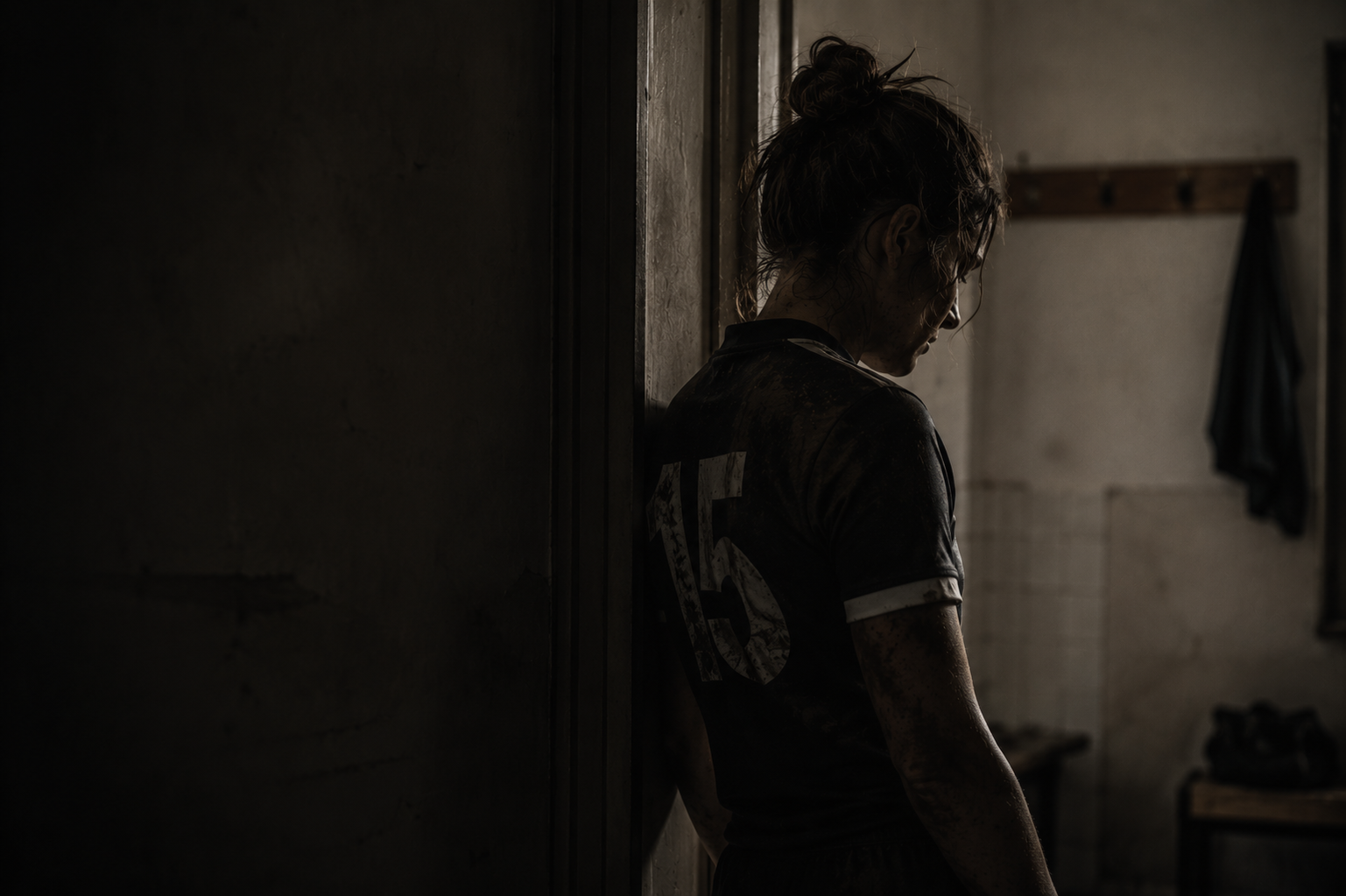
Anonymous 15 - The Committee
Every rugby club has a committee, and every committee has its own characters. Anonymous 15 shares a tongue-in-cheek look at the volunteers, personalities and unforgettable moments that keep grassroots rugby ticking over.
Anonymous 15 has been on the committee.
She will not be going back.
Not after what she saw.
Column No. 2
Every rugby club has a committee .Somebody elected them years ago. Nobody has seen that person since..
Nobody remembers agreeing to this. They simply appeared, like a mysterious smell in the changing room
that everyone pretends isn't there until one day you find the source and wish you hadn't.
The committee meets on the third Thursday of the month in the back room of a pub whose only qualification is that the chair's brother-in-law owns it.
There are eight people on the committee.
Four of them do everything.
Two of them are there to make sure the first four don't get too much credit for doing everything.
One of them has been "stepping back for personal reasons" since 2021 but still votes on everything and once sent a seventeen-message voice note to the group chat at 1am about the colour of the away kit.
And one of them — and I want you to understand this is a real person at a real club and she knows who she is — one of them has not done a single visible thing in three years but somehow gets a special mention in every end-of-season speech, described as "the backbone of this club," while the people who actually keep the lights on stand at the back with their wine and smile like they've been doing it their whole lives.
Which they have.
“They simply appeared, like a mysterious smell in the changing room”
Then there's Kryssi.
With a K. She'll tell you.
Why does Kryssi do it?
This is a question I have spent considerable time on.
Option A: Kryssi genuinely loves this club. She loves the players, the culture, the mud, the chaos, the 6am pitch inspections in November, the kit that arrives in the wrong sizes, the county meetings that could have been an email, the AGM that could have been nothing. She loves all of it. She is, in the purest sense, a person for whom rugby is not something she does but something she is.
This is possible.
Option B: Kryssi cannot say no. Not to anyone. Not about anything. She once agreed to cover three training sessions, organise the tour, write the match reports AND manage the new player enquiries in the same week because someone asked her in a car park and she didn't know how to get out of it. She has the word "no" somewhere in her vocabulary but it has never been located under operational conditions.
This is also possible.
Option C: The 2022 end-of-season awards.
I'm not going to tell you everything that happened at the 2022 end-of-season awards.
What I will tell you is this.
There was a chairlift. There was a speech. There was a person who shall remain nameless who made a toast that will never, under any circumstances, appear in the minutes. There was an incident involving the club president, a novelty trophy and the fire door that I have been asked by multiple parties never to speak of again.
And Kryssi was there for all of it.
Kryssi remembers all of it.
And somehow, the following January, Kryssi ended up with the keys.
Draw your own conclusions.
The committee recently held a volunteer recruitment drive.
They made a poster. It had a motivational font and a photograph of the first team from 2021, which is a bold choice given that two of the players in it have since left under circumstances nobody will discuss at volume and one of them is now playing for a rival club that beat us in the cup and celebrated in a manner I still find personally offensive.
The poster said: Get Involved. Shape The Future.
Six people responded.
One wanted to know if there was a discount on match fees.
One asked to be put in charge of social media because she had ideas. She was given social media. She posted twice and then went quiet. The last post is still pinned. It is a picture of a rugby ball with the caption "Big things coming 👀". That was fourteen months ago.
One turned out to already be on the committee and had missed the email because she'd muted the group chat and hadn't told anyone.
One came to the first meeting, said "wow, there's a lot going on isn't there" and was never seen again.
One joined with genuine enthusiasm, rewrote the entire volunteer onboarding process, created a shared drive, colour-coded the fixture responsibilities and sent a twelve-point improvement plan to the committee. The committee said they'd look at it. That was eight months ago. The shared drive has not been opened since March. Nobody remembers the password.
And one — and I say this as someone who was in the room — one person looked at the agenda, looked at the faces around the table, looked at the seventeen-item AOB list at 9:45pm on a Thursday, and said, very quietly: "I think I've made a mistake."
She had.
We all had
Here is what nobody tells you about the committee.
The committee knows everything.
Not the official everything. The other everything.
Who's been asked to leave a rival club and why. Which coach is thinking about walking. Which player has been having the same "conversation" with the same selector for three seasons running. Which sponsor is about to pull out. Which official complaint is sitting in someone's inbox that hasn't been actioned because the person who needs to action it is the person it's about.
The committee knows.
Kryssi especially knows.
Kryssi with a K.
And every year at the awards dinner, Kryssi stands up, gives a little speech about what a privilege it is, how much the club means to her, how she'd do it all again in a heartbeat.
And every year, I watch the faces of the people who know about the chairlift, and the toast, and the incident with the fire door.
And every single one of them is smiling.
Volunteer for your club.
Genuinely. It matters. They need you.
But maybe — and I say this as someone with direct experience — maybe read the room first.
And if Kryssi offers you a key?
Don't take it
Anonymous 15.
Some details have been changed to protect the innocent. And the committee.

Dear Gilbert
Rugby problems. Honest answers. Mostly.
Questions, dilemmas and occasional rugby-related chaos
Gilbert reads every letter — probably.

The letters. The advice. Make of it what you will.
-
I'm thinking about qualifying as a referee once I stop playing, but I've seen what some refs put up with — shouting, abuse, parents on the touchline. I love the game and want to stay involved, but I'm not sure I can handle being the person everyone's angry at every week.
Dear Future Whistle.
Good. That hesitation means you understand what you're signing up for, which puts you ahead of most people currently shouting at referees.
Here's what nobody tells you: the abuse says almost nothing about you and everything about the shouter. You'll make the right call and get screamed at anyway, because someone needed somewhere to put their frustration and you were standing there holding a whistle.
The players who actually respect referees — and there are more of them than the shouting suggests — will tell you plainly when you've had a good game. Hold onto that. It matters more than the noise.
Every referee working women's rugby right now was once exactly where you are, wondering if they could handle it.
— Gilbert -
I've done the kit wash four weekends running. Nobody else has volunteered, nobody's replaced me, and when I mentioned it in the group chat I got two thumbs-up emojis and silence. Do I keep doing it forever now?
Dear Volunteer By Default.
Yes.
That's how it works.
You did it once, competently, without complaining, and the squad's collective memory quietly filed you under "kit person" — permanently, no appeals process.
Every club has one. The kit person, the minibus person, the one who always has strapping tape. Nobody appoints them. They just make one competent decision early in their career and never recover from it.
The good news: this is a form of power. You control access to clean shorts. Use it wisely.
The bad news: the only way out is finding someone even more competent than you, handing it over mid-sentence, and immediately leaving the room.
— Gilbert -
I’ve somehow become the person who organises everything at our club. Fixtures, WhatsApp groups, teas, volunteers, fundraising, Christmas raffle, end-of-season awards… every year I say I’ll do less and every year somebody asks if I can “just sort one more thing”. I love the club, but I’m exhausted. Am I allowed to say no?
Dear Indispensable
Yes.In fact, you probably should.
Rugby clubs have a remarkable ability to mistake reliability for availability.
The first time you help, you’re appreciated.
The tenth time, you’re expected.
The hundredth time, people assume you were born holding a clipboard.
Here’s the thing.
If your club genuinely can’t function without one volunteer doing twelve jobs…
…the problem isn’t you.
It’s the system.
Say no occasionally.
Not because you care less.
Because you want to care for longer.
The game needs volunteers.
It also needs them to come back next season.
— Gilbert
-
Dear Gilbert,
Every week before kick-off, the same girl commandeers the changing room speaker and plays the exact same three songs, in the exact same order, at a volume that suggests she's personally trying to summon a war god. When challenged, she says it's "the ritual" and cannot be reasoned with. We have tried democracy. We have tried sabotage. Last week someone hid the speaker and she produced a second, backup speaker from her kit bag like some kind of unhinged Bond villain. How do I stage a coup?
— Sick of "Freed From Desire" Before I've Even Strapped My Boots
Gilbert says:
You don't stage a coup. You've clearly already tried, and she came prepared with a contingency speaker, which tells you everything about the seriousness of what you're up against. This is not a woman who leaves things to chance. This is a woman with a laminated warm-up routine.
Here is the thing you're missing: it isn't really about the songs. Nobody on earth needs to hear the same three-track playlist fifty-two Saturdays a year and still feel something. But rituals aren't there to be good — they're there to be reliable. In a sport where your studs might snap in the mud, the ref might be having a personal crisis, and Sharon might have forgotten the corner flags again, "the same three songs, in the same order, too loud" is the one constant in the universe. You are not fighting a playlist. You are fighting the closest thing your team has to religion.
My advice: stop trying to remove the ritual and start trying to own a corner of it. Ask to pick track two. Not track one — that's hers, don't touch it, you'll start a war you can't win — but track two is negotiable territory if you frame it as tribute rather than rebellion. Within a season you'll have co-opted the whole thing and be the one arriving early with your own backup speaker.
Alternatively: earplugs, and make peace with the fact that "Freed From Desire" is now permanently, tragically, associated with slightly muddy shin pads. This happens to everyone. There is no cure.
Yours, humming it against his will right now,
Gilbert.
“Got a problem you think I can’t handle? You can write to me below”
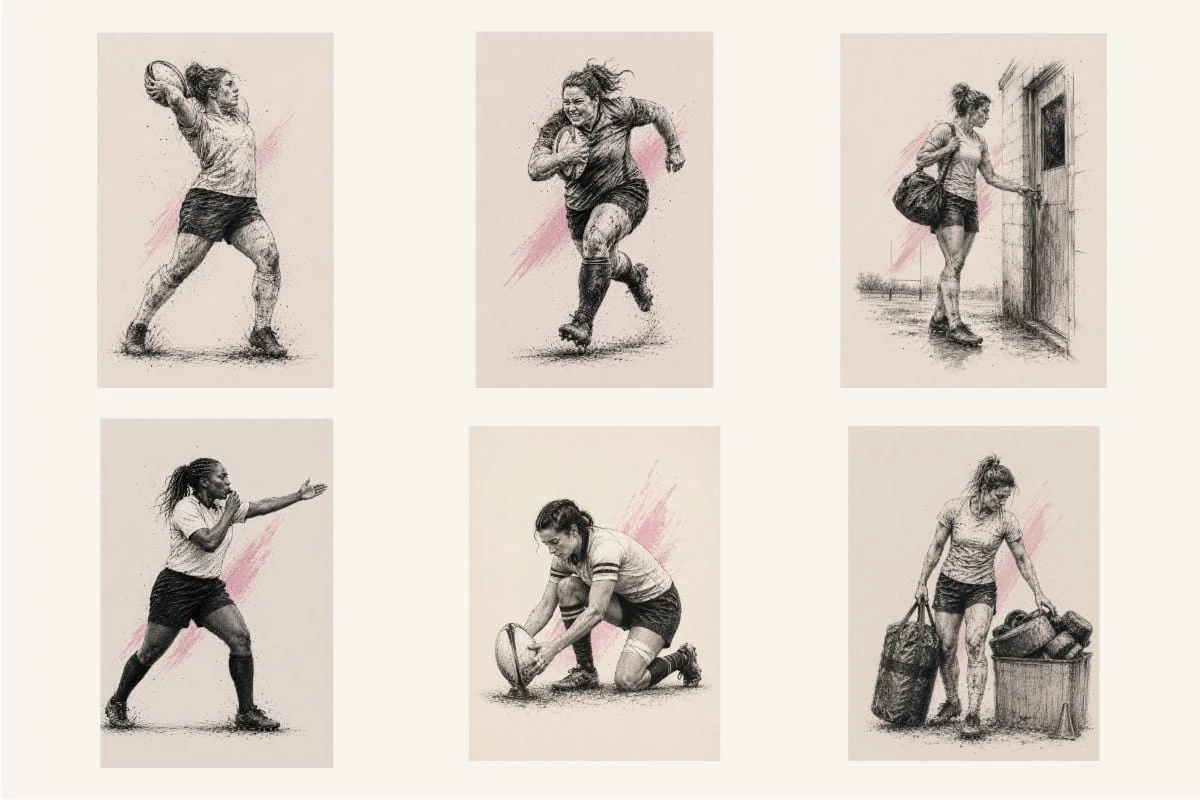
XV Art
Discover the original editorial artwork behind XV Style. Browse the growing XV Art collection or request your favourite illustration as a print or digital download.
The artwork behind the magazine
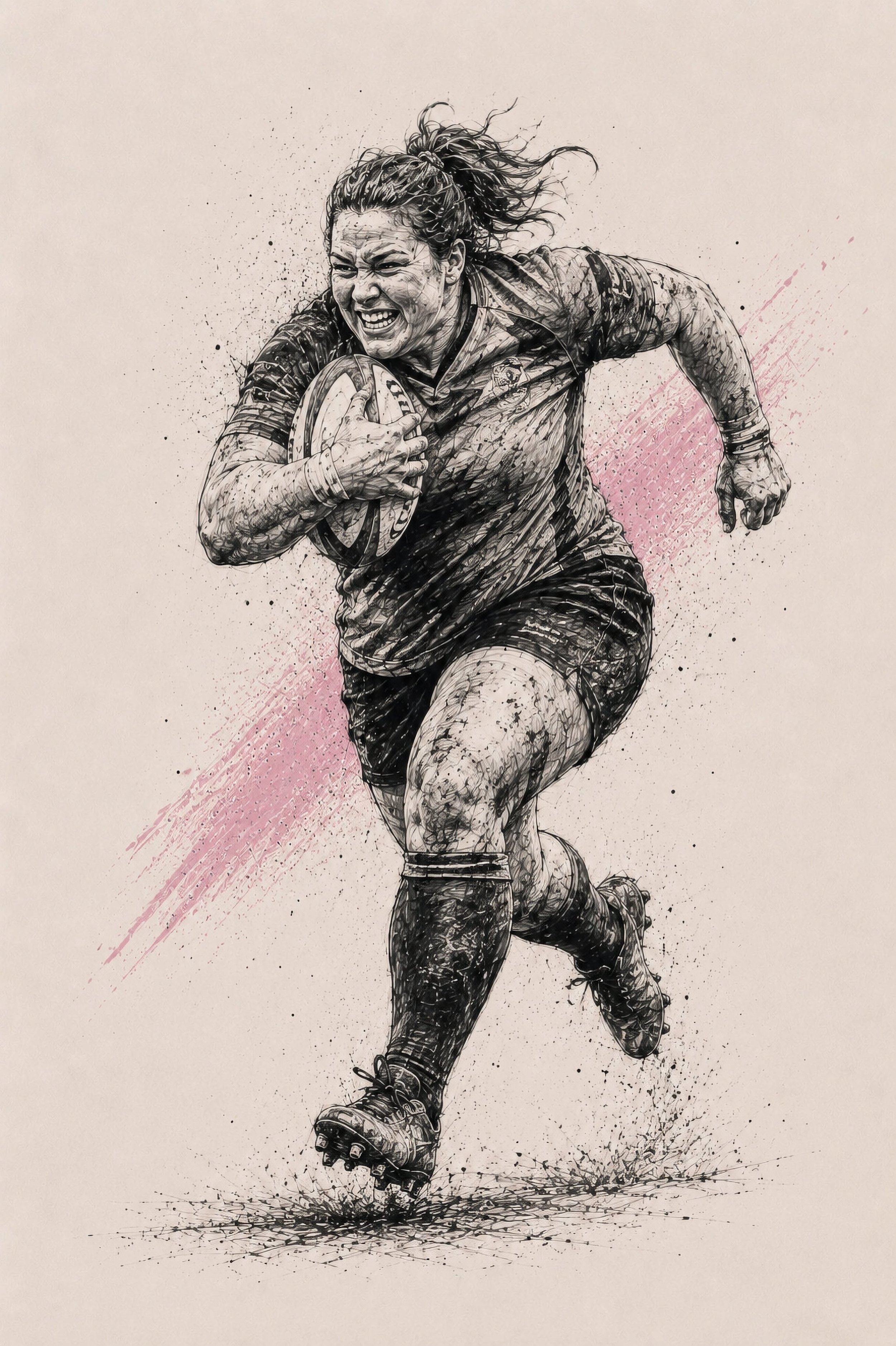


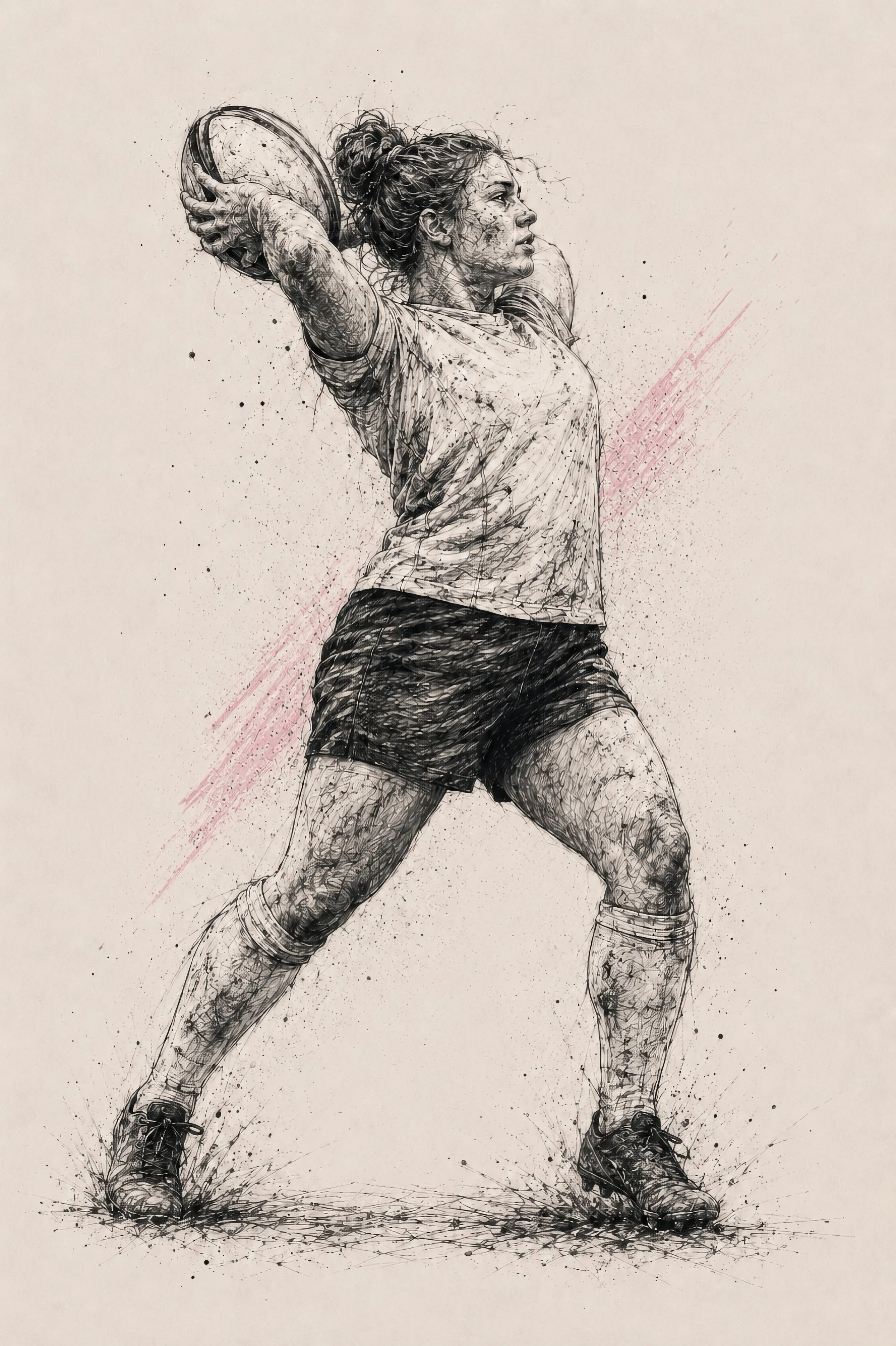
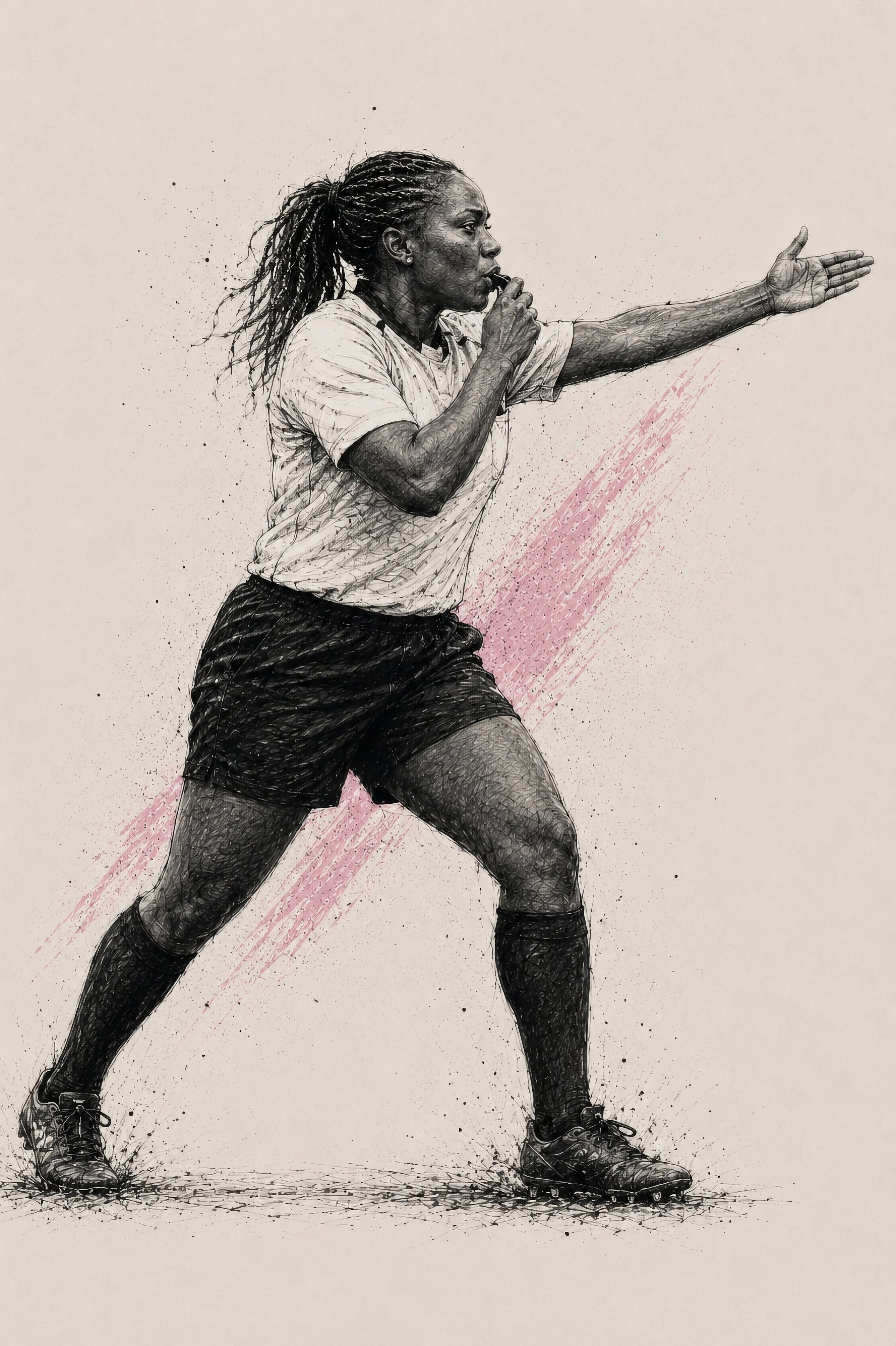
Every issue of XV Style is accompanied by original editorial illustrations, created exclusively for the magazine.
Some explain the game .Some celebrate the people who make rugby possible.
Others simply capture moments, emotions and stories that words alone never quite can.
The illustrations are every bit as much a part of XV Style as the articles themselves, helping to tell the stories of women's rugby in a way that's uniquely ours.
From dramatic matchday moments to simple sketches inspired by the people who make rugby special, every illustration begins life as part of the magazine before becoming part of the growing XV Art collection.
Own a piece of XV Style
The XV Art collection is growing over time, so you may not see every illustration from the magazine just yet.
If one particular piece has stayed with you, we'd love to hear from you. Get in touch and we'll do our best to make it available as a print or digital download.
Every purchase helps keep XV Style free to read while supporting the creation of new stories, original illustrations and independent coverage of women's rugby..
Whether you choose to own a piece of XV Art or simply continue reading the magazine, thank you for being part of the journey.

Support XV Style
XV Style is free to read and independently produced. If you've enjoyed this issue, discover two simple ways to support the magazine and help keep independent women's rugby stories alive.

Apparently I'm supposed to thank people
.
So... thank you.
XV Style is free to read because I believe good rugby stories should be shared, not hidden behind a paywall.
Every issue takes time to research, write, illustrate and publish. If you've enjoyed reading XV Style and would like to help keep it going, there are two simple ways to support it
Buy Gilbert a Coffee.
Help cover the cost of creating future issues.
Own a Piece of XV Art
Own one of the illustrations from the magazine and support independent publishing at the same time.
“I appreciate it. Don’t tell anyone.”

And Finally…
A final thought from Issue 03, celebrating the volunteers, coaches and club heroes who make rugby happen every week.
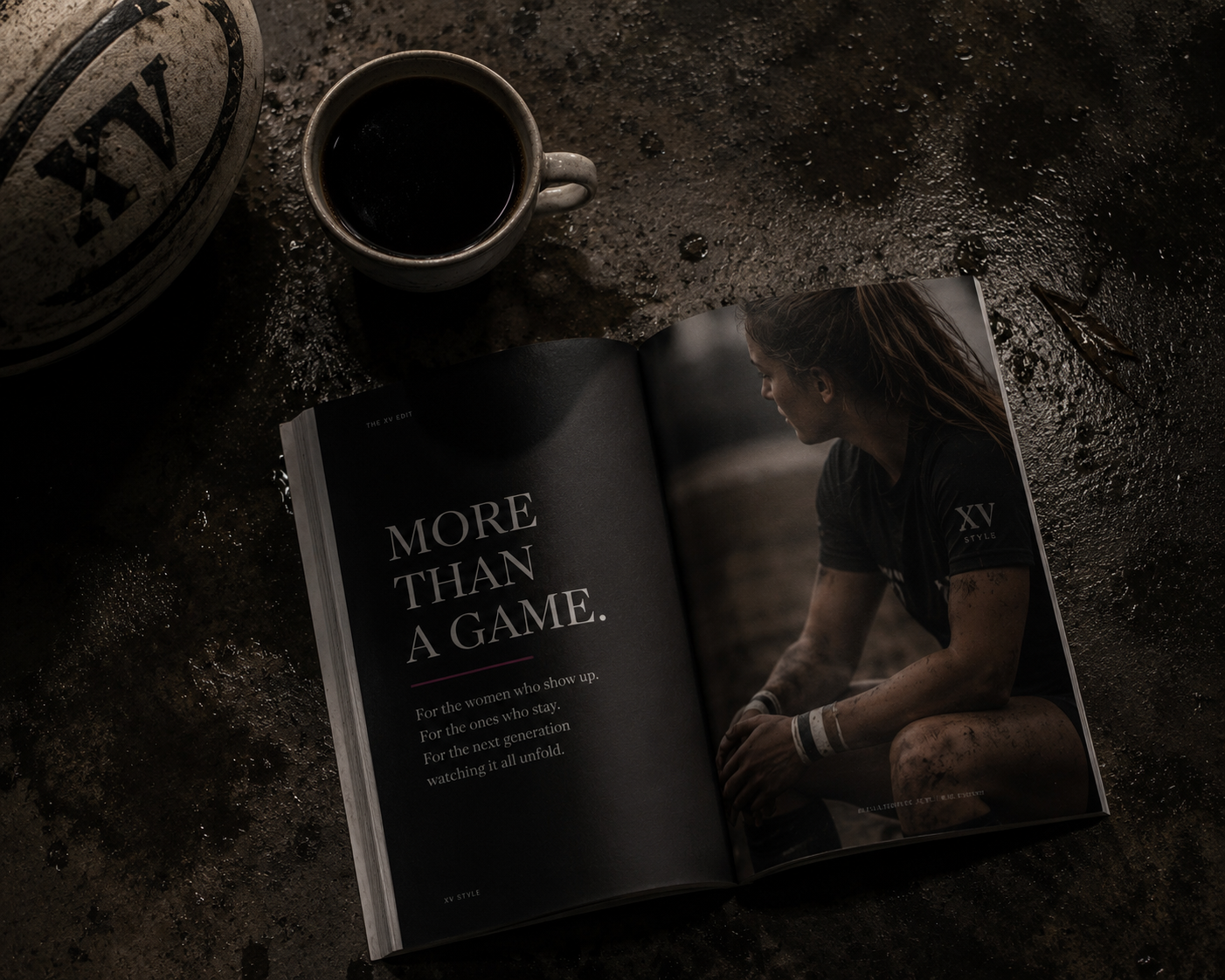
Issue 03 — The Club Hero Edition
This issue wasn't about the players who lifted trophies.
It was about the people who unlocked the clubhouse.
The volunteers who stayed late.
The coaches who came back every Tuesday.
The committee members who quietly kept everything moving.
And everyone who makes rugby happen without expecting recognition.
If this issue made you think of someone at your own club...
...perhaps tell them.
They've probably earned it.