

Before We Begin
Issue 04 looks at the future of women’s rugby — new ways into the game, changing rules, growing communities and the people keeping rugby moving.
There is a moment in every rugby match when everyone knows exactly what they are watching.

The whistle goes
.
The players move.
The ball is passed.
The crowd reacts.
For eighty minutes, the game is right there in front of us.
But rugby has always been more complicated than what happens between the first whistle and the last.
Sometimes the most interesting things are happening just outside the frame.
The people finding new ways into the game. The volunteers quietly keeping clubs going. The decisions that change how players tackle. The technology beneath a pitch that most supporters never think about.
The conversations happening around the game can be just as revealing as the game itself.
That's one of the things we wanted to explore in Issue 04.
Not because rugby needs to be explained.
But because sometimes it is worth looking a little closer.
Women's rugby continues to change at remarkable speed. More people are watching. More opportunities are appearing. More conversations are happening about how the game should grow, who it is for and what it needs to become.
And with that comes a responsibility to keep asking questions.
How do we bring more people into rugby?
How do we make the game safer without losing what makes it rugby?
How do we build clubs where people want to belong?
And what happens when the people who want something to exist decide they aren't prepared to wait for somebody else to build it?
There aren't necessarily simple answers.
There probably shouldn't be.
Because rugby has never stood still.
The game changes. The people change. The way we experience it changes.
What matters is that we keep paying attention.
So, as ever, we've tried to look beyond the obvious.
To the people, ideas, arguments and occasionally questionable decisions that make rugby what it is.
Welcome back.
XV Style.
HELP KEEP XV STYLE FREE TO READ
XV Style is free to read. Keeping it that way isn't free.
We're a one-person, independent women's rugby magazine, made without a publisher or subscription wall. Every issue takes time, work and money to produce.
If you've enjoyed reading XV Style, you can help keep it going by buying Gilbert a coffee. And if you can't, that's absolutely fine — sharing the magazine with a teammate, friend or someone who loves women's rugby helps too.

T1 Rugby: A New Way Into The Game
T1 Rugby offers a new way into the game. We explore how this non-contact format works, how it compares with Tag Rugby, and what it could mean for the future of women’s rugby.
What happens when rugby decides that the best way to grow the game is not to change who plays it — but to change how they enter it?

Rugby has always been a game built around belonging.
For some people, that journey begins in childhood: a first training session, a first team shirt, a first muddy Saturday morning when the game starts to become part of their lives.
For others, the route in looks very different.
It might start from the sidelines, watching someone else play. It might begin with a friend asking, “Do you fancy giving it a go?” It might happen years after the opportunity first appeared. And sometimes, the difference between someone becoming a rugby player and remaining a spectator is simply whether there is a version of the game that feels accessible enough to take that first step.
That leaves rugby with a deceptively simple question: how do you create more moments where someone feels that the game is for them?
T1 Rugby is one answer.
Developed by World Rugby and launched in 2023, T1 is a non-contact adaptation designed to retain many of the characteristics that make rugby union recognisable while removing the physical contact. World Rugby describes it as a format built around the attacking and defensive decision-making of rugby, with scrums, lineouts, kicking and the breakdown still part of the game.
That distinction is important.
T1 is not rugby with the rugby taken away. It is an attempt to create another way into the same game.
Where Did T1 Come From?
When World Rugby introduced T1, the ambition was not simply to create another recreational game with a rugby ball.
The idea was to produce a non-contact format that retained the characteristics of rugby union while making the game easier to approach. The result is a version of rugby in which players still have to read the game, make decisions and work within a structure that feels recognisably like rugby.
That means T1 can look surprisingly familiar to anyone who knows the traditional game.
There are scrums and lineouts. Kicking remains part of the tactical picture, while the breakdown still presents players with decisions to make. World Rugby's own description emphasises that the format retains many of the attacking and defensive aspects of rugby, rather than simply reducing the sport to running and passing.
That is perhaps the most interesting thing about T1.
It isn't asking people to learn a completely different sport and then hoping they eventually discover rugby. Instead, it offers a version of rugby that can meet people somewhere closer to where they are.
T1 Is Not Tag Rugby
For someone encountering T1 for the first time, the obvious comparison is likely to be tag rugby.
Both are non-contact formats, so the comparison is understandable. But they are not trying to do exactly the same thing.
Tag rugby uses a tag attached to the player as the mechanism for stopping the runner. T1 takes a different approach, using touches or flags while retaining considerably more of the structure and decision-making associated with rugby union.
That difference matters.
In T1, the scrum, lineout, kicking and breakdown aren't simply decorative reminders of the full game. They are part of what makes the format feel like rugby. The players are still being asked to read space, make tactical decisions and work together within a game that carries much of the identity of union rugby.
The purpose isn't to suggest that one format is better than another.
It is to recognise that different people may need different doors into the sport.
For one person, tag might be the thing that makes rugby appealing. For another, T1's closer relationship with rugby union might be exactly what makes them want to try it.
Why Does Rugby Need Another Door?
Every player has a first moment.
The first time they pick up a rugby ball. The first time they run onto a pitch. The first time they join a training session and realise that they can actually do this.
But getting to that first moment isn't always straightforward.
Rugby can look complicated from the outside. It has its own language, its own traditions and, in its traditional form, a physicality that can make the game feel like something you have to already understand before you are allowed to belong to it.
That is one reason non-contact rugby matters.
Not because contact rugby needs replacing, but because contact does not have to be the first step for everyone.
T1 creates another starting point. For someone completely new to the sport, it can be an introduction. For someone returning after time away, it can provide a way back. For existing players, it can offer another way to enjoy the game without the physical demands of contact.
And that opens up a bigger idea about what “growing the game” actually means.
It isn't only about finding the next generation of elite players.
It is about creating more opportunities for people to discover rugby in the first place — and then giving them somewhere to go once they have found it.
England's T1 Story
That idea is already becoming part of rugby's approach to schools in England.
The RFU began rolling out T1 in schools in 2024 as part of a wider attempt to broaden rugby's reach, particularly into schools without an established rugby tradition. The programme is supported by a national network of School Rugby Managers, whose role includes helping schools introduce rugby, supporting teachers and building stronger links between schools and local clubs. The RFU has set an ambition of reaching an additional 5,000 state primary and secondary schools by 2027.
The early numbers give some sense of the scale.
In the 2024–25 season, T1 reached 1,800 schools and around 80,000 students, with participation reported as being close to evenly split between boys and girls.
That is significant not simply because of the number of schools involved, but because of what it represents.
A school does not have to begin its rugby journey by putting a full contact team onto a pitch.
It can begin with T1.
A teacher who might not feel confident delivering traditional rugby has a simpler starting point. A pupil who might never have considered rugby can pick up a ball without needing to enter a contact environment. And a school can begin building a relationship with a local rugby club from there.
The RFU's School Rugby Manager network is intended to help make that connection more sustainable, rather than leaving schools to introduce the game in isolation.
That is where T1's role becomes bigger than the format itself.
It becomes a pathway.
A Global Movement
What began as a new approach to non-contact rugby is now spreading well beyond England.
Since its launch in 2023, T1 has been played or trialled by more than 90 national unions, according to World Rugby's Development Director Jason Lewis.
That is a remarkable amount of movement for a format only a few years old.
And the reason for that growth is relatively easy to understand. T1 can be adapted to different environments while retaining the fundamental characteristics of rugby. It can be used in schools, clubs and community settings, and it can bring new players into the sport without asking them to begin with the most physically demanding version of it.
The latest example comes from the United States.
In August 2026, USA Rugby and USA Youth & High School Rugby formally adopted T1 as the country's official non-contact adaptation of rugby. The move is explicitly linked to growing grassroots participation ahead of the men's Rugby World Cup in 2031 and the women's Rugby World Cup in 2033, both of which will be staged in the United States.
For the organisations behind the move, T1 is not simply another version of the sport.
It is being positioned as a way of introducing rugby to new communities, schools and youth programmes — and then creating a pathway from that first experience into clubs and ongoing participation.
That makes the American adoption particularly interesting.
A format created to answer one question — how do we make rugby easier to enter? — is increasingly being used as part of a much bigger question about how rugby grows.
But A New Game Needs Somewhere To Go
And this is where things get really interesting.
Because creating new players is only the beginning.
Eventually, people want to play.
They want opposition. They want fixtures. They want something to train for. They want to pull on a shirt and know that there is a reason to be there on a Sunday morning.
A pathway only works if there is somewhere for people to go next.
That is the challenge facing any attempt to grow participation. You can introduce somebody to a game, but if their next experience is “Great — now what?”, the opportunity can disappear almost as quickly as it arrived.
In the East Midlands, two women decided not to wait for someone else to provide the answer.
Lou and Ally had discovered T1 Rugby and helped build a community around it. But there was a problem. There was enthusiasm, there were players and there was a desire to keep playing — but there was no regular competition for them to enter.
So they decided to build one.
The Midlands East Ladies T1 League begins in September 2026, creating a competitive environment in which clubs and players can continue their journeys, develop their skills and experience something that every new rugby player eventually wants: a game to look forward to.
It is a small example of a much bigger point.
Rugby growth doesn't always begin with a major announcement from a governing body.
Sometimes it begins with a group of people looking at what exists, seeing what is missing and asking a very simple question:
Why not?
That is what makes T1 interesting.
The rules matter. The scrums matter. The lineouts matter. The fact that it still feels like rugby matters.
But ultimately, the real test of any new pathway is what happens after someone walks through the door.
Can they find a team?
Can they find a community?
Can they find a reason to keep coming back?
Lou and Ally's story suggests that sometimes the answer is to build the next step yourself.
Read more about Lou and Ally's journey in In Profile: From Sideline Mums to League Founders.
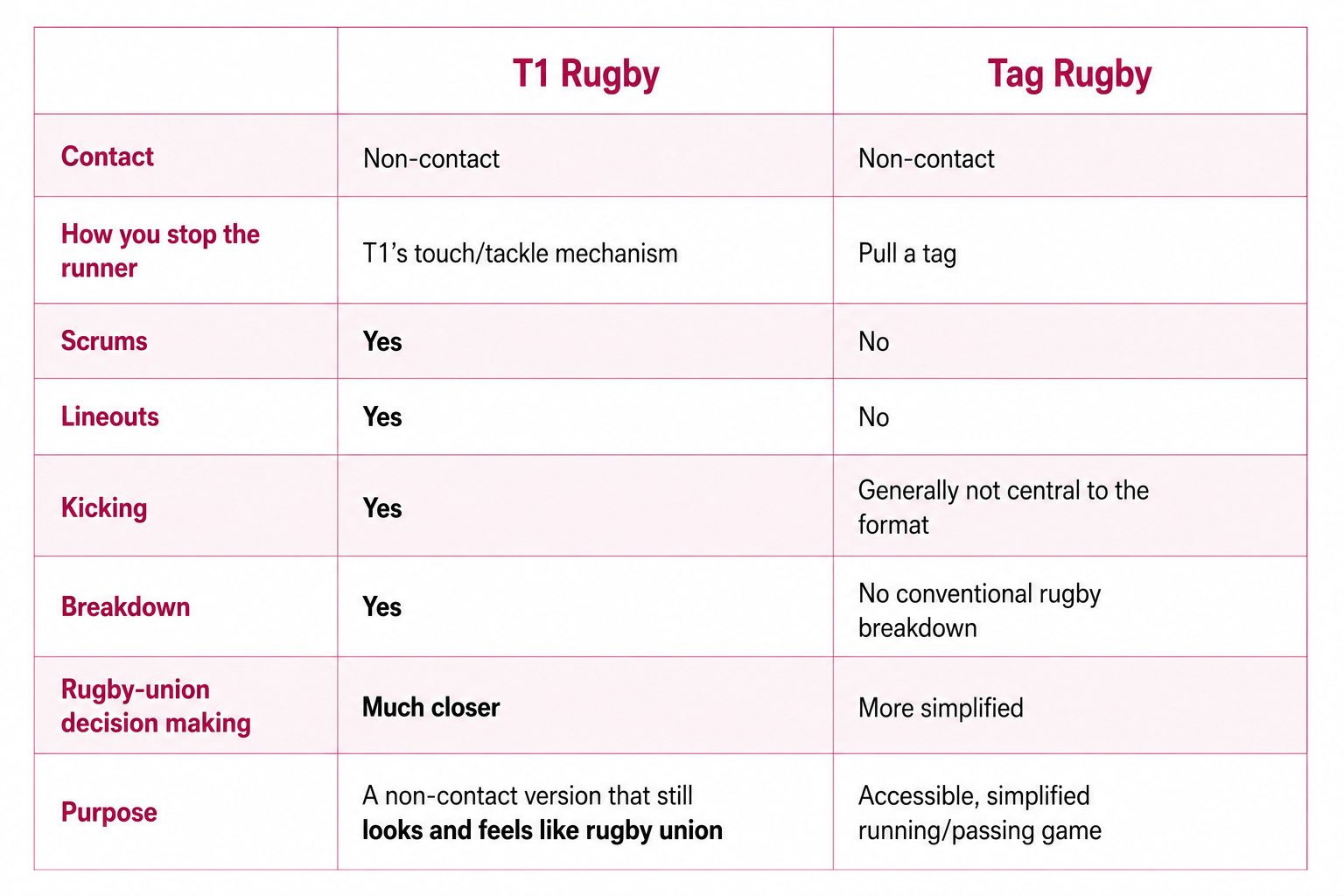
So what actually makes T1 different? Here's the format at a glance.
T1 Rugby: at a glance.
FIND OUT MORE
Curious about T1? England Rugby has a collection of resources explaining how the format works, how to play it and how clubs, schools and communities can introduce it.

From Sideline Mums to League Founders
Meet Louise Caller and Alexandra Hawley, the women behind the Midlands East Ladies T1 League, creating new opportunities for women and girls to play rugby.
Three years ago, they were the people standing on the sidelines. This September, they will stand at the centre of something they built themselve.
In Profile — Louise Caller & Alexandra Hawley.

Three years ago, Ashby RFC did not have a women’s rugby team.
What it did have was a familiar grassroots rugby scene: parents gathered at the side of the pitch every weekend, watching their children play.
But behind that was a challenge facing many grassroots clubs — creating a pathway for girls and women who wanted to continue their rugby journey.
Among them were Claire, Lou and Ally.
They arrived as mums supporting their children.
Then came the question that changed everything:
What if they tried it themselves?
“Three years ago, Ashby RFC did not have a women’s rugby offering,” says Lou. “What began as a group of mums standing on the sidelines supporting our children soon turned into a conversation about giving rugby a try ourselves.”
The first step was simple — a free six-week Saturday morning women’s rugby fitness programme.
No expectations.
No pressure.
Just an invitation to try something new.
Led by Claire and Dyl Kurpil, the programme was the first step in creating a women’s pathway at Ashby RFC — giving women in the local community the opportunity to experience rugby in a welcoming environment and take their first steps into the game.
Many of the women involved had never picked up a rugby ball before.
“We hoped a few people might be interested,” says Lou, “but the response exceeded all our expectations.”
The Ashby Bullettes were born.
Finding Their Place
For Ally, that first session represented more than just trying a new sport.
Her eldest child had been playing rugby at Ashby for some time, and when she saw the six-week trial advertised through the age-grade WhatsApp group, it felt like an opportunity to meet people locally and try something different.
“Turning up to a large group of women for the first time was honestly daunting,” says Ally. “But everyone was so welcoming. I loved learning something new and having a space that was just for me.”
For many women, especially those discovering rugby later in life, finding a place to belong can be just as important as learning how to pass or score.
“Rugby really is a sport for everyone, and it has given me so much,” says Ally. “It’s hard to make new friends in your 30s, everyone’s busy and life moves fast, but having something that’s yours matters.”
“These ladies became the women I didn’t even know I needed.”
Around the same time, T1 Rugby was emerging as another way into the game — keeping the shape, skills and traditions of rugby union while removing the contact.
For a group of women discovering rugby for the first time, it offered the perfect introduction.
“We gave it a try and immediately fell in love with it,” says Lou.
The journey quickly became bigger than Saturday mornings.
The Bullettes even had the opportunity to play at Twickenham as part of a T1 showcase event.
But T1 became more than just a starting point.
For some players, it became a pathway towards contact rugby.
For others, it remained the place where they built confidence, learned new skills and found their rugby home.
“T1 strengthened our contact offer rather than competing with it,” explains Ally. “Both formats work hand in hand.”
ENJOYING THIS STORY?
Join XV and every new issue of XV Style arrives by email, ready to read wherever you are.
Completely free. No paywall. Just thoughtful women's rugby stories, delivered free.
When The Opportunity Didn’t Exist, They Created It
There was just one thing missing.
Somewhere regular to play.
The Bullettes had found their team.
They had found their community.
They had found women who wanted to keep playing.
But fixtures were difficult to find.
“I quickly got involved in organising socials, tour, and most importantly, T1 fixtures,” says Ally. “They were incredibly hard to find.”
The group searched wherever they could.
They contacted clubs.
They posted in WhatsApp groups.
They reached out through social media.
Many teams had never heard of T1. Others were unsure about giving it a try.
But gradually, clubs began to join them.
Ashbourne, Long Eaton, Leicester Forest and Vipers all stepped forward, helping create more opportunities for women to experience the game.
But it still was not enough.
The build-up to fixtures was exciting, but afterwards the same question remained.
What next?
The women had found a love for rugby.
They needed something to play for.
So Lou and Ally stopped waiting for someone else to create it.
They built it.
“My friend and fellow Team Manager, Ally, and I have very recently established the Midlands East Ladies T1 League, which is due to commence in September 2026,” says Lou.
What started as a conversation between teammates has grown into a competition involving eight clubs across the region.
Fixtures will run home and away each month from September through to May, with results recorded in a league table and an awards ceremony bringing the season to a close in July.
But for Lou and Ally, the league is about much more than scores and standings.
It is about creating the opportunity they were looking for when they first stood on that sideline.
A place to belong.
More Than A Game
“Who doesn’t like a bit of competition every now and again,” says Ally, “but the real reason is giving more women the chance to show up and be part of something.”
Because that is what rugby has given them.
Friendships.
Confidence.
A community they never expected to find.
Neither Lou nor Ally imagined any of this when they walked into that first Saturday morning session.
“Never,” admits Lou. “At that point we’d never even heard of T1 rugby, and many of us had never thrown a rugby ball.”
What began with a few women wondering if they could play rugby quickly became something much bigger.
“It just seemed to naturally snowball into something special,” says Ally. “Wonderful ladies kept joining week after week, and that’s still the case today.”
Eventually, another question emerged.
Were they actually any good at this T1 rugby malarkey?
“Turns out,” laughs Lou, “we’re not bad. Not bad at all.”
Just Take The First Step
So what would they say to a woman thinking about trying rugby for the first time?
“Do it. Be brave,” says Ally. “It’s liberating, all-inclusive, and a great opportunity to put yourself first — with a world of opportunities open to you on and off the pitch.”
And perhaps that is the lesson from Lou, Ally and Claire’s journey.
You do not always need to know where something will lead.
Sometimes you just need to turn up.
“Our social calendar is as busy as our league fixtures,” says Lou
Because sometimes the first step into rugby is simply finding a group of people who make you want to come back next week.
And sometimes, those people become the family you never realised you needed.
The Midlands East Ladies T1 League
A new competition creating more opportunities for women to play T1 Rugby.
Launching: September 2026
Format: Home and away fixtures running from September to May
Teams involved:
Ashby RFC
Long Eaton Rugby Club
Hinckley RFC
Leicester Forest RFC
Vipers RFC
Sileby Town RFC
Notts Casuals RFC
East Leake
The season will conclude with an awards ceremony in July.
Find Out More
Ashby RFC Bullettes
Want to follow the team featured in this story?
Website:
ashbyrfc.co.uk
Instagram:
@ashbybullettes
Facebook:
Ashby RFC Bullettes
Email:
ladies@ashbyrfc.co.uk.

Help keep XV Style free to read
Talking Rugby
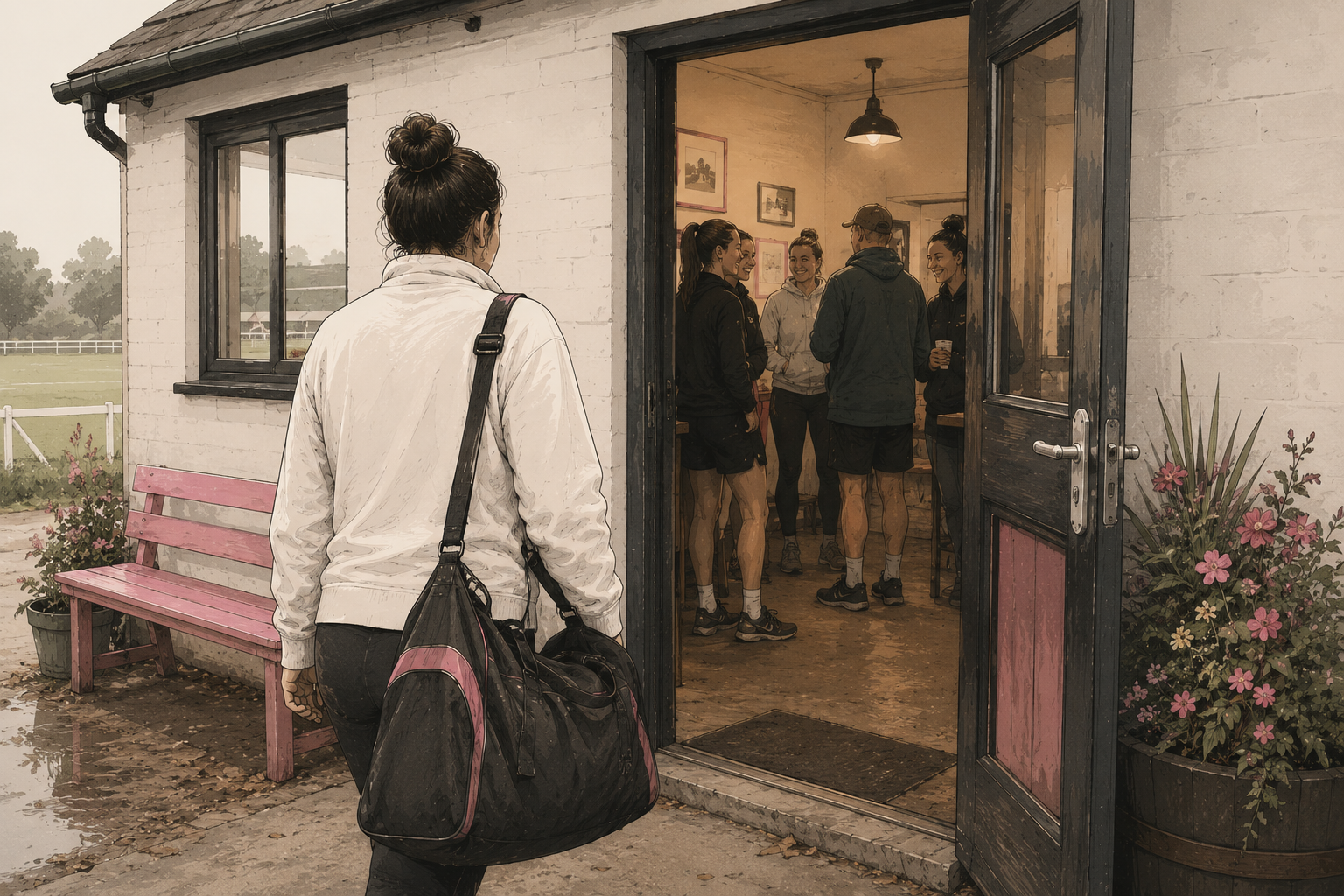
Why rugby club culture matters, and why creating welcoming, inclusive spaces is about more than having the right policies in place.
More Than a Policy
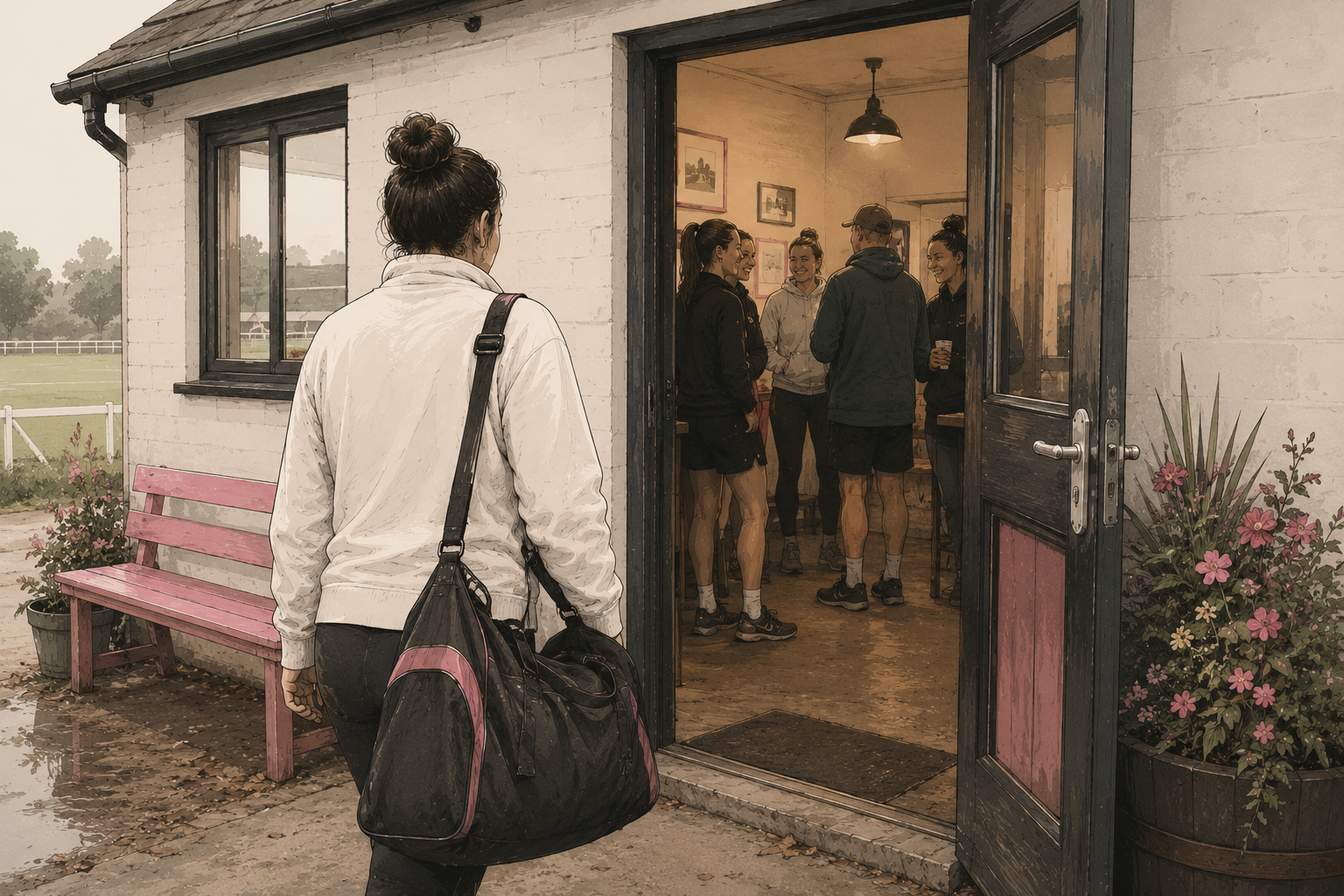
Every rugby club has a culture, whether it has consciously tried to create one or not.
It is there in the way a new player is welcomed on their first training night, in the language used in the changing room and in the confidence someone feels when they walk through the clubhouse door for the first time. It is there in the way coaches speak to players, the way teammates look after one another and the way volunteers make people feel that they are part of something rather than simply passing through it.
Culture is not something that exists only in a club's constitution or on a noticeboard. It is created, often quietly, by the people who make up the club.
That makes the RFU's new Way of the Rose vision particularly interesting. Announced in August 2026, the plan sets out the RFU's ambition to realise the social inclusion and environmental potential of rugby in England, with community clubs central to that ambition. The intention is not simply to grow the game, but to help create the conditions in which clubs can continue to thrive and have a positive impact on the communities around them.
It is an important distinction.
Growing participation is relatively easy to describe. Getting more people through the gate, more children into schools programmes or more players registered with clubs gives us numbers that can be measured. But numbers only tell part of the story. The more difficult question is what happens once somebody arrives.
Do they feel welcome?
Do they feel that the club is somewhere they can belong?
And, perhaps most importantly, do they have a reason to come back?
Those questions matter because rugby clubs are more than places where matches are played. They are social spaces, community organisations and, for many people, an important part of their identity. A club can provide friendship, confidence, routine and a sense of belonging that extends well beyond the pitch.
That is why inclusion cannot simply mean opening the door.
The door has to feel genuinely open.
A player who is invited to join a training session but spends the evening feeling like an outsider has technically been included, but the experience may tell them something very different. Equally, a club can have all the right policies in place and still have a culture that makes some people reluctant to return.
This is where the difference between policy and culture becomes important.
Policies have a purpose. They establish expectations, give people a framework to work within and provide clubs with guidance on issues that matter. The RFU's approach recognises that community clubs need resources and support if they are going to create the strongest possible foundations for future growth.
But a policy cannot greet a new player at the door.
It cannot notice that someone is standing on their own after training.
It cannot decide whether a joke has gone too far, whether a new volunteer feels valued or whether a player who has never played rugby before feels confident enough to come back next week.
People do that.
And that is where the everyday culture of a club becomes so important.
The most meaningful changes are often the least visible. They happen when an experienced player takes the time to explain something rather than assuming everyone already understands it. They happen when a coach creates an environment in which questions are encouraged rather than dismissed. They happen when volunteers recognise that the person making the tea, running the junior section or helping behind the scenes is just as much part of the club as the players on the pitch.
None of those moments are likely to make a national headline.
Collectively, however, they determine what a rugby club feels like.
There is also a wider question about who gets to see themselves in rugby's future. Women's rugby has demonstrated what can happen when opportunities are created and people are given the chance to participate, develop and lead. The progress of the women's game has not happened because of one decision or one strategy. It has been built by thousands of people creating teams, coaching players, volunteering, organising competitions and encouraging the next person to get involved.
That same principle applies across the game.
If rugby is serious about becoming more inclusive, responsibility cannot sit entirely with the RFU or with individual club committees. The governing body can provide the framework and the resources, but the experience of rugby is ultimately created at ground level.
It is created on Tuesday evenings and Saturday mornings.
It is created by coaches, players, parents, volunteers and supporters.
And it is created in all those small interactions that rarely appear in a strategy document but which can make the difference between someone deciding that rugby is not for them and deciding that they have finally found somewhere they belong.
Perhaps that is the real test of the Way of the Rose over the years ahead.
Not simply how many plans are published, how many initiatives are launched or how many targets are reached, important though those measures may be.
The more meaningful measure may be much simpler.
Someone walks into a rugby club for the first time.
They look around.
They meet some people.
They give it a try.
And when they leave, they are already thinking about coming back.
Because ultimately, an inclusive rugby club is not one that simply tells people they are welcome.
It is one that makes them feel it.
FIND OUT MORE:
The RFU's Way of the Rose sets out its vision for a more inclusive and sustainable future for rugby in England.
WHAT THE RUCK?
Three years after rugby began lowering the legal tackle height, we look at what changed, what the evidence tells us, and what the new tackle law means for the game.
The Tackle Has Changed.
Three years after rugby began lowering the legal tackle height, the evidence is starting to show what happened next.
You probably didn't notice the moment rugby changed.
There was no dramatic announcement during a Six Nations match. No stadium clock stopped. No player walked onto the pitch with a new piece of equipment.
Instead, one of the most instinctive skills in rugby began to change quietly, training ground by training ground, match by match.
The tackle.
For generations, players had been taught to meet the ball carrier, make contact and wrap. It was one of the fundamental skills of the game, learned through repetition until technique became instinct.
Then rugby started asking players to change where that contact happened.
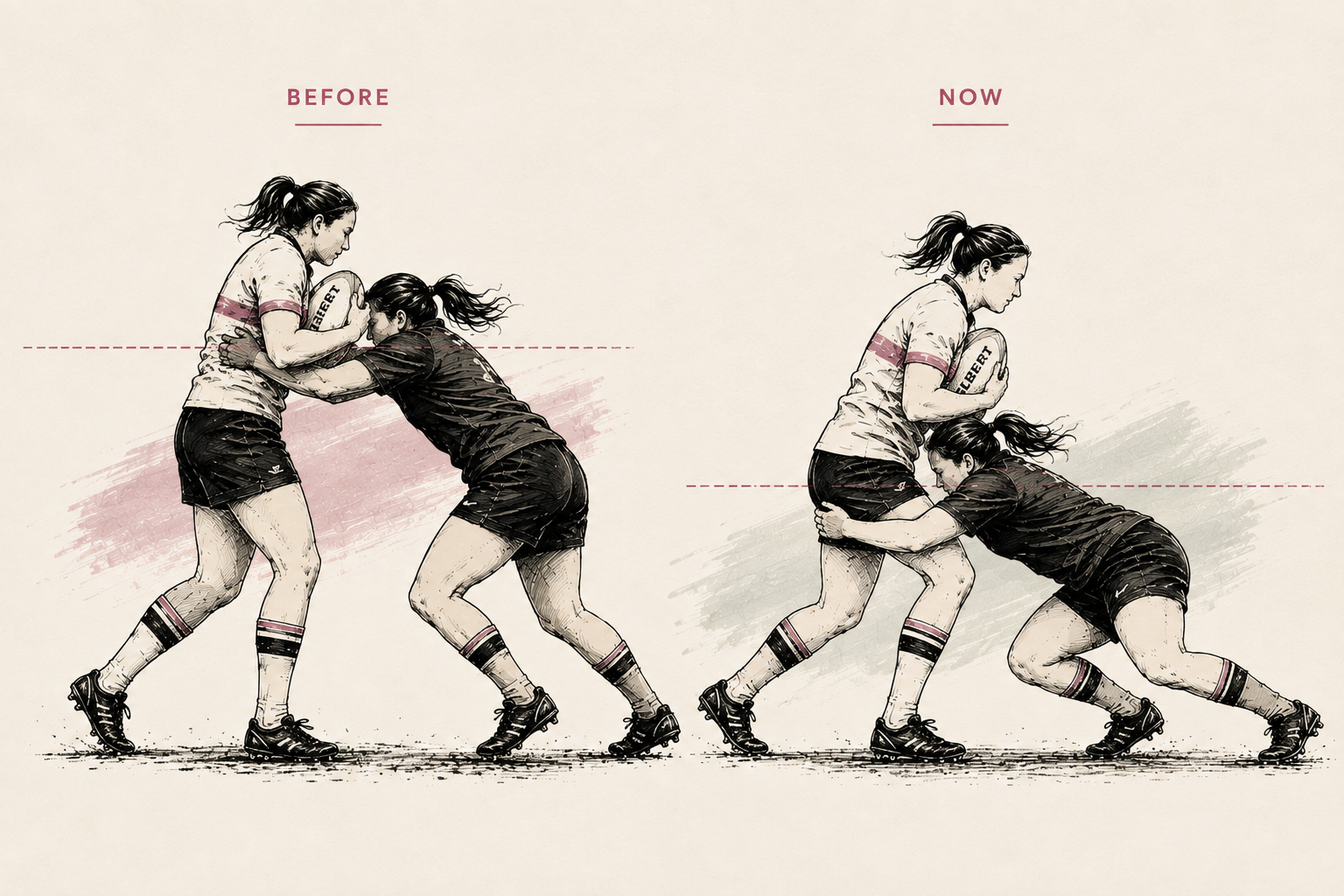
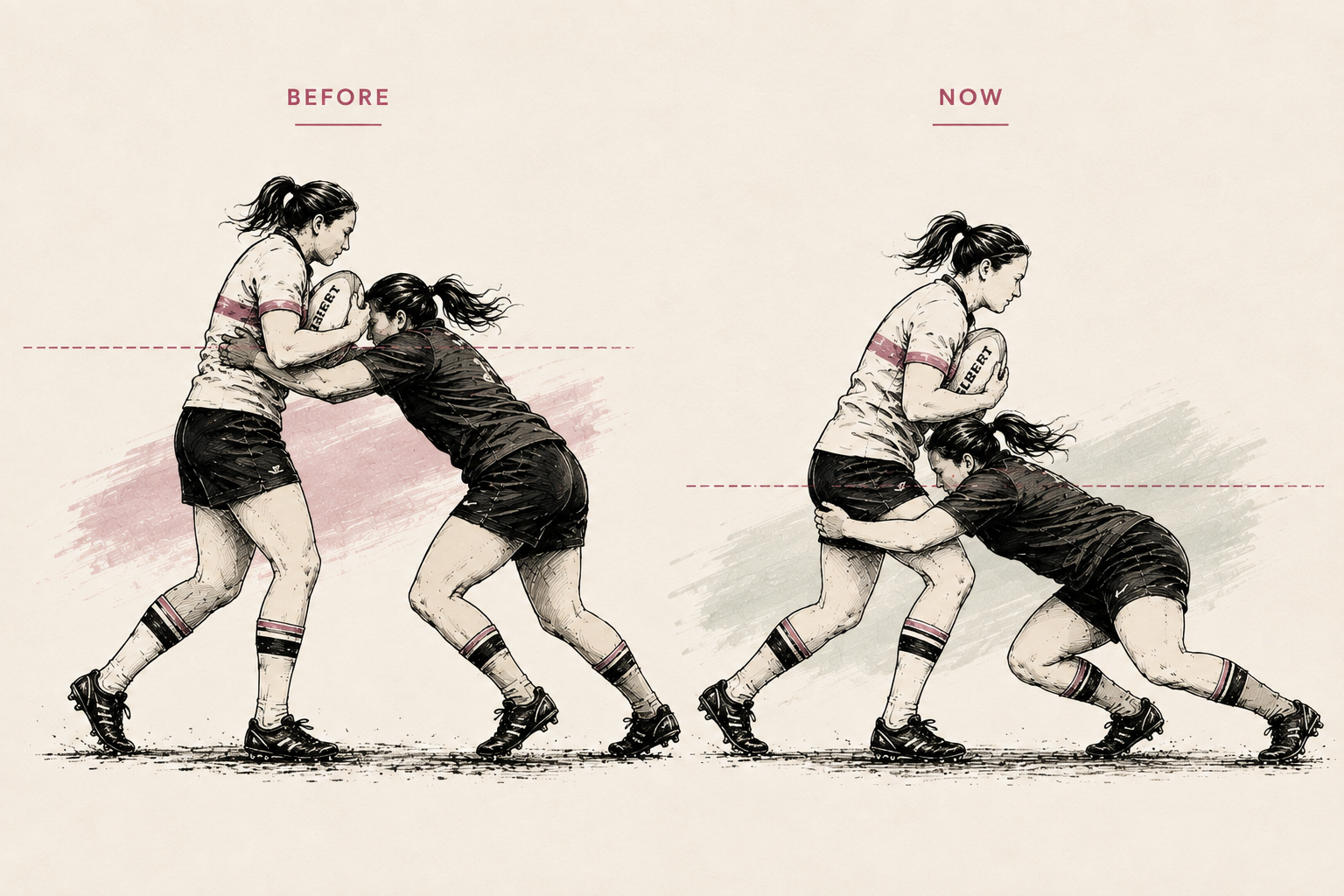
In community rugby, the legal tackle height was lowered, moving the target away from the upper body and towards the waist or the base of the sternum. In England, the RFU had already introduced the lower tackle-height approach in 2023. Now, in June 2026, World Rugby has taken the measure from trial to full community law. From 1 July, unions can choose either the waist or base of the sternum as the maximum legal tackle height.
The reasoning is straightforward. If the tackler goes lower, the two players' heads should be further apart.
But changing a law is one thing.
Changing the way people play the game is another.
Three years on, we are beginning to see what that change has actually done.
The Shape Of The Tackle
The most important thing about the lower tackle law may not be what referees are penalising.
It may be what players are doing differently.
World Rugby's trials, involving more than 170,000 tackles across 11 unions, found a consistent change in tackler behaviour. In men's community rugby, the proportion of upright tacklers fell from 36% to 29%. In women's rugby, it fell from 51% to 44%. The overall shape of the game remained broadly intact, with tackle numbers, tackle success and what happened after the tackle not fundamentally changing.
That matters.
The purpose of the law was never to remove the tackle from rugby. It was to change the circumstances in which it happens.
The evidence suggests players have responded.
Instead of arriving upright, more tacklers are entering contact with a lower body position. The target has moved, and the technique has followed it.
Research from Scottish community women's rugby tells a similar story. After the maximum tackle height was lowered to below the base of the sternum, researchers analysed more than 11,000 tackle actions across two seasons. Upright tackling reduced, while tackles made with the tackler bent at the waist increased. Contacts above the sternum also fell.
Perhaps most significantly, the researchers found reductions in the proximity of the tackler's and ball carrier's heads and shoulders.
In other words, the change was doing what it was intended to do.
It was changing the amount of shared head space in the tackle.
So, Has Rugby Become Safer?
This is where the story gets more interesting.
For a while, the evidence around lower tackle height was largely about behaviour. Players were tackling differently. High and upright tackles were reducing. That was encouraging, but it did not automatically prove that fewer injuries would follow.
Now we have stronger evidence.
A new Irish study, published in the Journal of Science and Medicine in Sport in June 2026, examined almost a decade of injury surveillance data. Researchers analysed approximately 86,000 hours of match play, more than 3,700 injuries and data from 239 men's, women's and schoolboy teams involving more than 8,800 players. Crucially, they were able to compare five seasons before the law change with two seasons afterwards.
The results were striking.
Among amateur women's rugby players, concussion rates fell by 63% after the lower tackle height was introduced. Among amateur men, concussion rates fell by 38%. Overall injury rates also fell in the adult game.
For a sport that has spent years looking for practical ways to reduce concussion risk, those numbers are difficult to ignore.
And the women's result is particularly significant.
Women's rugby has expanded rapidly, bringing more players into the game and increasing the importance of understanding how changes to the laws affect women specifically. The Scottish research had already shown that lowering the tackle height could reduce head contact and head proximity in women's community rugby. The Irish research now provides much larger-scale evidence of a substantial reduction in concussion rates among adult women.
That does not mean the tackle has suddenly become safe.
It means there is increasingly persuasive evidence that changing the tackle can reduce some of the risks associated with it.
But The Evidence Isn't Simple
There is an important reason not to turn those numbers into a victory lap.
The Irish study also looked at schoolboy rugby. Overall injuries fell by 19%, but there was no statistically significant reduction in concussion rates among school players.
That doesn't necessarily mean the lower tackle height doesn't work for younger players. It means the evidence is less conclusive, and the researchers point to possible differences in physical development, technique and playing characteristics as areas that need further investigation.
The Scottish women's study reached a similarly cautious conclusion. It found clear changes in tackle behaviour and reductions in head contact and head proximity, but it did not find a statistically significant reduction in concussion during the two seasons studied. The researchers explicitly called for further injury surveillance.
That distinction matters.
A change in behaviour is not automatically a change in injury rates.
But when behavioural change is accompanied by encouraging injury data from a much larger study, the picture begins to look considerably more promising.
The Ball Carrier Matters Too
There is another part of the change that is easy to miss.
Lowering the tackle doesn't only ask something of the person making the tackle. It can also affect the person carrying the ball.
The new community law recognises that relationship. World Rugby's wording gives the ball carrier a responsibility to enter the tackle safely, and the optional Game On variations allow match organisers to sanction a ball carrier who significantly lowers their height into dangerous contact.
It makes sense when you think about the mechanics.
If the tackler learns to go lower but the ball carrier suddenly drops their body height immediately before contact, the two players can still end up occupying the same dangerous space.
The aim, therefore, isn't simply to make everyone shorter at the moment of impact.
It is to change the shape of the collision.
That is a much more sophisticated proposition than simply saying: tackle lower.
A Law Change Becomes A Habit
There is also something fascinating about what this tells us about rugby itself.
Law changes can look very different on paper from how they feel on a training pitch.
A referee can blow a whistle and penalise a tackle above the permitted height. But ultimately, the law only succeeds if players stop thinking about the old version of the tackle and start instinctively performing the new one.
That is what the evidence increasingly suggests is happening.
The lower tackle has moved from a rule that players had to remember into a technique they are learning.
The upright tackle is becoming less common.
The lower body position is becoming more familiar.
The point of contact has moved.
And, in doing so, the game has demonstrated something rugby has sometimes been reluctant to acknowledge: changing a fundamental skill does not necessarily mean changing the character of the sport.
The tackle is still there.
The physical contest is still there.
Players still have to stop one another.
But the game is asking them to do it differently.
From Trial To Law
That is why World Rugby's decision on 17 June 2026 matters.
After two years of community trials involving more than 150,000 tackles in the original evaluation — with subsequent analysis expanding the dataset further — World Rugby Council approved the lower tackle height as full community law. The measure takes effect from 1 July 2026 for seasons beginning after that date, with unions able to choose between the waist and base-of-sternum heights.
This is no longer an experiment.
It is part of the way community rugby is being played.
And that makes the question slightly different now.
We're no longer asking whether rugby could change the tackle.
It has.
We're asking what happens next.
Because the most interesting thing about the lower tackle law may ultimately be less about the height of the tackle itself and more about what happens when an entire sport decides that one of its most instinctive skills needs to be relearned.
So far, the evidence suggests players can adapt.
The evidence also suggests that, at least in adult community rugby, that adaptation may be reducing concussion and injury.
There are still questions to answer, particularly around younger players and the long-term effects.
But three years after rugby began asking players to tackle differently, one thing is becoming clear.
The tackle has changed.
And for once, changing the way rugby is played may be helping preserve the part of the game that matters most: letting people keep playing it.
SOURCES
World Rugby — Lowering the legal tackle height in community rugby
World Rugby Passport — 2026 community tackle-height law wording
Journal of Science and Medicine in Sport — Tackle behaviour trial lowers concussion and overall injury rates: A seven-season prospective study in adult men's, women's and schoolboy rugby union
British Journal of Sports Medicine / PubMed Central — Scottish community women's rugby tackle-height research

Anonymous 15: Playing Away
Every rugby club has one away trip nobody talks about. Anonymous 15 looks at rugby’s unwritten laws, terrible decisions, club gossip and the stories that never stay secret.
Anonymous 15 knows there are two things every rugby player lies about.
The first is how many drinks they had.
The second is what happened on away fixtures.
I’ve played rugby long enough to know that every club has one away trip nobody talks about.
Not because it was traumatic.
Because nobody wants to explain it to new members.
Every season somebody asks:
“Why aren’t we allowed back in that pub?”
And every season somebody replies:
“Long story.”
It never is.
It’s usually quite a short story.
The problem is that it reflects badly on everybody involved
.
There are players who think what happens on away fixtures stays on away fixtures.
This is adorable.
The front row had screenshots before the coach got home
.
At some point during every away trip somebody says:
“Nobody tell the club.”
This statement has a success rate of approximately zero percent.
By Monday morning, the club knows. The opposition knows. The referee knows. Somebody’s mum knows.
The club dog probably knows.
The only people who don’t know are the two players at the centre of the story
.
Away fixtures have their own laws of physics.
A player can lose her boots, dignity and relationship status in a single evening, yet somehow still be selected the following week.
Try doing that in an office
.
I’ve seen things.
Good things.
Bad things.
Things that resulted in emergency committee meetings.
Things that resulted in emergency apologies.
Things that resulted in entirely new sections being added to the club constitution.
There is at least one rugby club in Britain operating under a rule that exists because somebody once said:
“Technically, nobody told us we couldn’t.”
Then there are the romances.
Not real romances.
Rugby romances.
The sort that begin with:
“We’re just sharing a taxi.”
And end six months later with two transfers, one awkward presentation evening and a social media statement nobody asked for
.
Every squad has one player who believes she is excellent at keeping secrets.
She isn’t.
I’ve seen international intelligence operations conducted with less information leakage than a women’s rugby squad.
The front row knew.
The replacements knew.
The physio knew.
A retired club volunteer who lives three counties away somehow knew.
Somebody’s mum knows because she accidentally got added to the WhatsApp group in 2021 and nobody has worked out how to remove her.
The only people still conducting a covert operation were the people involved
.
The most dangerous sentence in rugby is:
“It’ll be fine.”
Nothing good has ever followed.
Not once.
Not in the history of the sport.
“It’ll be fine” is responsible for:
missed kick-offs,
lost room keys,
unexpected tattoos,
disciplinary hearings,
and at least one player appearing in three different towns wearing a used jockstrap on her head that she found at the back of the bus.
I will not be elaborating.
People think rugby clubs are held together by shared values.
They’re not.
They’re held together by mutually agreed silence.
Entire friendships have been built on:
“I’ll never mention that again if you don’t.”
And that’s the thing about away fixtures.
The results disappear.
Nobody remembers who finished seventh in the league in 2022.
But twenty years from now, somebody will still lean across a bar and ask:
“Do you remember that away trip?”
The table will go quiet.
Somebody will start laughing.
Somebody else will say:
“Oh God.”
And a third person will immediately reply:
“We are absolutely not telling that story again.”
Which, of course, means the story is definitely being told again.
See you next issue.
— Anonymous 15
Anonymous 15 is a fictional character. Or is she?.

XV IQ: The Pitch Beneath Their Feet
It looks like grass, but a modern rugby pitch is anything but simple. XV IQ explores the layers, technology and engineering beneath the surface of the rugby field.
It looks like grass. It feels like grass. But the modern rugby pitch is one of the most advanced pieces of equipment in the game.

Most supporters arrive at Allianz Stadium thinking about the players.
The teams. The tackles. The tries.
Almost nobody thinks about the surface beneath their feet.
And that is exactly how it should be.
When a rugby pitch is doing its job properly, nobody notices it. The ball behaves as expected. Players trust their footing. The game flows. Nothing about the surface gets in the way of what is happening above it.
But beneath that apparently simple green surface is a world of science, engineering and technology designed to create a consistent stage for elite rugby.
The pitch is not simply where the game happens.
It is part of the game.
The 16th Player
Jim Buttar, Head Groundsman at Allianz Stadium, describes the pitch as the “16th player”.
It is a fitting description.
An international rugby player arrives at a match having spent hours preparing their body and mind. Their training, nutrition, recovery and performance are all carefully considered.
The pitch is prepared with a remarkably similar level of attention.
Temperature. Moisture. Growth. Recovery.
Every element matters.
The grounds team is constantly monitoring and managing the conditions in which the grass grows, because international rugby demands consistency. A player stepping onto the pitch for a Six Nations fixture needs to trust what is beneath their boots.
When they accelerate, change direction, kick or make a tackle, the surface needs to respond predictably.
The pitch cannot have a bad day.
Why Rebuild the Pitch?
The previous Allianz Stadium surface had been in place since 2012.
A hybrid pitch, combining natural grass with synthetic fibres, it had been designed to provide stability and durability at the highest level of the game. But even the most successful playing surface eventually reaches the end of its working life.
Elite rugby places enormous demands on a pitch.
International matches. Training sessions. Winter weather. Repeated use. And, between all of that, the need for the surface to recover and be ready for whatever comes next.
So the redevelopment isn't simply about replacing one layer of grass with another.
It is about creating a playing surface capable of meeting the demands of modern elite sport while also making better use of the resources required to maintain it.
And the scale of the project is considerable.
Around 9,500 tonnes of soil are being removed, while 8,600m² of new turf will be installed.
Even the infrastructure beneath the surface is being renewed. Around 19 miles of under-soil heating pipework are being removed and reinstalled.
From the stands, it will eventually look like a rugby pitch.
Behind the scenes, it is a major engineering project.
Beneath the Grass
The most fascinating part of the new pitch may be the part supporters will never see.
The grass is only the surface layer of a much larger system, with the infrastructure beneath it helping create the conditions in which the pitch can grow, recover and perform.
The heating system is a good example.
Nineteen miles of pipework will sit beneath the new surface, helping to maintain growing conditions during colder periods. The purpose isn't simply to make the pitch warm. It is to help create an environment in which the grass can continue to grow when temperatures fall.
Because grass doesn't simply need cutting.
It needs the right environment.
Temperature affects growth. Water affects the condition and stability of the surface. Drainage becomes crucial when a pitch needs to remain playable through a British winter.
The grounds team is therefore doing much more than maintaining grass.
They are managing an ecosystem.
And there is something wonderfully counterintuitive about the whole thing.
The more sophisticated the system becomes, the less you are supposed to notice it.
A Project Built by People and Machines
The scale of the redevelopment becomes even clearer when you look at what is happening on the ground.
Around 20 specialist machines are being used throughout the project, with between 15 and 30 people working on site each day.
That is a sizeable operation for something which, when finished, should look completely ordinary.
There will be no visible evidence of the tonnes of soil that have been moved, the miles of pipework beneath the surface or the machinery involved in creating it.
Instead, supporters will eventually see what appears to be a simple stretch of grass.
That is the point.
The complexity is there to create simplicity for everyone else.
A Smarter, More Sustainable Pitch
Water is another area where the new pitch system is designed to make a difference.
A new reservoir will be capable of holding up to 1,680m³ of water, with the system expected to save around 5.6 million litres of water every year.
Those are big numbers, but the principle behind them is relatively simple.
The better you understand what a pitch needs, the more precisely you can provide it.
Rather than treating irrigation as simply a matter of adding water, the new system is designed to collect, store and manage water more efficiently.
That means thinking about when the pitch needs water, how much it needs and how that resource can be used again.
Sustainability, in this context, isn't simply about using different materials.
It is about making the whole system work more intelligently.
Use less. Waste less. Control more.
Why Heating and Drainage Matter
A rugby pitch has a surprisingly difficult balancing act to perform.
It needs enough give to support players, while remaining firm and stable enough for speed, movement and the physical demands of the game.
It needs to withstand scrums, tackles and repeated pressure without deteriorating.
And it needs to do all of that while the weather does whatever the British weather decides to do.
Under-soil heating is not about making the pitch hot.
It is about helping maintain the conditions in which grass can continue to grow when temperatures fall.
Drainage is equally important. Water needs to move through the system without leaving the surface saturated or unstable.
The challenge is therefore not simply to create a pitch that is wet or dry, soft or hard.
It is to create the right conditions for the particular demands being placed upon it.
That is where the science comes in.
The Player Welfare Connection
Pitch quality tends to become a subject of conversation when something goes wrong.
A player slips.
The surface cuts up.
A fixture is postponed.
But perhaps the best measure of a pitch is the opposite.
Nothing happens.
Players need confidence in the surface beneath them. They need to know that when they accelerate, turn, jump or make a tackle, the pitch will behave predictably.
That consistency matters for performance.
It matters for the way the game is played.
And it matters for player welfare.
The grounds team's success is therefore measured partly by something rather strange.
If they have done their job perfectly, the players never think about them.
The Future of Rugby's Hidden Technology
The next time a match begins at Allianz Stadium, most supporters will see what they have always seen.
Green grass.
White lines.
A place where matches are won and lost.
But beneath that surface is something considerably more complicated.
Heating. Drainage. Irrigation. Water management. Monitoring. Engineering. And a team of people bringing all those elements together.
The modern rugby pitch has become something closer to a high-performance system than a simple playing surface.
And perhaps the greatest achievement is that nobody notices.
Because when the technology works, the pitch disappears.
The players take centre stage.
The ball behaves as it should.
The game takes over.
And that is exactly how it should be..

Dear Gilbert
Dear Gilbert answers the questions rugby players are too embarrassed, confused or British to ask, from matchday nerves to club etiquette and everything in between.
Questions, dilemmas and occasional rugby-related chaos
Gilbert reads every letter — probably.
The letters. The advice. Make of it what you will..
-
Dear Gilbert — I scored against my old club and celebrated. Now I feel guilty. Was that rude?
— Still Not Over It in KentG says:
No.You scored a try. You did not declare war.
Your old club will survive. Your former teammates will survive. Their WhatsApp group, however, may need a little time.
If they wanted you to be more restrained, they shouldn't have let you score.
Celebrate the try. Shake hands afterwards.
And don't apologise.
— G
-
Dear Gilbert — I don't understand half the things people shout at training. I've been nodding and hoping for the best. Should I admit it?
— Lost in LancashireG says:
Absolutely not.You've made it six months without anyone noticing. That's not failure. That's technique.
The important thing is to look busy when everyone else looks busy.
If someone shouts something you don't understand, run towards the nearest group and look determined.
Eventually you'll work it out.
Or you won't.
Either way, stop nodding.
It makes you look suspicious.
— G
-
Dear Gilbert — I love rugby but hate running. Have I made a terrible career choice?
— More Scrum Than Sprint in SussexG says:
Possibly.Rugby does contain a surprising amount of running for a sport that also involves lying on the floor.
The good news is that nobody actually enjoys running.
They simply enjoy being the person who doesn't have to run quite as far as everyone else.
Find your position. Learn where to stand. Make your tackles count.
And if anyone suggests extra fitness work, suddenly become very good at helping with the kit.
— G

Support XV Style
Help keep XV Style free to read. Every issue takes time, work and money to produce — your support helps keep the magazine going.
XV Style is free to read. Keeping it that way isn't free.
XV Style is a one-person independent women's rugby magazine. There’s no publisher, no subscription wall and no big media company behind it — just one person trying to make something interesting, useful and worth reading about women's rugby.
HELP KEEP XV STYLE GOING
Every issue takes time, work and money to produce. If you've enjoyed reading XV Style, you can help keep the magazine going — and help keep it free for the next reader too.
Buy Gilbert a Coffee — from just £3
CAN'T BUY GILBERT A COFFEE?
That's absolutely fine. Share XV Style instead.
Tell a teammate. Send an article to your club WhatsApp. Share it with a friend who loves women's rugby. Every new reader helps.
XV ART & DIGITAL DOWNLOADS
Want to take a little bit of XV Style with you
Our original artwork is available as digital downloads from only £4 — another way to support the magazine while getting something to keep.
Grassroots News
The people, clubs and stories building women’s rugby from the ground up, from new players making their debuts to teams creating new opportunities to play.
The people, clubs and stories building women’s rugby from the ground up
GOT A GRASSROOTS STORY?
Tell us what's happening at your club.
We're looking for the people, teams and moments building women's rugby from the ground up — new players, growing sections, community projects, milestones, tournaments and the stories that deserve a wider audience.Have something to share? Get in touch with XV Style.
The Biggest Win Wasn't The Score
14 women made their rugby debuts as Shrewsbury RUFC's women's section took a major step forward.
There were 39 women on the pitch at Shrewsbury RUFC on Sunday 30th August 2026.
Fourteen of them had never played a rugby match before.
By the final whistle, the Shrewsbury Reds had beaten the Blues 22–20, but the score was almost beside the point. What mattered was that two competitive women's teams had taken to the pitch — and that a whole new group of players had found their way into the game.
The match at Sundorne Castle brought a six-week Inner Warrior programme to a close. The summer programme had introduced women to the fundamentals of rugby, helped them develop their skills and confidence, and, perhaps most importantly, given them a route into the club.
The result is something that is easy to describe in numbers: 39 players. Two teams. Fourteen debutants.
But numbers don't really explain what that growth feels like.
For the players making their first appearances, Sunday's match was the moment when training became rugby. They were joined by experienced players, with the two sides — Shrewsbury Blues and Shrewsbury Reds — evenly matched enough for the game to go right down to the final moments.
The Reds eventually edged it 22–20. The Blues had a chance to take the win with a last-minute penalty, but the kick fell short.
For Jordan Bixley, captain of Shrewsbury RUFC's women's team, the significance was much bigger than the result.
“To have 39 women play and to be able to field two teams is something we can all be incredibly proud of.”
She also noticed something that doesn't appear on a scoreboard: injured players stayed on the sidelines to support their teammates, family and friends came to watch, and a former player returned to help as a touch judge.
That, perhaps, is what a growing rugby club actually looks like.
The six-week programme was led by women's head coach Rob Edison, supported by assistant coaches Simon Wait and Abbi Evans. The club says the recruitment drive has helped establish a second women's team, creating more opportunities for players at different stages of their rugby journeys.
And the growth didn't begin and end on Sunday.
Ten more players had made their first appearances in a pre-season friendly against Stafford RUFC Women the previous week. That means 24 women have made their rugby debuts in the space of two weeks.
For Edison, the development of the players is as important as the numbers.
“The fact there was only a two-point difference on the scoreboard proves just how quickly our new players have developed over the summer, and that's what matters most.”
That's the interesting part of this story.
Grassroots growth isn't always a new facility, a major signing or a headline result. Sometimes it's a player turning up for the first time. Then another. Then another ten.
Eventually, there are enough of them to put out another team.
Shrewsbury RUFC is now looking ahead with a women's section that has greater depth and more opportunities for new players to find their place in the game.
And for anyone watching from outside the club, there's a useful reminder here: women's rugby doesn't grow simply because more people are interested in it. It grows when clubs create somewhere for those people to go.
Shrewsbury is doing exactly that.
The Reds may have won 22–20.
But the bigger result was two teams on the pitch — including fourteen women playing their first rugby match.



-
Back row: Shelly, Sarah (PL), Jordan (C), Liv M (VC), Connie, Jacqueline, Hayley R-W, Cheryl, Sophie I, Robyn, Kate.
Front row: Bethan, Charlotte, Ella S, Sophie M, Kayleigh, Jade, Hannah, Annabel.
-
Back row: Lily, Daisy B, Izzie (C), Liv S, Tilly, Becky R, Tiffany, Menna (PL), Jenny C, Sam.
Front row: Laura R-T, Hayley N, Jen A, Shelley, Daisy C, Danni, Becky J, Ella P, Laura J.
-
Touch judge: Juliet Hurrell
Referee: Michael Mason
FIND OUT MORE
Shrewsbury RUFC Women
New to rugby or returning to the game? Shrewsbury RUFC Women welcome players with previous experience and those who have never picked up a rugby ball before.
Training:
Mondays & Wednesdays, 7.00–8.30pm
Shrewsbury RUFC, Uffington, Shrewsbury SY4 4RR
Follow Shrewsbury RUFC Women:
Facebook: facebook.com/ShrewsburyRUFCWomensXV Instagram: @shrewsbury_womens_rugby_team TikTok: @shrewsbury_womens_rugby
Club website:
https://shrewsburyrufc.rfu.club

And Finally…
Issue 04 closes with a look at the people, ideas and changes shaping the future of women’s rugby.
One more thing before you go.
Issue 04 — What Happens Next?
Rugby is changing.
Not always loudly.
Not always all at once.
Sometimes it looks like a new way into the game.
Sometimes it's a law change that alters the way we play.
Sometimes it's a club creating a second women's team because suddenly there are enough players to need one.
And sometimes it's simply someone standing on a pitch for the first time, wondering what comes next.
That's the bit we wanted to explore in this issue.
The people making the game different.
The people making it bigger.
And the people making sure there's somewhere for the next player to go.
Because the future of women's rugby isn't somewhere far away.
It's already taking shape.
We’ll see you at training — XV STYLE
HELP KEEP XV STYLE FREE TO READ
XV Style is free to read. Keeping it that way isn't free.
We're a one-person, independent women's rugby magazine, made without a publisher or subscription wall. Every issue takes time, work and money to produce.
If you've enjoyed reading XV Style, you can help keep it going by buying Gilbert a coffee. And if you can't, that's absolutely fine — sharing the magazine with a teammate, friend or someone who loves women's rugby helps too.