
XV IQ: The Pitch Beneath Their Feet
It looks like grass. It feels like grass. But the modern rugby pitch is one of the most advanced pieces of equipment in the game.
Most supporters arrive at Allianz Stadium thinking about the players.
The teams. The tackles. The tries.
Almost nobody thinks about the surface beneath their feet.
And that is exactly how it should be.
When a rugby pitch is doing its job properly, nobody notices it. The ball behaves as expected. Players trust their footing. The game flows. Nothing about the surface gets in the way of what is happening above it.
But beneath that apparently simple green surface is a world of science, engineering and technology designed to create a consistent stage for elite rugby.
The pitch is not simply where the game happens.
It is part of the game.
The 16th Player
Jim Buttar, Head Groundsman at Allianz Stadium, describes the pitch as the “16th player”.
It is a fitting description.
An international rugby player arrives at a match having spent hours preparing their body and mind. Their training, nutrition, recovery and performance are all carefully considered.
The pitch is prepared with a remarkably similar level of attention.
Temperature. Moisture. Growth. Recovery.
Every element matters.
The grounds team is constantly monitoring and managing the conditions in which the grass grows, because international rugby demands consistency. A player stepping onto the pitch for a Six Nations fixture needs to trust what is beneath their boots.
When they accelerate, change direction, kick or make a tackle, the surface needs to respond predictably.
The pitch cannot have a bad day.
Why Rebuild the Pitch?
The previous Allianz Stadium surface had been in place since 2012.
A hybrid pitch, combining natural grass with synthetic fibres, it had been designed to provide stability and durability at the highest level of the game. But even the most successful playing surface eventually reaches the end of its working life.
Elite rugby places enormous demands on a pitch.
International matches. Training sessions. Winter weather. Repeated use. And, between all of that, the need for the surface to recover and be ready for whatever comes next.
So the redevelopment isn't simply about replacing one layer of grass with another.
It is about creating a playing surface capable of meeting the demands of modern elite sport while also making better use of the resources required to maintain it.
And the scale of the project is considerable.
Around 9,500 tonnes of soil are being removed, while 8,600m² of new turf will be installed.
Even the infrastructure beneath the surface is being renewed. Around 19 miles of under-soil heating pipework are being removed and reinstalled.
From the stands, it will eventually look like a rugby pitch.
Behind the scenes, it is a major engineering project.
Beneath the Grass
The most fascinating part of the new pitch may be the part supporters will never see.
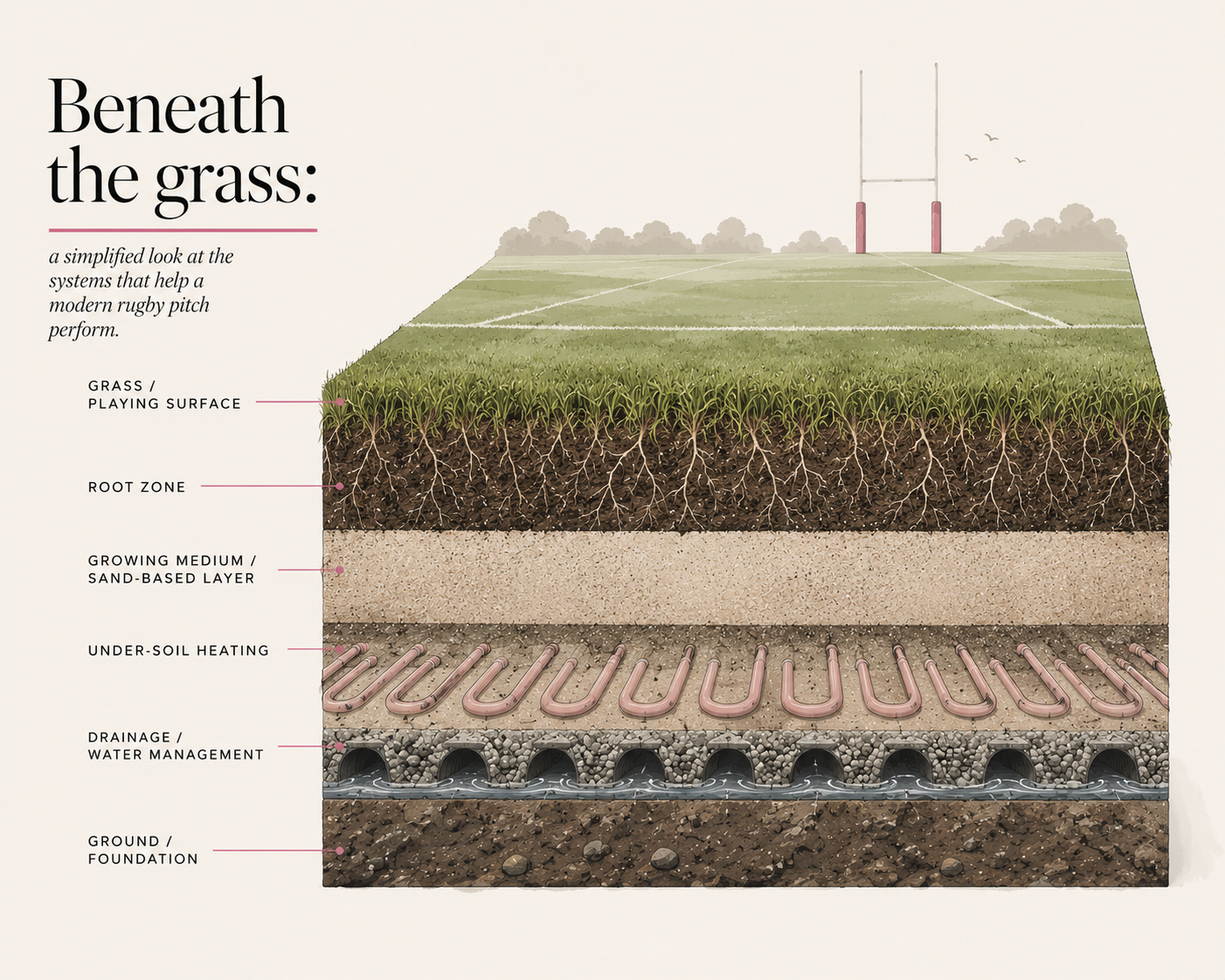
The grass is only the surface layer of a much larger system, with the infrastructure beneath it helping create the conditions in which the pitch can grow, recover and perform.
The heating system is a good example.
Nineteen miles of pipework will sit beneath the new surface, helping to maintain growing conditions during colder periods. The purpose isn't simply to make the pitch warm. It is to help create an environment in which the grass can continue to grow when temperatures fall.
Because grass doesn't simply need cutting.
It needs the right environment.
Temperature affects growth. Water affects the condition and stability of the surface. Drainage becomes crucial when a pitch needs to remain playable through a British winter.
The grounds team is therefore doing much more than maintaining grass.
They are managing an ecosystem.
And there is something wonderfully counterintuitive about the whole thing.
The more sophisticated the system becomes, the less you are supposed to notice it.
A Project Built by People and Machines
The scale of the redevelopment becomes even clearer when you look at what is happening on the ground.
Around 20 specialist machines are being used throughout the project, with between 15 and 30 people working on site each day.
That is a sizeable operation for something which, when finished, should look completely ordinary.
There will be no visible evidence of the tonnes of soil that have been moved, the miles of pipework beneath the surface or the machinery involved in creating it.
Instead, supporters will eventually see what appears to be a simple stretch of grass.
That is the point.
The complexity is there to create simplicity for everyone else.
A Smarter, More Sustainable Pitch
Water is another area where the new pitch system is designed to make a difference.
A new reservoir will be capable of holding up to 1,680m³ of water, with the system expected to save around 5.6 million litres of water every year.
Those are big numbers, but the principle behind them is relatively simple.
The better you understand what a pitch needs, the more precisely you can provide it.
Rather than treating irrigation as simply a matter of adding water, the new system is designed to collect, store and manage water more efficiently.
That means thinking about when the pitch needs water, how much it needs and how that resource can be used again.
Sustainability, in this context, isn't simply about using different materials.
It is about making the whole system work more intelligently.
Use less. Waste less. Control more.
Why Heating and Drainage Matter
A rugby pitch has a surprisingly difficult balancing act to perform.
It needs enough give to support players, while remaining firm and stable enough for speed, movement and the physical demands of the game.
It needs to withstand scrums, tackles and repeated pressure without deteriorating.
And it needs to do all of that while the weather does whatever the British weather decides to do.
Under-soil heating is not about making the pitch hot.
It is about helping maintain the conditions in which grass can continue to grow when temperatures fall.
Drainage is equally important. Water needs to move through the system without leaving the surface saturated or unstable.
The challenge is therefore not simply to create a pitch that is wet or dry, soft or hard.
It is to create the right conditions for the particular demands being placed upon it.
That is where the science comes in.
The Player Welfare Connection
Pitch quality tends to become a subject of conversation when something goes wrong.
A player slips.
The surface cuts up.
A fixture is postponed.
But perhaps the best measure of a pitch is the opposite.
Nothing happens.
Players need confidence in the surface beneath them. They need to know that when they accelerate, turn, jump or make a tackle, the pitch will behave predictably.
That consistency matters for performance.
It matters for the way the game is played.
And it matters for player welfare.
The grounds team's success is therefore measured partly by something rather strange.
If they have done their job perfectly, the players never think about them.
The Future of Rugby's Hidden Technology
The next time a match begins at Allianz Stadium, most supporters will see what they have always seen.
Green grass.
White lines.
A place where matches are won and lost.
But beneath that surface is something considerably more complicated.
Heating. Drainage. Irrigation. Water management. Monitoring. Engineering. And a team of people bringing all those elements together.
The modern rugby pitch has become something closer to a high-performance system than a simple playing surface.
And perhaps the greatest achievement is that nobody notices.
Because when the technology works, the pitch disappears.
The players take centre stage.
The ball behaves as it should.
The game takes over.
And that is exactly how it should be..