
T1 Rugby: A New Way Into The Game
What happens when rugby decides that the best way to grow the game is not to change who plays it — but to change how they enter it?

Rugby has always been a game built around belonging.
For some people, that journey begins in childhood: a first training session, a first team shirt, a first muddy Saturday morning when the game starts to become part of their lives.
For others, the route in looks very different.
It might start from the sidelines, watching someone else play. It might begin with a friend asking, “Do you fancy giving it a go?” It might happen years after the opportunity first appeared. And sometimes, the difference between someone becoming a rugby player and remaining a spectator is simply whether there is a version of the game that feels accessible enough to take that first step.
That leaves rugby with a deceptively simple question: how do you create more moments where someone feels that the game is for them?
T1 Rugby is one answer.
Developed by World Rugby and launched in 2023, T1 is a non-contact adaptation designed to retain many of the characteristics that make rugby union recognisable while removing the physical contact. World Rugby describes it as a format built around the attacking and defensive decision-making of rugby, with scrums, lineouts, kicking and the breakdown still part of the game.
That distinction is important.
T1 is not rugby with the rugby taken away. It is an attempt to create another way into the same game.
Where Did T1 Come From?
When World Rugby introduced T1, the ambition was not simply to create another recreational game with a rugby ball.
The idea was to produce a non-contact format that retained the characteristics of rugby union while making the game easier to approach. The result is a version of rugby in which players still have to read the game, make decisions and work within a structure that feels recognisably like rugby.
That means T1 can look surprisingly familiar to anyone who knows the traditional game.
There are scrums and lineouts. Kicking remains part of the tactical picture, while the breakdown still presents players with decisions to make. World Rugby's own description emphasises that the format retains many of the attacking and defensive aspects of rugby, rather than simply reducing the sport to running and passing.
That is perhaps the most interesting thing about T1.
It isn't asking people to learn a completely different sport and then hoping they eventually discover rugby. Instead, it offers a version of rugby that can meet people somewhere closer to where they are.
T1 Is Not Tag Rugby
For someone encountering T1 for the first time, the obvious comparison is likely to be tag rugby.
Both are non-contact formats, so the comparison is understandable. But they are not trying to do exactly the same thing.
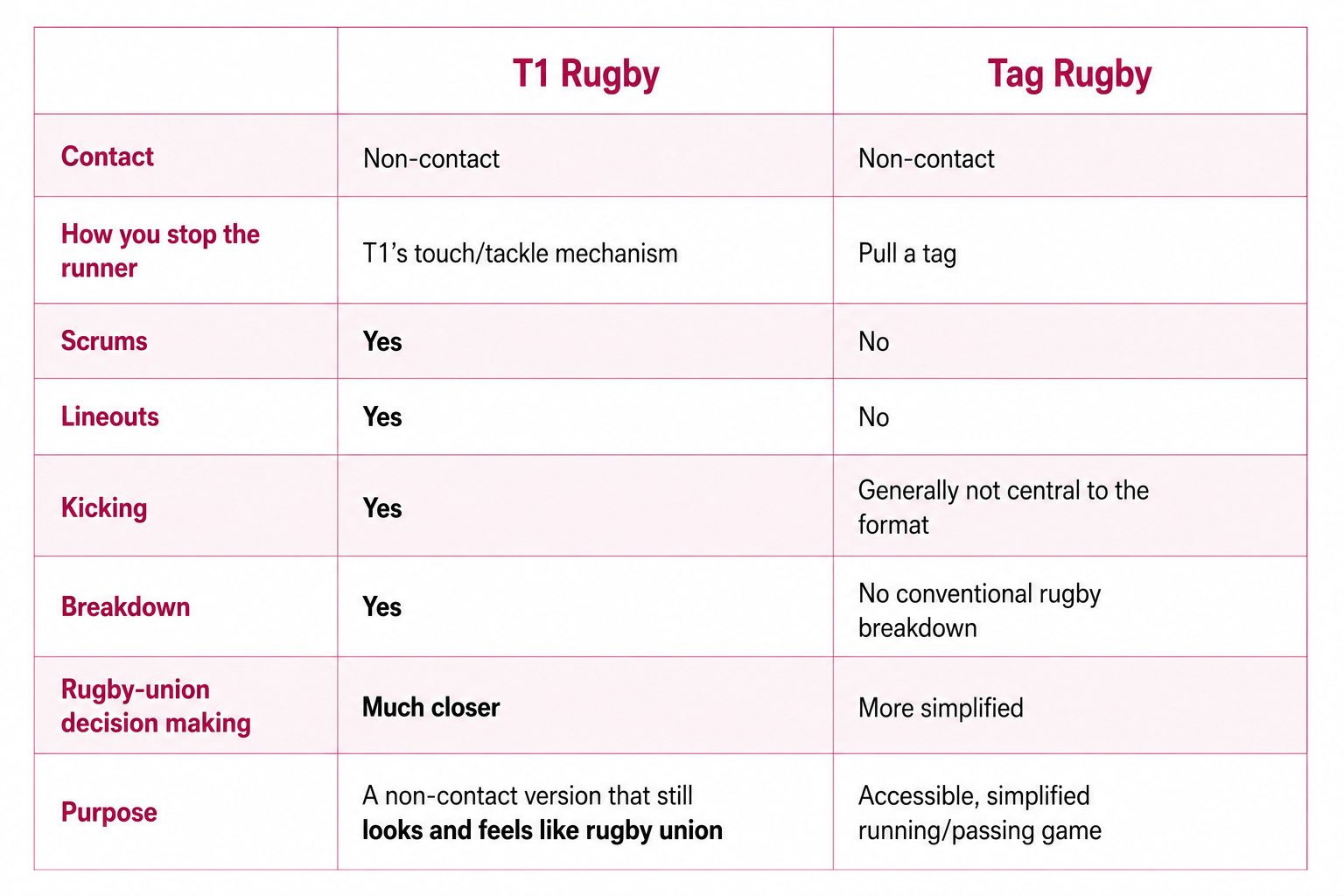
Tag rugby uses a tag attached to the player as the mechanism for stopping the runner. T1 takes a different approach, using touches or flags while retaining considerably more of the structure and decision-making associated with rugby union.
That difference matters.
In T1, the scrum, lineout, kicking and breakdown aren't simply decorative reminders of the full game. They are part of what makes the format feel like rugby. The players are still being asked to read space, make tactical decisions and work together within a game that carries much of the identity of union rugby.
The purpose isn't to suggest that one format is better than another.
It is to recognise that different people may need different doors into the sport.
For one person, tag might be the thing that makes rugby appealing. For another, T1's closer relationship with rugby union might be exactly what makes them want to try it.
Why Does Rugby Need Another Door?
Every player has a first moment.
The first time they pick up a rugby ball. The first time they run onto a pitch. The first time they join a training session and realise that they can actually do this.
But getting to that first moment isn't always straightforward.
Rugby can look complicated from the outside. It has its own language, its own traditions and, in its traditional form, a physicality that can make the game feel like something you have to already understand before you are allowed to belong to it.
That is one reason non-contact rugby matters.
Not because contact rugby needs replacing, but because contact does not have to be the first step for everyone.
T1 creates another starting point. For someone completely new to the sport, it can be an introduction. For someone returning after time away, it can provide a way back. For existing players, it can offer another way to enjoy the game without the physical demands of contact.
And that opens up a bigger idea about what “growing the game” actually means.
It isn't only about finding the next generation of elite players.
It is about creating more opportunities for people to discover rugby in the first place — and then giving them somewhere to go once they have found it.
England's T1 Story
That idea is already becoming part of rugby's approach to schools in England.
The RFU began rolling out T1 in schools in 2024 as part of a wider attempt to broaden rugby's reach, particularly into schools without an established rugby tradition. The programme is supported by a national network of School Rugby Managers, whose role includes helping schools introduce rugby, supporting teachers and building stronger links between schools and local clubs. The RFU has set an ambition of reaching an additional 5,000 state primary and secondary schools by 2027.
The early numbers give some sense of the scale.
In the 2024–25 season, T1 reached 1,800 schools and around 80,000 students, with participation reported as being close to evenly split between boys and girls.
That is significant not simply because of the number of schools involved, but because of what it represents.
A school does not have to begin its rugby journey by putting a full contact team onto a pitch.
It can begin with T1.
A teacher who might not feel confident delivering traditional rugby has a simpler starting point. A pupil who might never have considered rugby can pick up a ball without needing to enter a contact environment. And a school can begin building a relationship with a local rugby club from there.
The RFU's School Rugby Manager network is intended to help make that connection more sustainable, rather than leaving schools to introduce the game in isolation.
That is where T1's role becomes bigger than the format itself.
It becomes a pathway.
A Global Movement
What began as a new approach to non-contact rugby is now spreading well beyond England.
Since its launch in 2023, T1 has been played or trialled by more than 90 national unions, according to World Rugby's Development Director Jason Lewis.
That is a remarkable amount of movement for a format only a few years old.
And the reason for that growth is relatively easy to understand. T1 can be adapted to different environments while retaining the fundamental characteristics of rugby. It can be used in schools, clubs and community settings, and it can bring new players into the sport without asking them to begin with the most physically demanding version of it.
The latest example comes from the United States.
In August 2026, USA Rugby and USA Youth & High School Rugby formally adopted T1 as the country's official non-contact adaptation of rugby. The move is explicitly linked to growing grassroots participation ahead of the men's Rugby World Cup in 2031 and the women's Rugby World Cup in 2033, both of which will be staged in the United States.
For the organisations behind the move, T1 is not simply another version of the sport.
It is being positioned as a way of introducing rugby to new communities, schools and youth programmes — and then creating a pathway from that first experience into clubs and ongoing participation.
That makes the American adoption particularly interesting.
A format created to answer one question — how do we make rugby easier to enter? — is increasingly being used as part of a much bigger question about how rugby grows.
But A New Game Needs Somewhere To Go
And this is where things get really interesting.
Because creating new players is only the beginning.
Eventually, people want to play.
They want opposition. They want fixtures. They want something to train for. They want to pull on a shirt and know that there is a reason to be there on a Sunday morning.
A pathway only works if there is somewhere for people to go next.
That is the challenge facing any attempt to grow participation. You can introduce somebody to a game, but if their next experience is “Great — now what?”, the opportunity can disappear almost as quickly as it arrived.
In the East Midlands, two women decided not to wait for someone else to provide the answer.
Lou and Ally had discovered T1 Rugby and helped build a community around it. But there was a problem. There was enthusiasm, there were players and there was a desire to keep playing — but there was no regular competition for them to enter.
So they decided to build one.
The Midlands East Ladies T1 League begins in September 2026, creating a competitive environment in which clubs and players can continue their journeys, develop their skills and experience something that every new rugby player eventually wants: a game to look forward to.
It is a small example of a much bigger point.
Rugby growth doesn't always begin with a major announcement from a governing body.
Sometimes it begins with a group of people looking at what exists, seeing what is missing and asking a very simple question:
Why not?
That is what makes T1 interesting.
The rules matter. The scrums matter. The lineouts matter. The fact that it still feels like rugby matters.
But ultimately, the real test of any new pathway is what happens after someone walks through the door.
Can they find a team?
Can they find a community?
Can they find a reason to keep coming back?
Lou and Ally's story suggests that sometimes the answer is to build the next step yourself.
Read more about Lou and Ally's journey in In Profile: From Sideline Mums to League Founders.
So what actually makes T1 different? Here's the format at a glance.
T1 Rugby: at a glance.
FIND OUT MORE
Curious about T1? England Rugby has a collection of resources explaining how the format works, how to play it and how clubs, schools and communities can introduce it.