
The Four Women Who Started a Revolution
Long before sold-out stadiums, television deals and professional contracts, four volunteers quietly changed the course of women's rugby forever.
There are moments in sport that, looking back, feel inevitable.
Looking back, it's easy to believe they were always going to happen.
Professional leagues.
International tournaments.
World Cups.
History has a habit of making progress look effortless.
It rarely is.
Because every great sporting event begins with somebody looking at an impossible idea and deciding to try anyway.
In 1991, four women did exactly that.
Their names were Deborah Griffin, Sue Dorrington, Alice Cooper and Mary Forsyth.
Outside rugby circles, many people have never heard of them.
Yet without their determination, there may never have been a Women's Rugby World Cup as we know it today
“History remembers the tournament. It should also remember the four volunteers who made it possible.”
At the end of the 1980s, women's rugby was growing steadily, but opportunities remained limited. International fixtures were rare, funding was scarce and official
recognition varied enormously from country to country. The idea of staging a global tournament seemed ambitious, perhaps even unrealistic.
From their base at Richmond Women's Rugby Club, however, Deborah Griffin, Sue Dorrington, Alice Cooper and Mary Forsyth believed something very simple.
If the men's game could have a World Cup...
...why couldn't the women's game?
There was no blueprint.
No commercial investment.
No governing body leading the project.
No guarantee that national unions would support the idea.
There was simply a belief that women's rugby deserved the same opportunity to compete on the world's biggest stage.
So they stopped waiting for somebody else to make it happen.
They started planning instead..
Today it's almost impossible to appreciate the scale of what they were attempting.
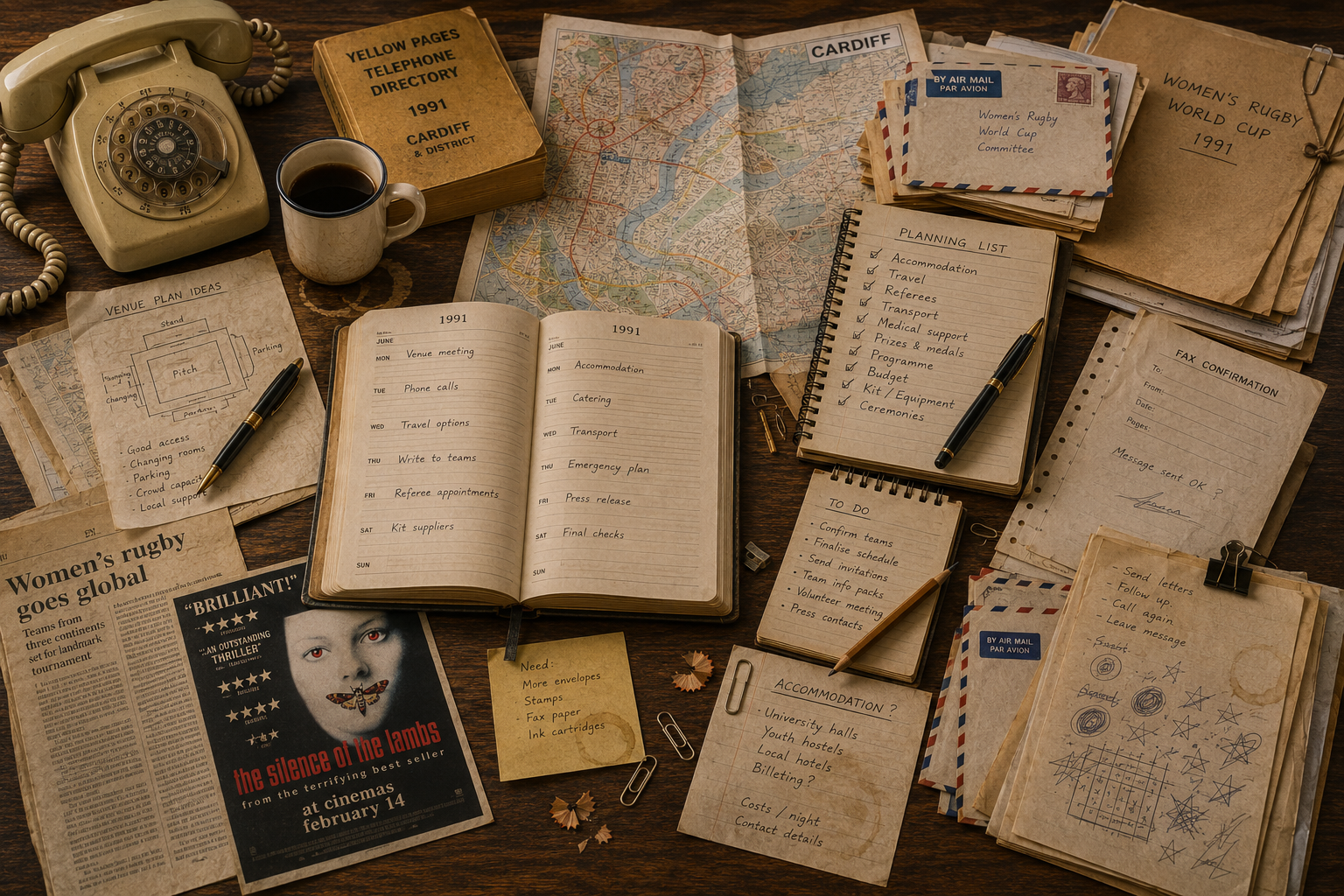
If four volunteers decided to organise an international tournament now, they would create a WhatsApp group before breakfast. Documents would be shared online. Video meetings would connect organisers across continents. Fixtures could be confirmed in minutes, while cloud storage, shared calendars and project management software would keep everyone moving in the same direction.
None of that existed.
Communication depended on letters, fax machines and carefully timed international telephone calls. Information travelled through the post. Documents were typed, copied and physically distributed. Every conversation required patience. Every amendment created more paperwork. Every unexpected problem meant starting the process all over again.
What feels like a few clicks today could take days—or even weeks.
Perhaps that's what makes their achievement so extraordinary.
They weren't simply organising a rugby tournament.
They were doing it in a world that lacked almost every communication tool we now take for granted.
“No WhatsApp. No shared documents. No cloud storage. Just determination, persistence and four volunteers who believed the tournament should exist.”
Of course, organising any major sporting event has never simply been about paperwork.
Teams had to be contacted.
Venues secured.
Accommodation arranged.
Sponsors persuaded.
Budgets balanced.
Problems solved.
Every task depended upon volunteers fitting the work around full-time jobs, family commitments and everyday life.
Nobody was being paid to build the future of women's rugby.
They simply believed it was worth doing. And because they did, women's rugby changed forever.
Perhaps that's the detail history sometimes overlooks.
The Women's Rugby World Cup wasn't created because somebody invested millions of pounds.
It existed because ordinary people kept saying yes to one more meeting.
One more phone call.
One more problem that needed solving.
That feels strangely familiar.
Anyone involved in a community rugby club today will recognise the pattern immediately.
The fixture secretary quietly rearranging postponed matches before work.
The coach locking up long after everyone else has gone home.
The committee member answering emails late into the evening because somebody has to.
Different jobs.
The same spirit.
When the inaugural Women's Rugby World Cup finally took place in Cardiff in 1991, something remarkable happened.
Not because a trophy was lifted.
Not because history was written in a single afternoon.
But because something that many believed couldn't happen...
...had happened.
A door had been opened.
Every Women's Rugby World Cup since has walked through it.
It's tempting to view progress as inevitable, as though the professional game we enjoy today was always destined to arrive.
It wasn't.
Progress happened because people chose to create opportunities instead of waiting for permission.
That may be the greatest legacy Deborah Griffin, Sue Dorrington, Alice Cooper and Mary Forsyth leave behind.
Issue 03 has celebrated the people who make rugby happen.
The volunteers who unlock the clubhouse before training.
The referees who give up their weekends because without them there is no match.
The committee members who quietly keep clubs alive.
The coaches who stay behind after training because one player wants ten more minutes practising kicks.
Deborah Griffin, Sue Dorrington, Alice Cooper and Mary Forsyth belonged to exactly that tradition.
They simply changed the game on a much bigger stage.
Technology has transformed rugby since 1991.
We organise fixtures through smartphones.
We communicate instantly.
We share documents with a tap of a screen.
The tools have changed beyond recognition.
The people haven't.
The game still depends on individuals prepared to organise, encourage, persuade and quietly keep everything moving behind the scenes.
Thirty-five years later, women still arrive at clubhouses where somebody has already unlocked the doors.
Somebody has marked the pitches.
Somebody has organised the fixtures.
Somebody has decided the game is worth giving their time to.
The Women's Rugby World Cup exists because four volunteers made exactly the same decision
You may not have known their names before reading this article.
Now you do.
And the next time the world gathers to celebrate the very best of women's rugby, perhaps spare a thought for the four volunteers who quietly proved that the impossible sometimes begins with nothing more than an idea, a few determined people... and the courage to start.
“Every revolution begins with someone deciding that waiting is no longer an option.”
Historical Context
The inaugural Women's Rugby World Cup was held in Cardiff, Wales, in 1991. Organised independently by Deborah Griffin, Sue Dorrington, Alice Cooper and Mary Forsyth, the tournament laid the foundations for the modern Women's Rugby World Cup.