
XV IQ — What's That Thing Between Their Shoulder Blades?
Every elite rugby player seems to wear one. Here's what it does—and why coaches wouldn't want to be without it.
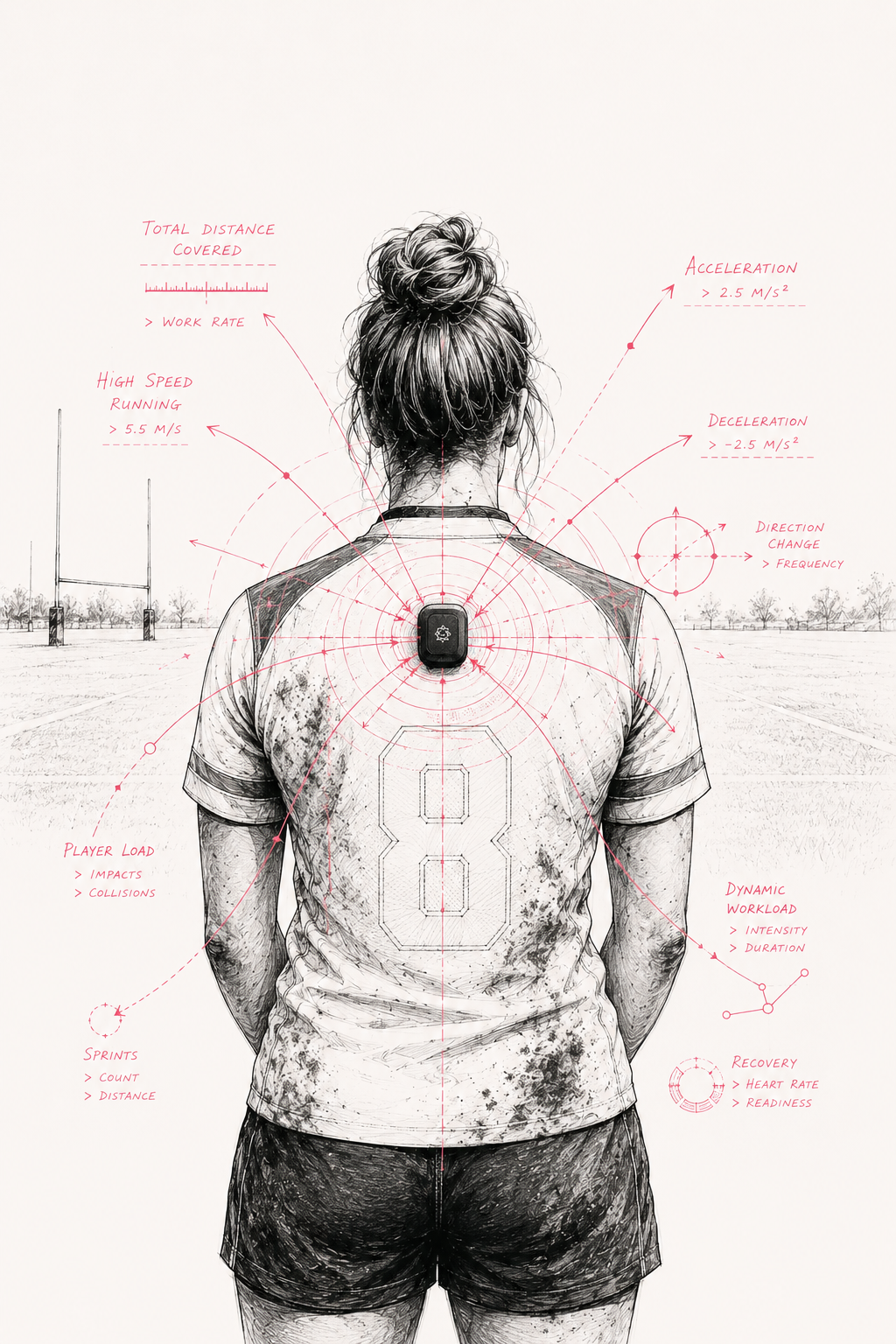
What is it, exactly?
If you've watched professional rugby recently, you've almost certainly seen it.
A small black rectangle sitting between a player's shoulder blades beneath their shirt.
Once you notice it, you see it everywhere.
Every player is wearing one. Every warm-up. Every training session. Sometimes even during matches.
Commentators mention "GPS data" as though everyone already knows what it means.
Coaches glance at laptops.
Analysts exchange numbers.
Players finish training and immediately hand the little black device back to a member of staff, who disappears with a box full of them.
Most fans have absolutely no idea what just happened.
So... what exactly is that little box?
More Than Just GPS
Despite the name, the small pod between a player's shoulder blades does far more than simply track their position on the pitch.
Inside that small pod are several different sensors working together.
The GPS receiver records where a player moves around the pitch.
An accelerometer measures how quickly they speed up, slow down and absorb impacts.
A gyroscope monitors changes in movement and body position.
Together, they build an incredibly detailed picture of a player's workload.
Not just where they ran.
How they ran.
What Can It Measure?
Quite a lot.
During a single training session or match, coaches can monitor:
Total distance covered
Maximum sprint speed
Number of sprints
High-speed running distance
Accelerations
Decelerations
Changes of direction
Overall workload
Positioning and movement across the pitch
Some systems even estimate the physical demands created by repeated collisions and contact, helping coaches understand how demanding a session has really been.
It isn't simply counting steps.
It's building a performance profile.
.
Why Does Any Of This Matter?
Imagine two players walking off the pitch after training.
Both tell the coach:
"I'm feeling good."
Without technology, that's all the information available.
With GPS data, the picture becomes much clearer.
One player may have completed twenty-five high-speed efforts.
Another may have completed fifteen.
One player's sprint speed might be exactly where coaches expect it to be.
Another's might have dropped noticeably compared to previous weeks.
Neither player necessarily feels different.
But the data tells another story.
That doesn't automatically mean someone is injured.
It simply gives coaches another piece of evidence when deciding tomorrow's training load.
Sometimes the smartest coaching decision isn't asking a player to do more.
It's recognising when they should do less.
The Hidden Team Behind Every Match
Most supporters focus on the players.
Modern rugby is supported by an entire performance team working behind the scenes.
Performance analysts download the data.
Strength and conditioning coaches compare workloads.
Medical staff monitor recovery.
Coaches look for patterns across the entire squad.
Instead of relying purely on instinct, elite teams can combine experience with evidence.
The numbers never replace coaching.
They support it.
“Think of it less as a crystal ball... ...and more as an early warning system.”
Can GPS Prevent Injuries?
Not completely.
No piece of technology can promise that.
What it can do is help coaches spot changes that the human eye might miss.
If a player's workload has increased dramatically over several weeks, training can be adjusted before small problems become bigger ones.
If someone returning from injury is gradually increasing their running volume, GPS helps ensure that progression happens safely rather than too quickly.
Think of it less as a crystal ball...
...and more as an early warning system.
Does It Decide Who Gets Picked?
No.
At least, it shouldn't.
Rugby is still played by people.
Not spreadsheets.
A GPS unit can't measure courage.
It can't measure leadership.
It can't recognise calm decision-making in the final minute of a match.
It doesn't know who will produce a perfectly timed tackle or inspire teammates when a game is slipping away.
The best coaches understand that.
Technology provides information.
People provide judgement.
The two work best together.
The Future Of Rugby?
The little device between a player's shoulder blades is just one part of a much bigger picture.
Elite rugby now uses video analysis, smart mouthguards, recovery technology and performance data in ways that would have seemed almost unimaginable twenty years ago.
The modern game is becoming smarter as well as faster.
Yet for all the technology now available, the objective hasn't changed.
Help players perform at their best.
Help them stay fit.
Help them enjoy long, successful careers.
The tiny black box can't score tries.
But it can help players be in the best possible condition to score them.
Next time you watch a match...
...you'll know exactly what you're looking at.
XV IQ | Next Time You Watch A Match...
Look for the black pod between a player's shoulder blades during the warm-up.
Remember, it isn't just tracking where they've been.
It's helping coaches understand:
How hard they've worked.
How quickly they've recovered.
Whether they're ready to go again.
The smallest piece of equipment on the pitch may be collecting the biggest story of the match.
XV IQ appears in every issue of XV Style — breaking down the moments, moves and mechanics that make rugby the game we love.