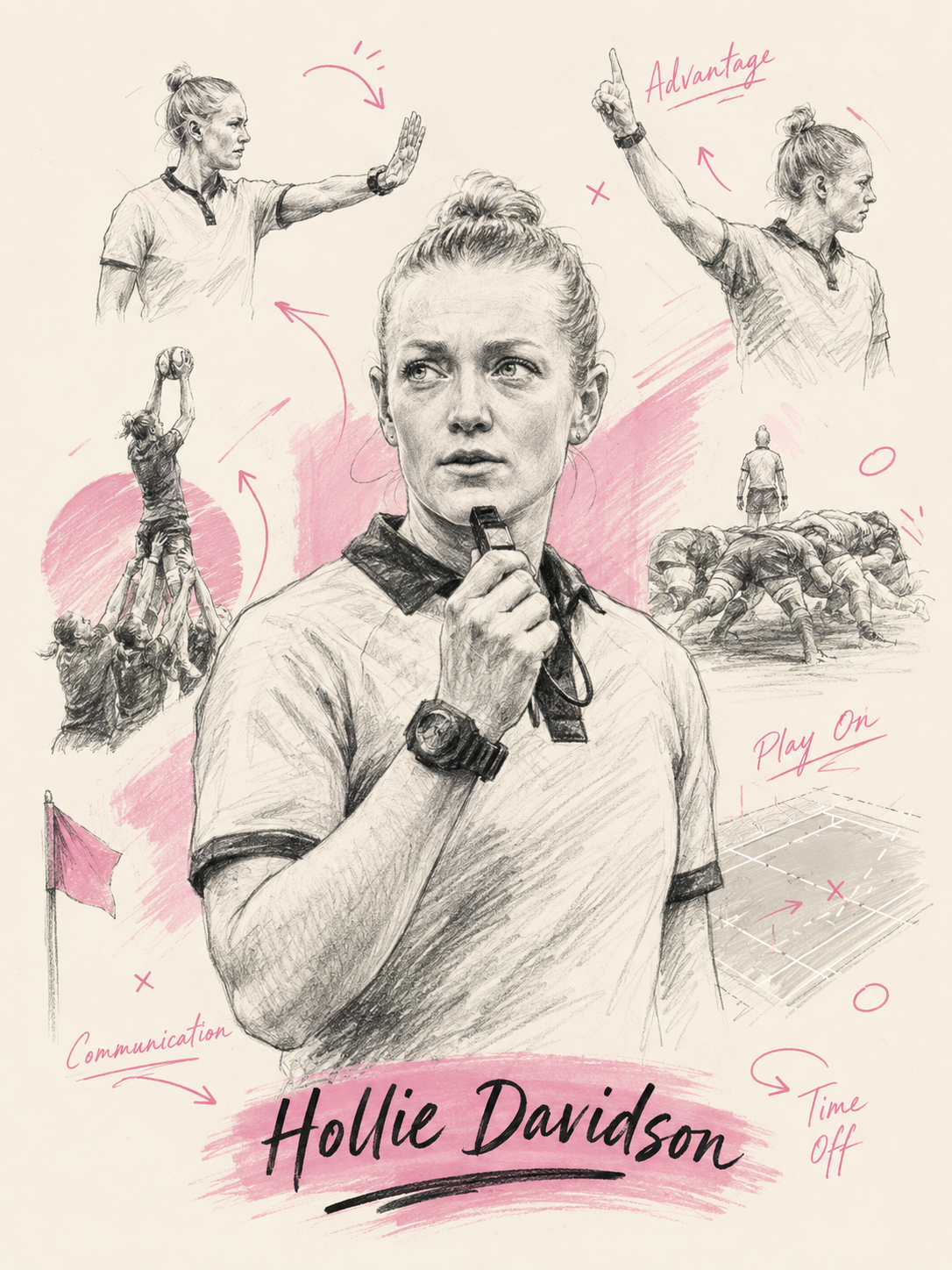
In Profile
Hollie Davidson
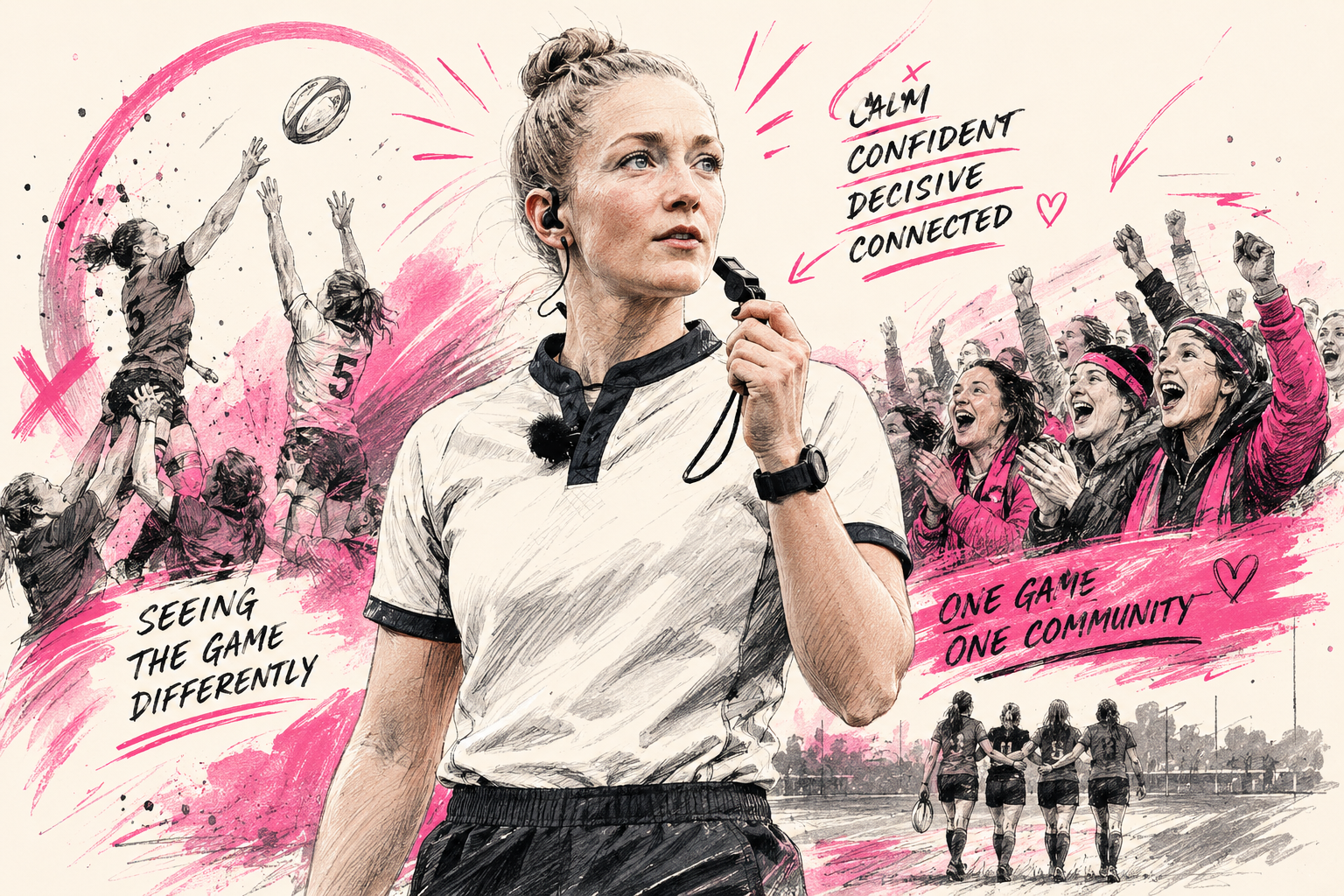
The whistle, the pressure and seeing the game differently.
The stadium falls quiet for a moment.
Not silent. Rugby stadiums are never silent. There are still conversations in the crowd, still movement in the stands, still players making final adjustments before kick-off. But there is a moment, just before the game begins, when thousands of people collectively hold their breath.
Most eyes are on the players.
Few are looking at the referee.
That's probably how Hollie Davidson likes it.
Because while much of modern sport is built around personalities, profiles and headlines, refereeing remains one of rugby's most unusual jobs. If you've done it perfectly, people barely notice. If you've made a mistake, everyone notices.
And yet Davidson keeps walking into the middle of some of the biggest rugby matches in the world.
The story could easily be told through milestones.
First woman to referee a men's Six Nations match — and before that, the first female assistant referee in the same competition.
First woman to referee a European professional final.
First woman to referee matches involving the All Blacks and Springboks.
Referee of two Women's Rugby World Cup finals.
World Rugby Referee Award recipient.
Inducted into the Scottish Rugby Hall of Fame (2025).
It's an impressive list.
But milestones rarely tell the whole story.
“Few are looking at the referee. That’s probably how Hollie Davidson likes it.”
What makes Davidson interesting isn't simply where she's ended up. It's how she got there.
Long before she became one of the most recognisable referees in world rugby, Davidson was a player.
A scrum-half.
The sort of player she once described as a "yappy little terrier".
She represented Scotland at Under-20 level and looked set for a future in the game. Then came injury. Called up to the senior Scotland squad, Davidson dislocated her shoulder in a practice game the week before her first cap. Two surgeries followed. One path ended before it had properly begun.
For many players, that's where the story ends.
Rugby becomes something they used to do.
Something they occasionally miss.
Something they talk about in the past tense.
For Davidson, it became the beginning of something else.
One of the themes that appears repeatedly throughout rugby is that people rarely stay for the reasons they expect.
Players join because they want to play.
Years later they find themselves coaching.
Or volunteering.
Or organising tours.
Or standing in the middle with a whistle.
The game has a habit of keeping people around.
Davidson found refereeing almost by accident. What started as a way to remain involved gradually became something bigger. In 2017 she left a career in banking, taking a significant pay cut to become Scotland's first full-time professional female referee.
At the time, it looked like a gamble.
Looking back now, it looks like the moment everything changed.
Rugby referees occupy a strange space.
They are central to every match yet rarely the focus of it.
The best officials combine authority with communication, confidence with humility, decisiveness with calm. They have to manage pressure, criticism and occasionally thousands of people who disagree with them simultaneously.
Davidson seems unusually comfortable in that environment.
Players and coaches frequently talk about her communication. Her ability to explain decisions. Her calmness in difficult moments. Her willingness to make big calls when the game demands it.
Those qualities have taken her from local club grounds to the biggest stages in rugby.
Not overnight.
Not without setbacks.
And certainly not without criticism.
Early in her refereeing career, Davidson often arrived at clubs where people assumed she couldn't possibly be the referee.
Some thought she was a physio.
Others questioned whether a woman could keep up with the men's game.
There were comments from touchlines.
Doubts.
Assumptions.
The usual collection of obstacles that tend to appear whenever somebody is first through a particular door.
The remarkable thing is how quickly those conversations disappear once the whistle blows.
Because rugby players ultimately care about one thing.
Can you referee?
Davidson could.
And increasingly, she was doing it at levels where nobody could ignore it.
Today her CV includes World Cups, Six Nations fixtures, international test matches and professional finals.
She has officiated in front of packed stadiums and global audiences. She has become one of the most respected referees in the game.
Yet there is something refreshing about the way she talks about rugby.
Not as a trailblazer.
Not as a pioneer.
Simply as somebody who loves the sport.
The same sport she watched as a child.
The same sport she played.
The same sport she found a way back into when playing was no longer possible.
Perhaps that's the lesson hidden inside her story.
Rugby doesn't always give us the journey we expected.
Sometimes the playing career ends too early.
Sometimes the role changes.
Sometimes the dream evolves into something different.
But for those who stay involved, the game has an extraordinary ability to open unexpected doors.
Davidson walked through one carrying a whistle.
The rest is history
.
Enjoying what you've read so far?
Join XV Style and you'll receive every new issue by email before it's published on the website.
Every issue is completely free and you'll receive just one email each time a new edition is released.