
XV IQ — The Anatomy of a Line-Out
Timing. Lift. Height. Control. Four words that make it sound simple. It isn't.
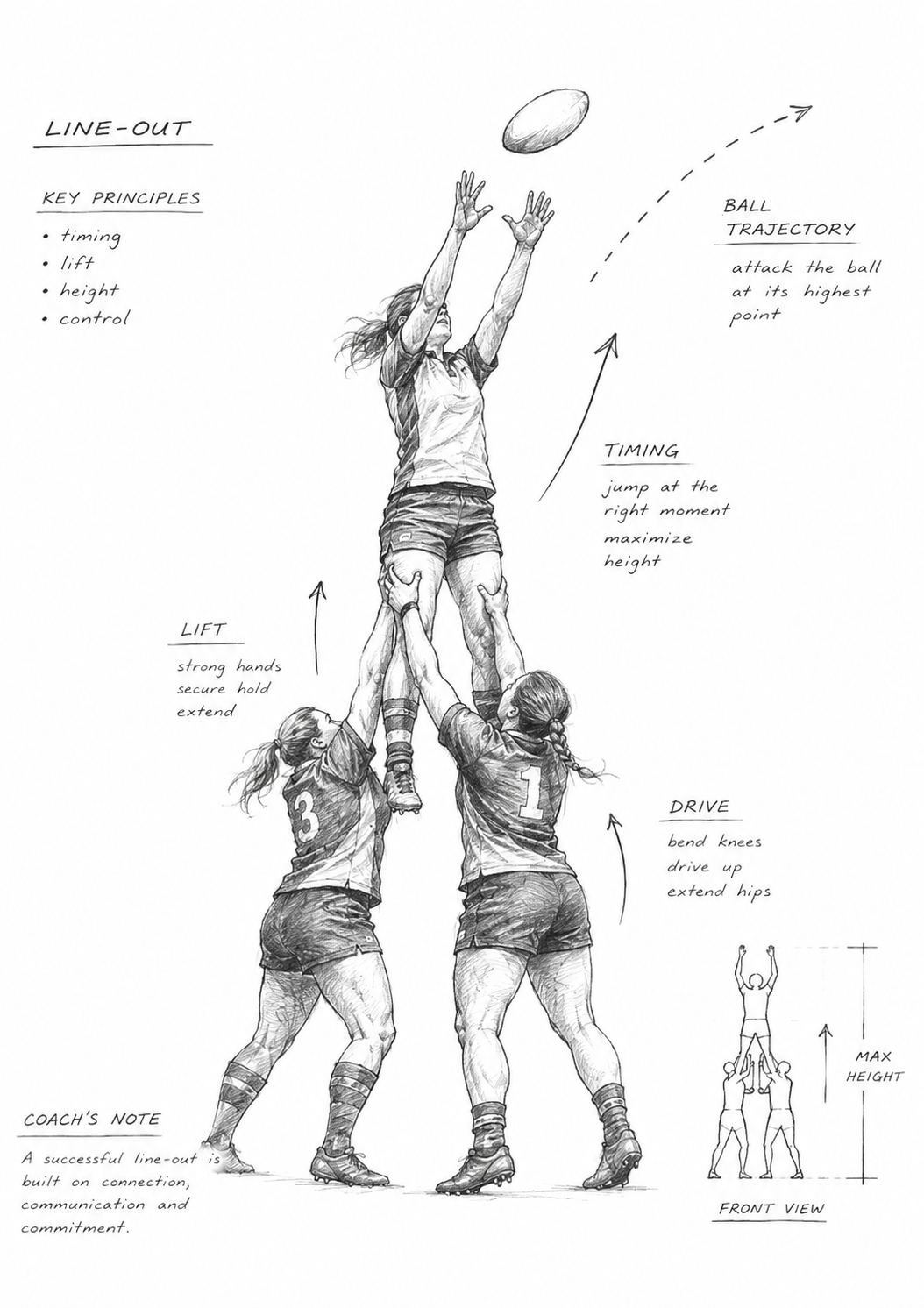
What is it, exactly?
A line-out is how play restarts after the ball has gone out of bounds. In most situations, the team that did not put the ball into touch gets the throw — which means they also, in theory, control what happens next. That's the first thing worth understanding: the throwing team should win their own lineout. When they don't, something has gone wrong.
The line-out can involve anywhere from two players to the entire forward pack on each side. How many players take part, and where they stand, is a tactical decision made before the throw — and it's one the opposition is desperately trying to decode.
The Roles
Every line-out has the same core cast.
The hooker throws. She stands outside the field of play, ball in hand, and must deliver it straight down the middle of the gap between the two lines. The throw has to travel at least five metres before anyone can catch it. It sounds straightforward. It isn't. The hooker has just come out of a scrum or a tackle, her hands may be cold or muddy, and she has to throw with both accuracy and timing — because the jumper isn't standing still waiting for it.
The jumper — usually a lock, chosen for height and aerial ability — is the target. She doesn't simply wait for the ball to arrive; she times her jump to meet it at its highest point, attacking it rather than receiving it. The difference between those two things is the difference between clean possession and a fumble.
The lifters — typically two forwards, one front and one back — make the whole thing possible. They grip the jumper securely around the shorts and lower body and drive her upward explosively, fingers locked, arms extending fully, finishing on their toes to generate every centimetre of height. They hold her there until the ball is secured, then bring her safely back to ground. It takes strength, timing, and complete trust.
And then there's the caller — often one of the jumpers — whose job is to read the opposition's setup and communicate the plan before the throw. A short call, made quickly, so the defence has as little time as possible to react.
The Call
This is where it gets interesting.
Line-out calls are coded. A word, a number, a signal — something that tells your own team which jumper is going at which position, and when. To the opposition, it should mean nothing. Teams build their own calling systems in training, layering in dummy movements, delayed jumps, and false signals to keep defenders guessing.
The defence is doing exactly the same thing in reverse — watching body language, reading the formation, trying to anticipate where the ball is going before it's thrown. The best defensive line-out players have become specialists in that reading, tracking their opposite number, contesting in the air, or simply disrupting the lift.
“It’s competitive code-breaking, happening in real time, under physical pressure, in less than two seconds”
When It Goes Wrong
A mistimed lift. A throw that drifts. A call that breaks under pressure. The line-out is one of the few moments in rugby where failure is immediate, visible, and unambiguous. The ball hits the floor, or it goes to the wrong player, or nobody at all.
For the hooker, it's perhaps the loneliest skill in the game. She stands apart from both teams, making a decision that the entire structure depends on. One degree of drift and all the preparation counts for nothing.
When It Goes Right
When the call is clean, the lift explosive, and the jumper rises at precisely the moment the ball arrives — claiming it above a flailing opponent — there is a precision to it that is almost architectural.
Eight players becoming one structure, briefly, perfectly, and then dissolving back into the chaos of open play.
That's what you're watching when you watch a line-out. Not a pause in the game. The game, at its most precise.
XV IQ appears in every issue of XV Style — breaking down the moments, moves and mechanics that make rugby the game we love.
Enjoying what you've read so far?
Join XV Style and you'll receive every new issue by email before it's published on the website.
Every issue is completely free and you'll receive just one email each time a new edition is released.
“DID YOU KNOW?
Any player can throw the ball into the line-out — it doesn’t have to be the hooker. At professional level it almost always is, but the laws place no restriction on who takes the throw.”
“RULE CHANGE
In force from January 2025
If the defending team chooses not to contest the throw, play continues even if the throw is not perfectly straight. Teams must also form the line-out within 30 seconds. The aim: faster, cleaner rugby.”
“BY THE NUMBERS
Elite hookers regularly achieve line-out success rates above 90%, making the line-out one of the most important set-piece contests in modern rugby. At grassroots level, consistent clean ball from your own throws is a genuine competitive advantage.”